Selecting the right physical security model is one of the most important operational and budgetary decisions for commercial facility directors, asset managers, and industrial property owners across Greater Houston and Texas. Deploying physical security assets typically comes down to two foundational paradigms: contracting a dedicated stationed (standing) security guard to maintain a continuous, uninterrupted post presence, or utilizing a mobile vehicle security patrol that executes scheduled or randomized perimeter sweeps across multiple commercial checkpoints.
Choosing between these two models is rarely a matter of one being universally superior to the other; it is a question of site acreage, operational tempo, visitor density, and budget optimization. A 20-acre logistics trucking yard with unlit staging bays requires an entirely different tactical footprint than a high-density, multi-tenant Class A corporate office lobby. Confusing these requirements results in either runaway operating expenditures or dangerous security dead zones that invite property crime and premises liability exposure.
This operational analysis provides commercial decision-makers with a detailed technical and financial breakdown of mobile patrol vs dedicated stationed guards, detailing cost-per-square-foot dynamics, response latency, GPS telemetry verification, Texas DPS compliance standards, and hybrid deployment strategies.
Phase 1: Tactical & Financial Trade-Offs: The Fundamental Divide
Understanding the fundamental divide between stationary security posts and vehicular mobile patrols requires looking beyond hourly invoice rates to examine operational density and site geometry.
The Dedicated Stationed Guard: Fixed Post Saturation
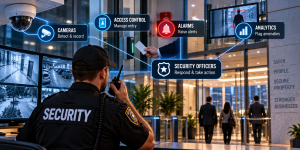
A dedicated stationed security officer is assigned to a single, continuous geographic post for the duration of an 8-to-12-hour shift. This officer provides an unbroken physical presence, functioning as an active visual deterrent, customer concierge, access control enforcer, and immediate on-scene incident responder. Stationed guards excel in environments characterized by continuous human interaction—such as screening employee credentials, processing visitor badges, inspecting contractor bills of lading, and mitigating lobby altercations before they escalate.
However, stationed guards possess fixed geometric limits. A standing guard stationed at a main building entrance or gate shack cannot actively monitor a remote 10-acre perimeter fence line or dark rear loading bays half a mile away without abandoning their primary access control post. Extending stationary physical coverage across expansive commercial properties requires deploying multiple guards, causing monthly security payroll to scale rapidly.
The Mobile Security Patrol: Roving Perimeter Interdiction
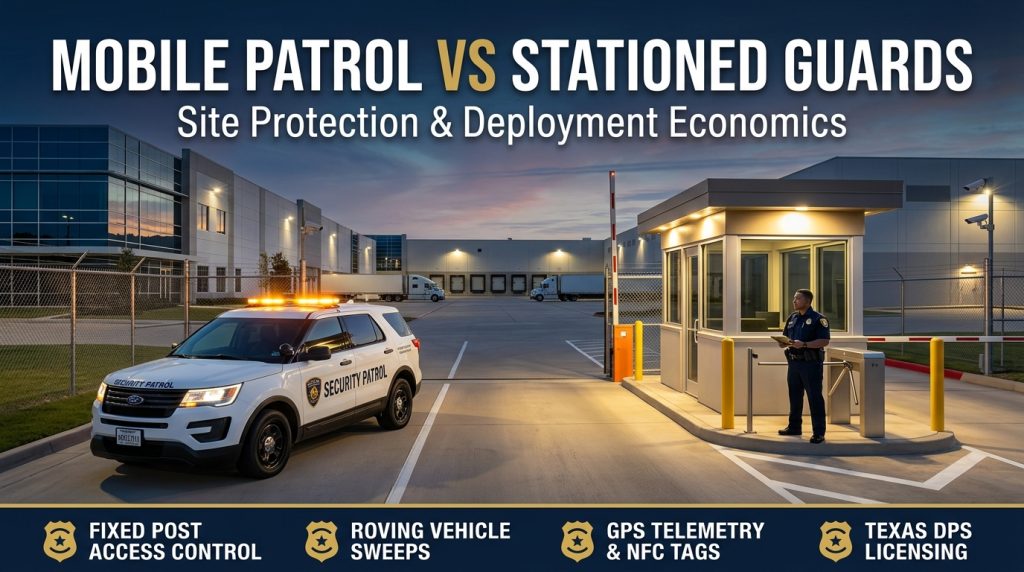
Mobile security patrols leverage marked, high-visibility patrol vehicles equipped with amber auxiliary light bars, high-intensity LED search spotlights, and mobile digital dispatch systems. Rather than remaining static, a mobile patrol officer visits a facility anywhere from 2 to 6 times per shift, executing designated vehicular drive-bys, perimeter gate lock-ups, foot patrols of darkened corridors, and exterior door integrity checks before moving to the next contracted property.
Mobile patrols maximize spatial coverage. A single patrol officer in a marked utility vehicle can sweep vast industrial parking fields, deter opportunistic catalytic converter thieves across hundreds of parked vehicles, and inspect exterior mechanical assets in a fraction of the time required by a walking officer. However, because the mobile officer is not permanently on site, the facility experiences operational coverage gaps between patrol visits, relying on perimeter hardware, alarm systems, and CCTV between inspections.
Phase 2: Complete Deployment Matrix: Standing Guard vs. Mobile Patrol
To evaluate which deployment model matches your facility’s operational risk profile, review the direct functional and financial comparisons below (rates reflect general Texas commercial market estimates; actual quotes vary based on risk tier, armed status, and post hours):
| Operational Dimension | Dedicated Stationed Guard | Mobile Vehicle Security Patrol |
|---|---|---|
| Cost Model & Invoicing | Typically billed on an hourly bill rate (commonly $24.00 – $38.00+/hr per guard); 24/7 posts frequently range from $17,000 – $25,000+ monthly. | Typically billed per sweep/hit ($15.00 – $35.00 per visit) or dedicated patrol blocks; monthly totals typically range from $900 – $3,500. |
| Deterrence Continuity | Continuous, uninterrupted 100% physical visibility at the assigned post during operational hours. | Intermittent, high-impact visible deterrence during active randomized sweeps; relies on CPTED and signage between hits. |
| Spatial Coverage Limit | Constrained to line-of-sight and immediate walking radius (typically under 1 to 2 acres per officer). | Rapid coverage of vast geographic areas (10 to 50+ acres, industrial loops, multi-building office parks). |
| Access Control Execution | Manages continuous visitor logging, optical turnstiles, badge checking, and gate arm operations. | Executes scheduled physical gate locking/unlocking, door latch checks, and perimeter barrier audits. |
| Incident Response Speed | Instantaneous (0 to 60 seconds) within the assigned facility footprint. | Variable (10 to 30 minutes) if dispatched during an alarm trip while off-site on a patrol loop. |
| Accountability Telemetry | Daily Activity Reports (DAR), fixed-post clock-ins, visitor management software logs. | Real-time GPS geofencing, vehicular telematics, NFC checkpoint scans, time-stamped photo logs. |
For a line-item breakdown of hourly billing elements, fuel surcharges, and sweep pricing in the local market, consult our guide on how much mobile security patrol costs in Houston.
Phase 3: Operational Logistics & Accountability Systems
Modern commercial security deployment depends heavily on technological infrastructure to prevent guard sleep-on-duty occurrences, ensure post fulfillment, and furnish legally defensible activity records.
1. Geofenced Telemetry & Speed Monitoring
Professional mobile patrol units are outfitted with automated GPS transponders. Operations dispatchers verify when a patrol cruiser enters the client’s property geofence, tracking speed, dwell time, and route coverage down to the exact second.
2. NFC & QR Checkpoint Audits
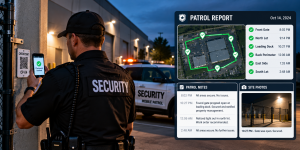
Both standing foot patrols and mobile officers utilize ruggedized handhelds to tap passive Near Field Communication (NFC) RFID tags mounted on exterior gates, HVAC condenser cages, emergency exits, and dumpster enclosures, generating verifiable electronic breadcrumb trails.
3. Body-Worn & Dashcam Evidence
During after-hours trespass contacts or property disturbance interdictions, forward-facing vehicle dashcams and officer body cameras capture high-definition audio and video. This documentation provides critical evidence for law enforcement and shields property owners from liability.
4. Digital Incident Escalation
When an officer discovers property defacement, unlatched mechanical doors, or unauthorized loiterers, digital reporting software instantly logs high-resolution photographs and dispatches incident notices directly to property managers in real time.
For large-scale commercial facilities analyzing foot vs vehicular movement in pedestrian-heavy parking areas, compare operational dynamics in foot patrol vs mobile vehicle patrol for large commercial lots.
Phase 4: Texas Legal & Regulatory Framework for Patrol Deployment
Deploying private security guards in Texas requires strict adherence to state statutory mandates enforced by the Texas Department of Public Safety (DPS) Private Security Bureau under Texas Occupations Code Chapter 1702:
1. Commissioned (Armed) vs. Non-Commissioned (Unarmed) Guard Status
Standing guards and mobile patrol drivers must hold appropriate state credentials. A Non-Commissioned Security Officer (Level II) is trained in basic observation, reporting, and verbal deterrence. A Commissioned Security Officer (Level III) completes state-mandated firearms qualifications, defensive tactics, and weapon retention training. High-risk commercial industrial yards and jewelry retail plazas frequently mandate Level III armed security for both stationary gate posts and mobile patrol sweeps.
2. Texas Vehicle Lighting and Livery Restrictions
Mobile security patrol vehicles operate under strict visual guidelines governed by the Texas Transportation Code § 547.305. Under Texas law, security patrol vehicles may only utilize green, amber, or white auxiliary lighting, along with prominent company lettering; flashing red or blue lights are strictly reserved for law enforcement and emergency vehicles.
3. Statutory Criminal Trespass Enforcement
Both stationary guards and patrol officers enforce private property boundaries under Texas Penal Code § 30.05 (Criminal Trespass). When an unauthorized individual enters private property after business hours, a uniformed guard acting as an authorized agent of the property owner delivers a binding verbal or written notice to depart. If the individual fails to comply, the officer coordinates immediate law enforcement interdiction; review statutory boundaries in our legal analysis of Texas shoplifting laws and security guard authority.
When selecting between in-house guard forces and outsourced commercial contractors, review labor liability and insurance indemnification structures in our guide to in-house vs contract security guards: complete cost and liability breakdown.
Phase 5: Site-Specific Deployment Archetypes: Which Fits Your Property?
To determine whether your facility requires a dedicated stationed guard, a mobile patrol sweep, or a combined hybrid model, evaluate these four distinct property archetypes:
Archetype A: High-Density Corporate Office Towers (Downtown / Galleria)
- Core Vulnerabilities: Unauthorized lobby visitors, tailgating into tenant elevators, executive floor access, delivery contractor screening.
- Optimal Model: Dedicated Stationed Concierge Guards. A stationary lobby security desk requires continuous staffing to verify credentials, issue visitor badges, monitor turnstiles, and manage elevator banks during business hours. A mobile patrol visiting once an hour cannot maintain access control; review visitor protocols in our manual on office building access control: visitor policies and guard protocols.
Archetype B: Multi-Tenant Suburban Strip Malls & Shopping Centers
- Core Vulnerabilities: Overnight loitering, dumpster scavengers, vehicle burglaries, rear corridor vandalism.
- Optimal Model: Marked Mobile Security Patrols. Retail tenants operate on varied schedules and tight CAM budgets. Deploying a dedicated guard 24/7 is often financially impractical. A marked mobile cruiser executing 3 to 5 randomized evening and overnight sweeps deters opportunistic crime, inspects rear delivery doors, and verifies parking lot lighting at a fraction of the cost; explore shared expense models in shared security cost models for strip malls and shopping centers.
Archetype C: Logistics Hubs, Truck Terminals & Industrial Yards
- Core Vulnerabilities: High-value cargo theft, unauthorized vehicle access, fuel siphoning, cut perimeter fences.
- Optimal Model: Hybrid Model (Stationed Gate Officer + Roving Mobile Patrol). A dedicated standing officer is stationed at the primary access gate to verify driver BOLs, conduct physical trailer seal inspections, and log equipment in and out. Simultaneously, a dedicated mobile patrol truck sweeps the perimeter fence line, drops onto unlit yard rows, and monitors bulk material storage yards.
Archetype D: After-Hours Commercial Construction Sites
- Core Vulnerabilities: Copper pipe theft, heavy machinery hotwiring, tool container burglaries, arson.
- Optimal Model: Dedicated Overnight Stationary Officer (or High-Frequency Mobile Patrol). If valuable tools, raw copper, and active equipment are stored on site, a dedicated overnight officer who conducts foot rounds every 30 minutes provides the highest rate of asset protection; review night physical defense strategies in commercial property security after-hours: preventing vandalism and trespassing.
Phase 6: The Hybrid Deployment Model: Maximizing Protection & Budget
For many commercial properties across Greater Houston, the most effective security strategy is not choosing one over the other, but integrating both into a synchronized Hybrid Deployment Model:
- Daytime Standing Access Control: Deploy a dedicated stationed officer at primary customer-facing entry points during peak operational hours (e.g., 7:00 AM to 6:00 PM) to manage visitor intake, screen vendor deliveries, enforce building access policies, and de-escalate customer disputes; review customer handling strategies in de-escalation techniques for retail security officers.
- Evening / Overnight Mobile Patrol Interdiction: Transition to mobile security patrol sweeps when the facility closes (e.g., 7:00 PM to 6:00 AM). Marked patrol units execute exterior checks, scan parking lots to prevent auto theft (utilizing strategies from our guide on how to stop car break-ins in commercial parking lots), verify door latches, and provide rapid alarm response across overnight hours.
- Shared Common Area Allocation: For leased properties, incorporating both dedicated lobby staffing and common-area patrols allows property managers to align costs transparently with lease clauses; review tenant-landlord structures in commercial lease security responsibilities: tenant and landlord roles.
Deploy Proven Physical Security with God’s Armour Security
Whether your commercial property requires a dedicated concierge security officer to command a Class A corporate lobby or high-visibility mobile vehicle patrols to secure an expansive industrial yard, God’s Armour Security provides customized, Texas DPS-licensed physical defense solutions across Greater Houston, Harris County, and statewide Texas.
Our operations leadership conducts detailed on-site risk assessments, mapping your property’s vulnerable blind spots, egress routes, and after-hours risks to build an actionable security program. We equip our personnel with real-time GPS tracking, body-worn cameras, digital NFC checkpoint hardware, and marked patrol fleets. Explore our specialized commercial security patrol services and our dedicated commercial security services in Houston.
Ready to evaluate the right deployment balance for your commercial site? Request a commercial property security assessment and patrol consultation or contact our Houston operations center directly at (713) 878-9984.
Frequently Asked Questions
What is the difference between a mobile patrol and a stationed security guard?
A stationed (standing) security guard remains fixed at a specific post (such as a front lobby desk or gate entrance) for their entire shift, providing continuous access control and immediate physical response. A mobile security patrol utilizes a marked vehicle to visit and inspect multiple commercial properties or expansive perimeter zones, conducting randomized sweeps and door checks before moving to the next location.
Is mobile security patrol cheaper than hiring a dedicated on-site guard?
Yes, significantly. A full-time, 24/7 dedicated stationed guard post typically costs between $17,000 and $25,000+ per month due to continuous hourly staffing requirements. Mobile security patrols are typically billed per visit ($15 to $35 per sweep in typical commercial setups) or in contracted patrol blocks, generally ranging between $900 and $3,500 per month, making it an efficient option for properties with lower continuous risk.
How do property managers know mobile security guards actually visit their property?
Professional security contractors utilize geofenced GPS tracking, dashcam telemetry, and Near Field Communication (NFC) RFID checkpoint tags. Officers must physically scan checkpoints installed on gates, utility boxes, and building doors using handheld devices, generating time-stamped inspection reports and photographic proof delivered directly to property managers.
When should a commercial property use a hybrid security model?
A hybrid model is ideal when a property experiences high pedestrian and visitor traffic during standard business hours (requiring a stationed officer for front desk access control, visitor badging, and tenant safety), but only requires exterior deterrence, lock-ups, and randomized perimeter sweeps during low-traffic overnight hours.
Key Takeaways
- Dedicated stationed guards provide continuous 100% presence, ideal for lobby access control, gate check-ins, and immediate incident intervention.
- Mobile vehicle patrols deliver cost-effective, high-visibility deterrence across large acreage, industrial parks, and multi-tenant retail centers.
- Stationed guards are billed on hourly rates, whereas mobile patrols are billed per sweep or by dedicated patrol blocks.
- Enforce accountability through GPS geofencing, digital NFC checkpoint verification, and time-stamped incident reporting systems.
- Ensure patrol vehicles comply with Texas Transportation Code § 547.305 (green, amber, or white auxiliary lighting) and employ DPS Level II or Level III licensed officers.