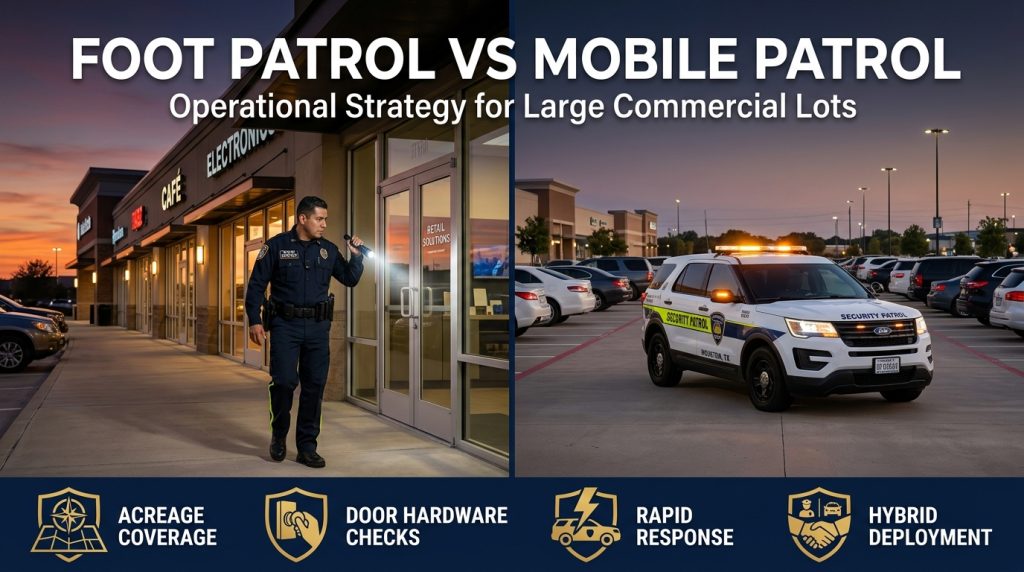
Managing security across a multi-acre retail center, corporate office campus, or industrial logistics facility presents a fundamental operational choice: should you deploy foot patrol officers or marked mobile vehicle patrols? Each patrol style delivers distinct security benefits, but applying the wrong patrol format to a sprawling commercial property wastes budget and leaves critical security voids.
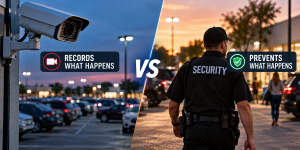
A marked security cruiser offers rapid boundary coverage, prominent visual deterrence, and quick response times across large surface acreage. However, a vehicle cannot walk interior breezeways, check rear service corridor door handles, inspect stairwell landings, or detect subtle signs of physical tampering. Conversely, a dedicated foot patrol officer delivers intimate, hands-on physical inspection but cannot quickly cover expansive parking perimeters.
Across Greater Houston and Texas, high-liability commercial facilities frequently require a calculated balance of both methods. This operational comparison breaks down the trade-offs between foot patrol and mobile vehicle patrol, detailing acreage thresholds, cost variables, and how to structure an airtight hybrid defense.
Phase 1: Foot Patrol vs Mobile Vehicle Patrol Comparison
Evaluate how both operational models contrast across key commercial property security metrics:
| Operational Dimension | Foot Patrol Officers | Mobile Vehicle Patrols |
|---|---|---|
| Speed & Acreage Coverage | Slow and methodical (2 to 3 mph); optimal for properties under 3 acres or dense pedestrian zones. | Rapid mobility (10 to 25 mph); capable of monitoring 10 to 50+ acres and multi-building campuses. |
| Visual Deterrence Profile | Close-quarters presence; highly effective for tenant interaction and lobby order. | High-visibility amber and white LED light bars visible from hundreds of yards across open lots. |
| Tactical Blind Spot Access | Unrestricted; easily accesses stairwells, narrow alleys, dumpster alcoves, and roof hatches. | Restricted to asphalt roadways, driving lanes, and wide parking structures. |
| Physical Door & Gate Verification | Hands-on physical checks of push bars, deadbolts, padlock latches, and window seals. | Visual scan from driver seat; requires dismounting to manually check physical locking hardware. |
| Incident Response Time | Slower response across large lots; officer must travel on foot carrying duty gear. | Instantaneous vehicle response; arrives at distant property gates within seconds. |
| Weather Endurance | Limited by extreme heat, severe rain, and Gulf Coast humidity; requires relief rotations. | High endurance; climate-controlled mobile patrol unit maintains continuous surveillance in all conditions. |
To examine legal premises liability standards for commercial grounds, review our detailed guide on parking lot crime liability for property owners.
Phase 2: When Foot Patrol Is the Superior Operational Strategy
Foot patrol is the indispensable choice when detail-oriented, close-quarters physical inspection is paramount:
1. High-Density Mixed-Use & Strip Retail Breezeways
In retail strip malls and lifestyle centers, shoplifters and loiterers congregate under covered walkways, behind columns, and near outdoor dining patios. A mobile patrol cruiser on the outer drive lane cannot observe someone trying a locked rear service door or hiding behind architectural columns. Foot patrol officers maintain constant human contact, reassuring retail shoppers and eliminating retail theft opportunities.
2. Multi-Level Parking Decks & Interior Stairwells
While patrol vehicles can circle garage driving decks, they cannot navigate enclosed pedestrian fire stairs, elevator vestibules, or rooftop machine rooms. These isolated sectors represent primary ambush zones; review structural defense methods in our analysis of parking garage security and blind spot elimination.
3. Hands-On Hardware & Access Control Inspections
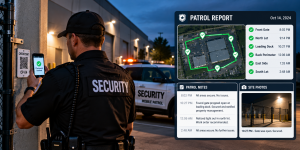
Criminal burglary crews often pre-tamper with commercial facilities by taping over emergency door latches or jamming exterior gates during operating hours. A foot patrol officer physically tests door handles, verifies electronic RFID reader functionality, and scans checkpoint barcodes, creating a verified digital audit trail.
Phase 3: When Mobile Vehicle Patrols Outperform Foot Officers
For expansive commercial footprints, mobile vehicle patrols provide unmatched deterrent reach and containment speed:
1. Sprawling Surface Acreage
Shopping malls, industrial truck depots, and multi-acre office parks are too vast for a single foot officer. A marked patrol vehicle sweeps multiple parking sectors in minutes, maintaining continuous visibility across hundreds of vehicle bays.
2. High-Lumen Spotlight Interdiction
Patrol cruisers equipped with 360-degree high-output LED spotlights strip away darkness between parked cars, exposing prowlers who conceal themselves behind large trucks or SUVs.
3. Neutralizing Vehicle Burglary Crews
Professional smash-and-grab syndicates use stolen getaway cars. A foot officer cannot safely pursue or intercept a fleeing car, whereas a marked patrol vehicle can instantly block escape pinch points and alert dispatch; see tactics in our guide on how to stop car break-ins in commercial parking lots.
4. Cost-Effective Shared Patrols
For budget-conscious properties that cannot afford a dedicated full-time guard, scheduled mobile patrol sweeps provide randomized drive-through coverage at a fraction of the cost of dedicated standing guard staffing.
Phase 4: The Hybrid Deployment Model: Best of Both Worlds
For premier commercial centers, medical campuses, and expansive office developments, the most effective security deployment is a coordinated hybrid structure:
1. Mobile Perimeter & Outer Lot Shield
A marked patrol cruiser continuously patrols exterior entrance drives, access gates, and surface parking lanes. The vehicle’s amber beacons provide psychological deterrence to criminal scouts, preventing vehicle break-ins and cataloging unauthorized license plates entering the property.
2. Dedicated Foot Patrol Core
Simultaneously, a foot patrol officer is stationed within the interior retail courtyard, office lobby, or pedestrian promenade. This officer focuses entirely on customer assistance, de-escalating disruptive individuals, monitoring common areas, and physically checking tenant rear delivery doors.
3. Radio-Linked Tactical Coordination
When the foot patrol officer detects a trespasser attempting to flee toward the parking lot, they radio the mobile patrol unit. The mobile vehicle quickly cuts off the escape route, containing the situation safely until local law enforcement arrives.
Phase 5: Operational Decision Matrix: Selecting Your Model
Use this decision framework to match security deployment to property parameters:
- Under 3 Acres (Enclosed Footprint): Deploy dedicated foot patrol officers. The primary risks are door security, internal loitering, and close-quarters property access.
- 3 to 10 Acres (Strip Retail & Suburban Offices): Deploy a hybrid model, or a mobile patrol officer required to conduct mandatory dismounted foot sweeps every 30 to 45 minutes.
- 10+ Acres (Regional Malls, Logistics Hubs, Corporate Campuses): Deploy primary marked vehicle patrols supplemented by dedicated interior foot guards at high-traffic hubs.
- Multi-Level Parking Structures: Vehicle patrols handle driving decks and ramp transitions; mandatory foot patrols must inspect all interior stairwells, elevator lobbies, and roof decks.
Partner with God’s Armour Security for Commercial Patrol Solutions
Whether your commercial property requires agile foot patrol officers, high-visibility marked mobile cruisers, or a synchronized hybrid team, God’s Armour Security provides customized protection engineered for commercial real estate across Greater Houston, Harris County, and statewide Texas.
Our licensed security personnel, GPS-tracked patrol vehicles, and real-time electronic checkpoint reporting give property managers transparent, documented proof of continuous protection. Explore our specialized commercial mobile patrol and foot security services in Houston and comprehensive commercial property security services.
Ready to design an optimized patrol model for your commercial facility? Request a commercial property patrol consultation and site audit or call our Houston operations desk directly at (713) 878-9984.
Frequently Asked Questions
Is foot patrol or mobile vehicle patrol better for parking lots?
It depends on property size and design. For large surface parking lots over 5 acres, mobile vehicle patrol is superior because it covers acreage quickly, provides visible light-bar deterrence, and reaches incidents fast. For multi-level parking garages, narrow retail breezeways, or properties under 3 acres, foot patrol is essential to inspect blind spots, doors, and stairwells.
What are the primary advantages of foot patrol?
Foot patrol allows officers to conduct hands-on physical door checks, navigate tight architectural spaces like stairwells and alleys, build direct relationships with tenants and visitors, and detect subtle signs of tampering or trespassing that cannot be seen from inside a vehicle.
What are the primary advantages of mobile vehicle patrol?
Mobile vehicle patrol provides rapid coverage across expansive commercial properties, immediate response times to alarms across multiple acres, high-impact visible deterrence via overhead roof beacons, and protection for the officer against extreme weather.
What is a hybrid security patrol model?
A hybrid patrol model combines mobile vehicle patrols with foot patrols. A marked cruiser continuously secures the outer parking perimeter and access gates, while foot officers inspect interior corridors, stairwells, and retail breezeways, maintaining communication via two-way radio for coordinated response.
Key Takeaways
- Foot patrol offers superior hands-on physical inspection, blind spot access, and direct tenant engagement, but covers limited acreage.
- Mobile vehicle patrol delivers rapid acreage coverage, high-visibility perimeter deterrence, and instant response times across multi-acre lots.
- Commercial properties over 5 acres should utilize marked vehicle patrols or a hybrid model to avoid unmonitored blind zones.
- Multi-level garages require a combined approach: vehicle patrols for driving ramps and foot patrols for enclosed stairwells and elevator vestibules.
- Deploying GPS-tracked patrols creates defensible digital documentation that protects Texas commercial owners against premises liability claims.