
Most property owners pick between these two without being told there is a choice. A provider quotes a stationed officer because that is what gets quoted, and the property pays for forty or eighty hours a week of someone standing in one place. Mobile patrol security covers the same property for a fraction of those hours, and for a good share of commercial properties it produces better coverage rather than worse.
The two models solve different problems. Here is how to tell which problem you have.
What Each Model Actually Does
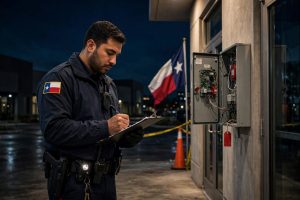
A static guard holds one position for the length of a shift. A lobby, a gate, a dock, a front desk. The officer is present continuously at that point and is available for anything that happens there.
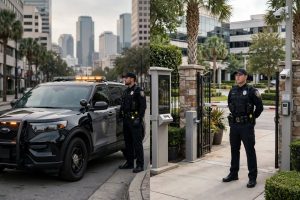
Mobile patrol covers ground. An officer arrives at the property, completes a route, checks what needs checking, documents the visit, and moves on. Depending on the arrangement, that officer may be covering several properties in the same shift.
The trade is straightforward. Static coverage gives you certainty at one spot and nothing anywhere else. Patrol gives you coverage across the whole property and nobody there between rounds.
When a Static Guard Is the Right Answer
Certain properties need a person in a fixed place, and no amount of patrol substitutes for it.
There Is a Control Point That Has to Be Staffed
If people are entering your property and someone needs to verify them, that is a static post. Office lobbies, residential building entrances, gated construction sites during working hours, and any location where access depends on a human decision all fall here.
A patrol passing through every ninety minutes cannot check credentials for people arriving continuously.
Presence Is the Product
Retail floors, bank lobbies, and front desks at buildings where tenants expect to see someone are positions where the officer being visible is the point. Removing that person and replacing them with periodic visits changes what the property is buying.
Response Time Has to Be Immediate
Properties where something could develop quickly, including locations with cash handling, high-value inventory, or a known concern, need someone already on site rather than someone who arrives in twenty minutes.
The Job Includes Service Work
Where the officer also handles deliveries, directions, visitor logs, or tenant requests, that workload requires a stationed position.
When Mobile Patrol Is the Better Fit
Patrol works where exposure is spread across an area rather than concentrated at a point.
The Property Is Empty During the Hours That Matter
Closed businesses, construction sites after hours, warehouse yards overnight, and office buildings on weekends have no one to protect and nothing happening except what should not be. Patrol covers those hours at a cost that makes sense for a property with nobody in it.
The Area Is Larger Than One Officer Can Watch
Industrial yards, apartment communities with multiple buildings, business parks, and large parking areas all exceed what a stationed officer can observe. A patrol covering the full property beats a static post covering one corner of it.
You Have Several Locations
Businesses with multiple sites can put one officer on a route covering all of them. That arrangement gives every location regular presence at a fraction of the cost of staffing each one.
Unpredictability Is the Deterrent
A patrol arriving at irregular times is difficult to plan around. Anyone watching a property learns a static officer’s position in one visit, and learns nothing useful from a patrol that comes at a different hour each night.
The Combination Most Properties End Up With
In practice the split is usually by time of day rather than by model.
A commercial property staffs a static post during business hours when people are moving through and access needs controlling, then switches to patrol coverage overnight and on weekends when the building is empty. The static hours handle access. The patrol hours handle the periods when the exposure is break-ins and after-hours activity rather than people.
Apartment communities often reverse the weighting, with patrol through the evening and overnight and no static post at all, since there is no single entrance to hold.
Retail centers run a hybrid, with officers moving through common areas during trading hours and patrol coverage after close.
The useful question is not which model to buy. It is which hours need a person standing somewhere and which hours need someone covering ground.
What to Look at Before Deciding
A few property facts settle most of this.
Count the access points. One controlled entrance points toward a static post. Six access points spread across a site usually point towards patrol. Look at when incidents have happened. If your losses occur overnight on an empty property, static coverage during business hours is never going to prevent them.
Measure the footprint. A single building is coverable by one stationed officer. Several acres is not. Consider who is on site. A property full of people during covered hours needs presence. An empty one needs rounds.
Look at the budget honestly. Patrol at the right hours beats static coverage at the wrong ones, and a property that cannot afford continuous staffing is better served by well-timed rounds than by thin static coverage stretched across a schedule.
What Patrol Should Include
If you go the patrol route, the details matter more than the frequency.
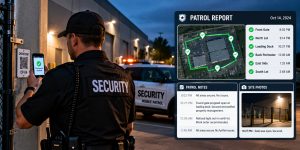
Rounds should be randomized rather than scheduled, since predictable timing removes most of the deterrent. The route should cover access points, the perimeter, equipment, and any area with a history of activity rather than following a path written at the start of the contract. Every round should be documented in writing, covering what was checked and anything found out of place.
Those reports are also what tells you if the model is working. Activity clustering at a particular hour or location is the signal to adjust the route, add rounds, or add a static post at that point. A patrol schedule that never changes is not a security plan, and a property that never reviews its coverage is paying for a decision made once at the beginning.
Cost, Coverage, and Texas Rules: The Details Behind the Choice
This section consolidates our earlier comparison of mobile patrol vs dedicated stationed guards, so the cost, coverage, and regulatory details live in one guide.
What Each Model Costs
A dedicated stationed guard is typically billed on an hourly bill rate, commonly $24.00 to $38.00 or more per hour per guard, and a full-time 24/7 post typically costs $17,000 or more per month. Mobile patrol is typically billed per sweep or visit ($15.00 to $35.00 per visit) or in dedicated patrol blocks, so covering the same acreage usually costs considerably less per month than a round-the-clock stationed post.
How Much Ground Each Model Covers
A stationed guard is constrained to line of sight and the immediate walking radius, typically under 1 to 2 acres per officer, but response within that footprint is effectively immediate, in 0 to 60 seconds. A single patrol officer in a marked vehicle can cover 10 to 50 or more acres, industrial loops, and multi-building parks, but response is variable, typically 10 to 30 minutes, if the officer is dispatched while off-site on a patrol loop.
How Each Model Is Verified
Stationed posts are documented with daily activity reports, fixed-post clock-ins, and visitor management logs. Mobile patrol is verified with real-time GPS geofencing, vehicle telematics, NFC checkpoint scans, and time-stamped photo logs, plus dashcam evidence during after-hours contacts.
Which Model Fits Which Property
High-density corporate office towers in Downtown and the Galleria suit dedicated stationed concierge guards, because the lobby desk must continuously verify credentials and control elevator and executive-floor access. Multi-tenant suburban strip malls and shopping centers suit marked mobile patrol, since tenants run varied schedules on tight common-area budgets. Logistics hubs, truck terminals, and industrial yards suit a hybrid: a stationed gate officer verifying driver paperwork and checking loads, plus a roving mobile patrol for the perimeter. After-hours construction sites suit a dedicated overnight stationed officer, or high-frequency mobile patrol where valuable tools, copper, and equipment are stored on site.
Texas Rules That Apply to Both Models
Under Texas Occupations Code Chapter 1702, standing guards and mobile patrol officers must hold the appropriate state credentials, commissioned (armed) or non-commissioned (unarmed). Under Texas Transportation Code Section 547.305, security patrol vehicles may only use green, amber, or white auxiliary lighting. Both stationed guards and patrol officers enforce private property boundaries under Texas Penal Code Section 30.05 (Criminal Trespass).