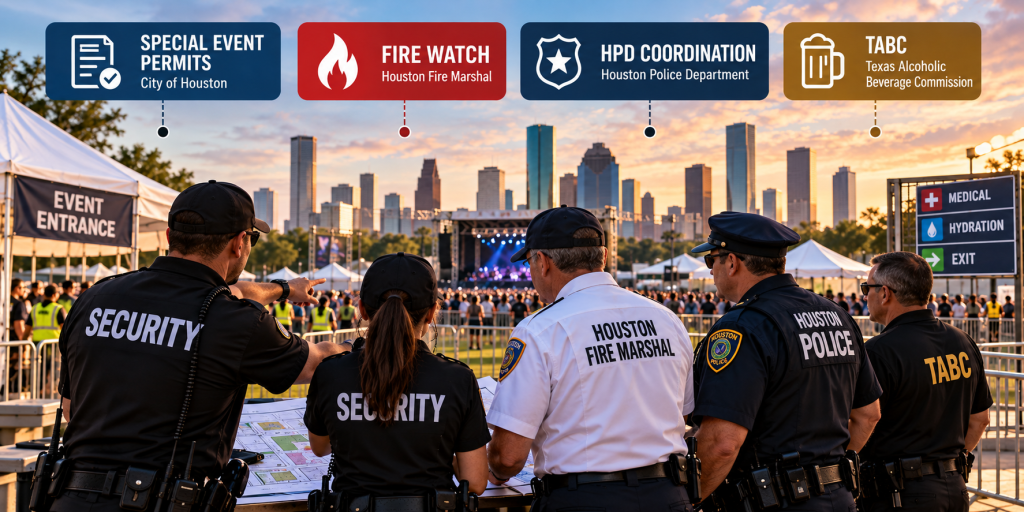
Most event-security guides tell you to “coordinate with local authorities” and leave it there. In Houston, that one line hides four separate bodies, each with its own rules, and getting any of them wrong can stall or shut down an event before the first guest arrives. The permit office, the Fire Marshal, the police department, and the state alcohol regulator all touch a large event, and your security plan has to line up with all of them.
This guide lays out how those pieces fit together for a Houston event, what each one actually governs, and where your security team belongs in the picture. It is written from the operator’s side, not the counter at city hall, so you know what to expect and what your security provider should already be handling.
The Four Bodies a Houston Event Answers To
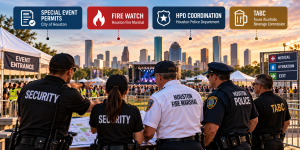
A Houston event of any real size usually sits inside four overlapping sets of rules:
- ✓ Special event permitting through the City of Houston (the Mayor’s Office of Special Events coordinates city-wide events, street closures, and public-property use)
- ✓ Fire and life safety through the Houston Fire Marshal (occupancy limits, exits, and fire watch)
- ✓ Police coordination with HPD (traffic, road closures, and larger-crowd safety)
- ✓ Alcohol regulation through the Texas Alcoholic Beverage Commission, or TABC (any event serving or selling alcohol)
They are not interchangeable, and they do not talk to each other for you. The organizer, and the security provider working with them, is what ties the four together into one plan. Below is what each one governs and where security fits.
Special Event Permits
If your event uses public property, closes a street, or gathers a crowd on city ground, you are almost certainly in permit territory. Houston routes city-wide special events and street-closure requests through the Mayor’s Office of Special Events, which coordinates the departments an event touches. Private-venue events may not need a city special event permit at all, but the venue itself usually carries its own occupancy and safety requirements that function the same way.
What this means for your plan:
- The permit process has lead time, so start early, well before the event date
- Permits can come with conditions, including required security, fire watch, or traffic control
- Your security plan is often something the permit process wants to see, not an afterthought
A good security provider has been through this and can speak to what a permit reviewer expects, so the security side of the application is not the thing holding up approval. Confirm the current thresholds, forms, and fees with the city directly, since those change.
Fire Watch and Occupancy
This is the requirement organizers most often miss. The Houston Fire Marshal sets occupancy limits and life-safety rules for a venue or event, and for certain events a fire watch is required: trained personnel whose job is to monitor for fire hazards, keep exits clear, watch occupancy, and be ready to start an evacuation.
A fire watch is commonly triggered by things like a large indoor crowd, a venue where fire-protection systems are impaired or absent, pyrotechnics or open flame, or specific occupancy conditions the Fire Marshal flags. The exact triggers and personnel counts come from the Fire Marshal and the applicable fire code, so confirm them for your specific event rather than guessing.
Where security fits:
- ✓ Officers support the fire watch by keeping exits and aisles clear all night
- ✓ Occupancy counting at the doors keeps the crowd under the posted limit
- ✓ The security team knows the evacuation plan and its role before doors open
Fire watch is a distinct function with its own standards. For the underlying rules on when it is legally required in Texas, see when a fire watch is legally required, and build the event version of that into the plan.
HPD Coordination
The Houston Police Department enters the picture when an event affects public safety beyond the venue: road closures, large crowds, traffic flow, and any credible threat or protest. For larger or higher-profile events, HPD coordination is not optional, and it often runs through the same special-event process.
HPD handles the public-order and traffic side. Your private security team handles inside the fence: access control, crowd management, VIP protection, and the first response to an incident. The two have to work from the same plan so there is no gap between where HPD’s responsibility ends and yours begins. A security provider that has worked Houston events will already know how to coordinate that handoff and who to talk to.
- ✓ HPD for road closures, traffic, and public-order at scale
- ✓ Private security for gates, crowd, VIPs, and in-venue response
- ✓ One plan, so the two coordinate instead of colliding
TABC: The Moment Alcohol Is Served
The second alcohol enters your event, the Texas Alcoholic Beverage Commission’s rules apply. TABC governs who can serve, age verification, over-service, and the liability that comes with all of it. An event with a bar carries a materially higher risk profile, and most event incidents, the ejections, the disputes, the medical calls, trace back to alcohol.
Security’s role around alcohol is specific: support age and ID checks, work with bar staff on over-service, manage the crowd around the bar, and handle an intoxicated guest calmly before it becomes the story of the night. This is its own topic, covered in do you need security for an event with alcohol in Texas.
How It All Fits in One Timeline
For a Houston organizer, the four bodies are not four separate projects. They are one timeline:
- Early: Start the permit process and confirm whether the city, venue, or Fire Marshal requires security, fire watch, or traffic control.
- Planning: Build the security plan to the venue, occupancy, alcohol, and crowd, and make sure it satisfies the permit conditions.
- Coordination: Line up HPD for traffic and public order, and fold the fire watch and TABC requirements into the same plan.
- Event day: The security team runs access, occupancy, crowd, and VIPs, supports the fire watch and alcohol compliance, and coordinates with HPD on the public-order side.
Get the sequence right and the compliance side stops being a threat to the event. Get it wrong and a missing permit or an unmet fire-watch condition can stop the event cold.
Where Your Security Provider Should Carry the Load
A Houston event has enough moving parts without the organizer learning four regulatory systems from scratch. The right security provider already knows this terrain: they plan the security side to fit the permit, support the fire watch and occupancy counts, coordinate with HPD, and keep alcohol service on the right side of TABC. The security plan and the permit plan end up as one plan instead of two that fight each other.
That is the standard we work to. If you are planning a Houston event, from a downtown gala to a festival at a public park, tell us about the event and we will build the security side to fit the rules it has to live inside. For the staffing side of that plan, see how many security guards you need for an event and the full event security checklist for venue managers.
Frequently Asked Questions
Do I need a permit for an event in Houston? If your event uses public property, closes a street, or gathers a crowd on city ground, you very likely need a city special event permit, coordinated through the Mayor’s Office of Special Events. Private-venue events may not, but the venue carries its own occupancy and safety requirements. Confirm current thresholds with the city, since they change.
When is a fire watch required at a Houston event? The Houston Fire Marshal requires a fire watch in certain conditions, such as a large indoor crowd, impaired or absent fire-protection systems, pyrotechnics or open flame, or specific occupancy situations. The exact triggers and personnel counts come from the Fire Marshal and the fire code, so confirm them for your event.
Does HPD have to be involved in my event? HPD coordination is typically required for events that affect public safety beyond the venue: road closures, large crowds, traffic, or a credible threat. HPD handles public order and traffic, while your private security team handles inside the venue. The two work from one coordinated plan.
What do I need for alcohol at an event? Any event serving alcohol falls under TABC rules on serving, age verification, and over-service. Your security team supports ID and age checks, works with bar staff on over-service, and manages the crowd around the bar. See our guide on security for an event with alcohol in Texas.
Can a security company handle the permit and fire-watch coordination? A security provider does not issue your permit, but an experienced one plans the security side to fit the permit conditions, supports the fire watch and occupancy counts, coordinates with HPD, and keeps alcohol service TABC-compliant. That is exactly what we do for Houston events. Talk to us.