
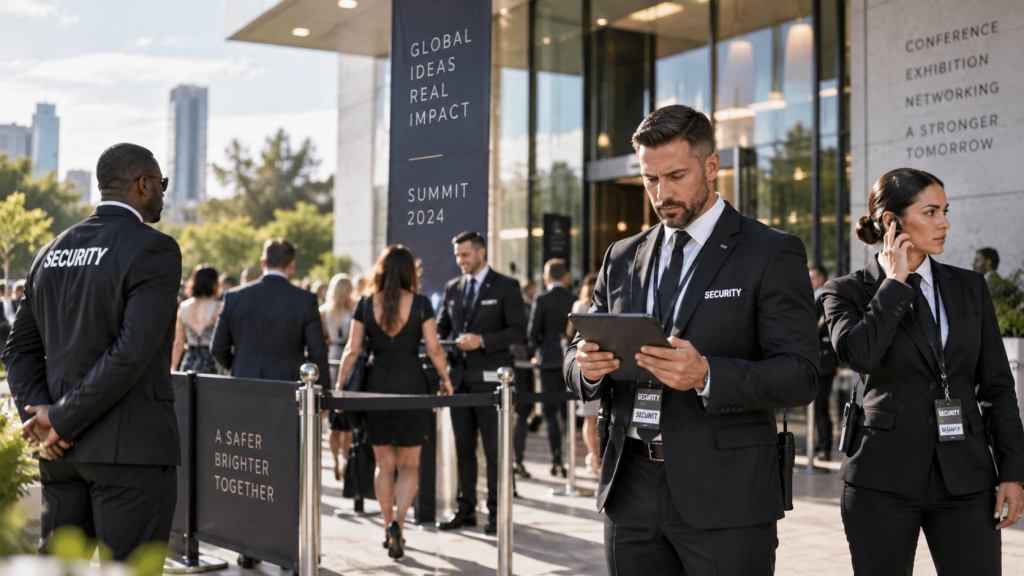
The standard baseline for event security staffing is 1 security guard for every 50 to 100 attendees. For low risk, seated daytime gatherings without alcohol, such as corporate shareholder meetings or educational seminars, a ratio of 1 guard per 100 guests is sufficient. However, once an event introduces open bar service, standing crowds, or live entertainment, the required ratio tightens to 1 guard for every 50 guests. For high density nightlife environments, multi stage music festivals, and open air public rallies, risk protocols mandate 1 guard for every 20 to 35 attendees.
Relying solely on headcount to determine security personnel is one of the most dangerous mistakes an event organizer can make. Two events with exactly 500 attendees can require vastly different security plans. An indoor seated banquet with a single controlled entryway operates safely with 5 to 6 officers, whereas an outdoor music festival with alcohol across five acres demands 18 to 25 guards.
True event security calculation requires a two part staffing framework: Ratio Based Floor Guards plus Dedicated Fixed Post Assignments.
Event Security Ratio by Gathering Type
Staffing benchmarks depend heavily on crowd behavior, environmental layout, and whether intoxicating substances are present.
| Event Classification | Planning Ratio | Primary Risk Drivers | Core Security Mandate |
|---|---|---|---|
| Seated Corporate Seminar or Trade Expo | 1 : 100 guests | Controlled ingress, low interior movement, zero alcohol | Credential access control, emergency exit clearance |
| Corporate Gala or Awards Dinner | 1 : 75–100 guests | Low mobility, seated meal, limited wine or beer service | VIP entry protection, discreet perimeter presence, registration desk |
| Private Wedding or Milestone Party | 1 : 50–75 guests | Open bar service, parking lot liabilities, uninvited guests | Alcohol monitoring, vehicle security, gift and cash box safety |
| Indoor Standing Concert or Nightclub Event | 1 : 40–50 guests | High physical movement, continuous alcohol intake, surges | Stage barricade lines, bag checks, queue de-escalation |
| Outdoor Festival or Multi Stage Public Fair | 1 : 25–40 guests | Sprawling multi-acre perimeters, cash vendors, crowd density | Perimeter fence integrity, medical lane clearance, patron ejection |
| High Profile VIP Appearance or Political Gala | 1 : 10–25 guests | External threat exposure, media surges, protesters | Close personal escort, sweeping magnetometers, access logging |
The Master Event Staffing Formula
Industry leading security directors do not guess guard counts. They calculate fixed operational positions first and then layer headcount ratios on top.
Total Required Guards equals Peak Anticipated Attendance divided by Risk Ratio Factor, plus Dedicated Fixed Posts, plus Command and Supervisory Staff.
-
Headcount Dynamic Officers: Roaming floor patrols, crowd engagement, and de escalation.
-
Point of Entry Posts: Metal detectors, bag searches, and ID verification.
-
Emergency and Egress Monitors: Unmonitored fire exit doors and emergency vehicle lanes.
-
Financial Asset Protection: Box office, merchandise tents, and ticket sales windows.
-
Restricted Backstage Detail: VIP green rooms, production corridors, and stage pits.
-
External Perimeter and Lot: Parking facility sweeps, outer fence lines, and loitering deterrence.
-
Operational Shift Command: Tactical supervisor, venue liaison, and dispatch lead.
Fixed Post Requirements What Attendee Ratios Miss
A common flaw found in generic planning guides is the assumption that a team of roaming floor guards can simultaneously watch exterior doors, monitor cash deposits, and manage entrance queues. Fixed security posts must always be staffed independently.
1. Ingress and Access Control Checkpoints
Every public entry lane requires dedicated personnel. Throughput math dictates that an experienced security officer can visually inspect bags and wand an incoming attendee in approximately 15 to 20 seconds.
-
That equals 180 to 240 patrons processed per hour, per security lane.
-
If 600 attendees are scheduled to enter within a 45 minute window prior to a keynote or headlining performance, a minimum of 4 dedicated entry guards (2 credential scanners and 2 search officers) is mandatory to prevent massive bottlenecks and sidewalk surges.
2. Emergency Egress and Fire Door Enforcement
Venues with unmonitored rear emergency doors face severe perimeter breach risks. In concert halls, convention centers, and wedding venues, guests routinely open panic doors to let non paying friends or prohibited items inside. Every primary secondary exit with exterior street access requires a dedicated fixed post guard or direct line of sight monitoring.
3. Financial and High Value Asset Depots
Any physical location where cash transactions take place, such as high volume ticket windows, silent auction checkout desks, and merchandise counters, presents a prime target for opportunistic grab and run theft. Assigning a stationed guard creates an immediate deterrent and provides secure escort during evening cash drops.
4. Backstage and VIP Protection Details
Keynote speakers, corporate executives, and musical performers require isolated transit routes from dressing rooms to stage zones. Organizers frequently augment general venue security with dedicated personnel trained in discreet executive protection in Houston to maintain an unbroken protective bubble around high profile guests.
5. Supervisory and Command Structure
Any event deployment requiring 4 or more security officers demands an on site Security Shift Supervisor. The supervisor does not cover a static door or roaming aisle. Their sole responsibility is coordinating radio communications, liaising directly with venue management, monitoring entry lines, and managing emergency escalations.
5 Critical Factors That Instantly Shift Your Ratio
Applying a flat 1 to 100 ratio without evaluating these five operational risk levers can result in catastrophic under staffing.
1. Alcohol Service and Texas Liquor Liability
Alcohol consumption is the single greatest catalyst for physical altercations, medical emergencies, and premises liability claims. Under Texas law, venue operators, organizers, and hosts can be held liable under Dram Shop statutes if visibly intoxicated patrons injure themselves or third parties.
When alcohol is sold or served:
-
The floor ratio immediately tightens from 1 to 100 down to 1 to 50 or 1 to 40.
-
Dedicated officers must be stationed at service bars to verify legal age, identify fraudulent identification cards, and assist bartenders with patron cut offs.
-
For a comprehensive look at state requirements, review our detailed guide on Texas liquor law event security requirements.
2. Architectural Multi Level Layout and Sightlines
Single room ballrooms provide broad lines of sight that allow two officers to scan hundreds of guests simultaneously. Conversely, venues featuring split level mezzanines, outdoor smoking patios, dark hallway corridors, or separate VIP lounges fragment security sightlines. Every isolated room or hidden alcove requires its own assigned personnel regardless of guest count. To evaluate physical facility layout risks, walk through our comprehensive event security checklist for venue managers.
3. Crowd Demographics and Event Volatility
A corporate anniversary gala with industry professionals presents a minimal risk index. However, youth music concerts, rival sporting watch parties, political rallies, and events featuring polar opposite audience viewpoints demand an aggressive deterrence model. When tension or audience energy is high, organizers must implement structured crowd physical barriers and clear transit corridors as detailed in our guide on concert and festival crowd control planning.
4. Event Duration, Relief Shifts, and Guard Fatigue
Security effectiveness degrades significantly when an officer remains on their feet past 6 continuous hours without scheduled breaks. For 10 to 14 hour events, such as multi day conventions or all day music festivals, staffing calculations must include a 15 percent to 20 percent staffing relief buffer to cover mandatory meal rotations, hydration relief, and rest cycles without leaving perimeter posts unstaffed.
5. Parking Lot Crime and Vehicle Vulnerabilities
Many organizers focus exclusively on the interior venue, forgetting that most event related criminal incidents, including vehicle burglaries, catalytic converter theft, and physical assaults, occur in parking lots and exterior pathways as guests arrive or depart. A comprehensive plan stations marked vehicle patrols or roving foot guards in vehicle facilities to protect attendees and shield organizers from premises liability lawsuits.
Real World Staffing Case Studies
Scenario A: 300 Guest Evening Wedding Reception
-
Venue: Private suburban ranch venue with outdoor courtyard, main indoor reception hall, and gravel parking lot.
-
Risk Factors: Open bar service, cash and gift table, unlit perimeter, high guest movement.
-
Calculation:
-
Ratio Allocation: 300 guests divided by 60 ratio equals 5 Roaming Guards.
-
Fixed Posts:
-
1 Guard stationed at main driveway gate to check RSVP list and verify arriving vehicles.
-
1 Guard monitoring the interior gift table, cash box, and bar perimeter.
-
1 Guard conducting roving mobile patrols across the parking lot and exterior perimeter.
-
-
-
Total Staffing Requirement: 8 Licensed Security Officers.
Scenario B: 1,000 Attendee Indoor Tech Conference and Product Launch
-
Venue: Downtown convention center, multi room breakout spaces, exhibit hall.
-
Risk Factors: High value prototype hardware, credential counterfeiting, media congestion, zero alcohol.
-
Calculation:
-
Ratio Allocation: 1,000 attendees divided by 100 ratio equals 10 Roaming Exhibit Hall Guards.
-
Fixed Posts:
-
4 Guards at main entrance glass doors (2 registration scanners, 2 bag check and wanding officers).
-
2 Guards covering loading dock and staging bays for equipment protection.
-
2 Guards stationed at executive backstage and speaker prep rooms.
-
1 On site Operations Shift Supervisor for radio dispatch and venue liaison.
-
-
-
Total Staffing Requirement: 19 Licensed Security Officers.
Scenario C: 2,500 Person Outdoor Music Festival
-
Venue: 8 acre open park, multi stage layout, general admission standing crowd, extensive beer and liquor sales.
-
Risk Factors: Heavy crowd surges, intoxication, perimeter fence hopping, ticket scalping, medical extraction needs.
-
Calculation:
-
Ratio Allocation: 2,500 attendees divided by 40 ratio equals 62 Crowd Patrol Guards.
-
Fixed Posts:
-
8 Entry Gate Officers (4 metal detection lanes, bag inspection stations).
-
6 Stage Pit Barricade Officers (preventing stage rushes and pulling distressed patrons).
-
4 Perimeter Fence Patrol Officers (deterring fence jumpers and exterior loitering).
-
4 Dedicated Bar Area De escalation Guards.
-
2 Box Office and Cash Handling Officers.
-
2 Security Supervisors plus 1 Lead Incident Commander.
-
-
-
Total Staffing Requirement: 89 Licensed Security Officers.
Armed vs Unarmed Officers Which Does Your Event Need
In Texas, private security personnel are governed by the Texas Department of Public Safety Private Security Bureau under strict credential categories.
Level II Non Commissioned (Unarmed) Security Officers
These officers handle customer service, credential checking, metal detector wanding, ushering, directional support, and visible deterrence. Their operational toolkit centers on conflict avoidance and non violent de escalation. Unarmed officers are standard for corporate events, charity luncheons, and indoor conferences.
Level III Commissioned (Armed) Security Officers
Armed officers complete state mandated tactical instruction, firearms proficiency exams, and legal training on the lawful use of force. Armed personnel are deployed at external perimeters, vehicle entry gates, high dollar cash collection rooms, and events hosted in high crime municipal areas or featuring high threat attendee demographics.
The Recommended Hybrid Structure
For the majority of medium to large events, the most cost effective and operationally sound strategy utilizes unarmed Level II officers for internal guest facing roles, backed by armed Level III supervisors positioned strategically at external checkpoints and vehicle gates.
Budgeting Event Security in the Houston Market
When budgeting for security services in Greater Houston, rates reflect officer certification levels, lead times, and scheduling commitments:
-
Unarmed Level II Officers: Typically range from 25 to 40 dollars per hour.
-
Armed Level III Officers: Typically range from 35 to 55 dollars per hour.
-
Shift Minimums: Most professional security firms maintain a mandatory 4 hour minimum billing window per guard.
For a detailed financial breakdown of weekend overtime rates, holiday differentials, and equipment fees, consult our comprehensive pricing analysis on event security costs in Houston.
4 Common Event Security Pitfalls to Avoid
-
Using Venue Staff or Friends as Bouncers: Relying on venue bartenders, ushers, or volunteers to manage hostile individuals creates severe legal vulnerability. Under Texas law, hiring unlicensed personnel to perform security duties is a direct violation that immediately invalidates event liability coverage.
-
Staffing for Average Crowds Instead of Peak Arrival Times: If 80 percent of your audience arrives within a 30 minute surge before a concert or main event, an entry team designed for smooth continuous flow will be overwhelmed, causing crowd frustration and perimeter safety hazards.
-
Ignoring Radio Frequency Dead Zones: In large concrete exhibition spaces or metal framed industrial venues, cell service and basic walkie talkies often fail. Professional security contractors deploy dedicated, multi channel tactical repeaters to maintain communication across all guard posts.
-
Failing to Establish a Documented Chain of Command: In a crisis, such as a severe weather evacuation, active threat, or medical emergency, guards must know exactly who possesses the legal authority to halt the event and direct emergency first responders.
Build Your Custom Event Security Plan with Gods Armour Security
Whether you are coordinating an executive summit in Downtown Houston, managing a high attendance charity gala in the Galleria, or organizing an open air public festival, Gods Armour Security delivers state licensed, insured, and thoroughly vetted personnel.
Our operations team conducts thorough on site risk audits to design a tailored security footprint that balances discreet hospitality with crowd control.
Planning an upcoming event? Request a free security consultation and staffing breakdown or call our Houston dispatch desk directly at (713) 878 9984 to review your venue layouts and guest counts.