Here is the quiet fear every property manager has about mobile patrol: you are paying for an officer to check your site through the night, and you have no real way to know they did. Did the car actually show up at 2 a.m., or just log it? Did they walk the back lot, or drive past the front and leave? The whole value of patrol depends on it happening, and for years the only proof was the officer’s word.
That is the problem this guide is about. A patrol is only worth what you can verify, and modern patrol accountability, GPS-stamped tours and real reports, is how you close the gap between what you are billed for and what actually happened on your property.
Why “Trust Us, We Came By” Is Not Good Enough
An unverified patrol has a built-in weakness: the easiest way to cut corners is invisible to the client. A skipped round, a shortened route, a drive-by instead of a walk-through, none of it shows up on an invoice. The industry has a long history of exactly this, which is why the fear is reasonable and why accountability is now the thing that separates a real patrol service from a billing arrangement.
If you cannot verify the patrol, you are not buying security. You are buying a promise.
What GPS-Verified Patrol Proof Looks Like
Modern patrol runs on checkpoints and timestamps, not trust. The common tools:
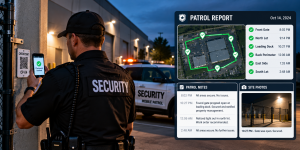
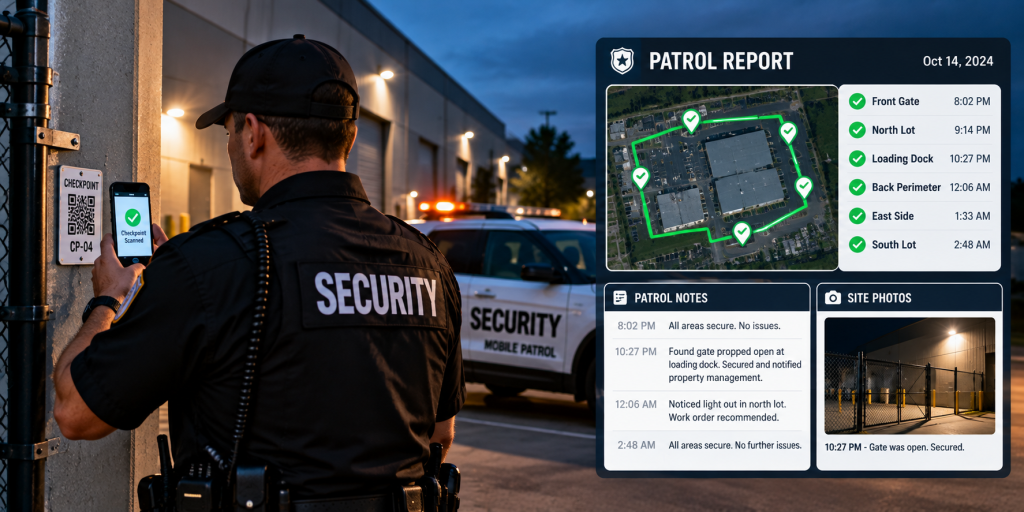
- ✓ GPS-stamped check-ins: the officer’s location and time recorded at each point on the route, so you can see the patrol moved through your property, not past it
- ✓ Scan or tag checkpoints: physical points around the site (a tag at the back gate, the loading dock, the stairwell) the officer must reach and scan, proving they covered the areas that matter, not just the easy ones
- ✓ Timestamped rounds: each pass logged with a start and end, so a skipped or shortened round is visible
- ✓ Photo and note capture: officers attach photos and notes to a checkpoint, turning a round into a record
This is what a “guard tour system” actually delivers: not surveillance of the officer, but proof for you. It is the difference between a patrol you hope happened and one you can pull up and confirm.
What a Good Patrol Report Actually Says
A GPS trail proves the patrol happened. The report is what makes it useful. The weak version is a daily activity report that says “all quiet, no issues” every single night, which tells you nothing. A good report explains what changed on the site:
- ✓ A gate found propped open, and when
- ✓ A light out in the north lot
- ✓ A vehicle parked overnight that should not be there
- ✓ A door that keeps getting left unlocked at a certain hour
- ✓ The round where something was handled, and what was done
A report that only ever says “quiet” is a report nobody reads. A report that surfaces the recurring problem, the same door, the same hour, the same corner, is what lets you fix the underlying issue instead of treating every incident as unrelated. Over time, that documentation is also what protects you: a record that shows your property took reasonable, verifiable steps.
Why This Protects You, Not Just the Officer
Verified patrol and real reporting do three things for a property owner:
- You get what you pay for. The patrol is confirmed, not assumed, so the service you are billed for is the service you receive.
- You see your site’s real patterns. The reports surface the recurring problems a single “all quiet” note would bury.
- You are protected if something happens. A documented, GPS-verified patrol is a far stronger position than “we think the guard came by” if an incident ends up in an insurance claim or a negligent-security case.
That last point matters more than most owners realize. For how documentation plays into liability on a property, the same principle runs through parking lot crime liability for property owners.
How We Run Accountable Patrol
Our patrols are built to be verified, not taken on faith. Officers check in at GPS-stamped points around your property, cover the checkpoints that matter rather than the easy loop, and file reports that explain what they found, not just that the shift passed. You get proof the patrol happened and a record you can actually use.
If you want patrol you can verify, tell us about your property. For how patrol coverage is structured and priced, see mobile patrol vs dedicated stationed guards and what mobile security patrol costs in Houston. And because predictability is the other way a patrol loses value, see randomized vs scheduled patrol rounds.
Frequently Asked Questions
How do I know a security patrol actually showed up? Through GPS-stamped check-ins and checkpoint scans that record the officer’s location and time at each point on the route, plus timestamped rounds. That turns the patrol from something you hope happened into something you can pull up and confirm.
What is a guard tour system? It is the checkpoint-and-timestamp system that verifies a patrol. Officers reach physical checkpoints around the site and scan or GPS-stamp them, proving they covered the areas that matter. The output is proof for the client, not surveillance of the officer.
What should a security patrol report include? More than “all quiet.” A good report records what changed on site: a propped gate, a light out, an overnight vehicle, a door left unlocked, and what was done about it, each with a time. Reports that only ever say “quiet” are the ones nobody reads and nobody can act on.
Why does patrol documentation matter for liability? If an incident leads to an insurance claim or a negligent-security case, a documented, GPS-verified patrol shows your property took reasonable, verifiable steps. “We think the guard came by” is a much weaker position. See parking lot crime liability for property owners.
Do you provide verified patrol in Houston? Yes. Our patrols use GPS-stamped check-ins and checkpoint coverage, with reports that explain what was found. Tell us about your property and we will set up coverage you can verify.