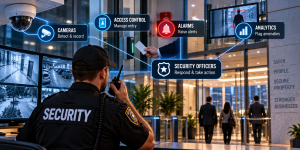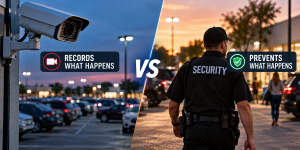
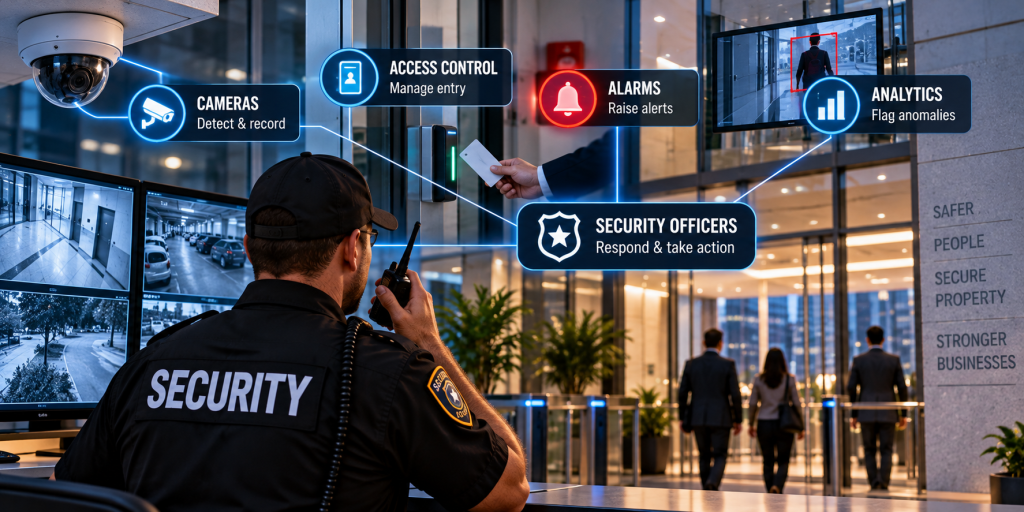
Walk into most modern commercial buildings and the security is mostly electronic: cameras in the lobby, badge readers at the doors, an alarm panel in a back room, maybe motion sensors and analytics watching the feeds. It looks complete. Then an alarm trips at 11 p.m., a door is propped open, or a camera catches someone tailgating in behind an employee, and the system does the one thing it cannot do on its own. It waits for a person.
That gap is the whole point of this guide. Technology detects. People decide and act. The buildings that are actually secure do not choose between guards and technology, they integrate the two into one system, where the hardware watches everything and the officer is the response and judgment the hardware does not have.
Technology Is a Detection Layer, Not a Response Layer
A camera, a badge reader, an alarm, and a motion sensor all do the same essential job: they notice something and raise a flag. That is detection, and modern systems are very good at it. What none of them do is act on what they notice.
- ✓ A camera records the tailgater. It does not stop them.
- ✓ An access system logs the forced door. It does not go see why.
- ✓ An alarm sends an alert. It does not clear the building or meet the police.
- ✓ Analytics flag the loitering figure. They do not walk over and ask a question.
Every one of those alerts is only as valuable as the response behind it. An alarm nobody answers is noise. A camera nobody is positioned to act on is a record of a loss, not a prevention of one. The technology raises its hand; something has to be there to call on it.
Where a Security Officer Completes the System
A security officer is the response and judgment layer that makes the detection layer worth the money. In an integrated commercial setup, the officer is not duplicating the technology, they are doing the part it cannot.
Acting on the alert in real time
When the access system flags a forced door or the camera catches the tailgater, an officer on site investigates and resolves it while it is happening, instead of the building learning about it from footage the next morning.
Judgment the sensor does not have
Technology flags anomalies, but it cannot tell the delivery driver from the intruder, the lost visitor from the person casing the lobby, or the real emergency from the false alarm. An officer applies the human read that keeps a system from either crying wolf or missing the real thing.
The physical presence a screen cannot project
A visible officer in the lobby and on patrol is a deterrent in a way no camera is. People behave differently around a person who will notice and respond than around a lens that only records. The technology extends the officer’s reach; the officer gives the technology teeth.
- ✓ Real-time response to what the system detects
- ✓ Human judgment on what an alert actually means
- ✓ A physical deterrent the hardware cannot provide
- ✓ Coordination with police and management when it matters
The 5 D’s: Where Each Layer Fits
A useful way to see the integration is the classic security model, deter, detect, delay, deny, defend, and which layer owns each:
| Technology | Security Officer | |
|---|---|---|
| Deter | Visible cameras, lighting | Visible presence, patrol |
| Detect | Cameras, alarms, sensors, analytics | On-site observation |
| Delay | Locks, access control, barriers | Controlled entry, verification |
| Deny | Badge systems, locked zones | Enforcing who gets through |
| Defend | (none, it only records) | Response, de-escalation, action |
Read down that last row. Technology genuinely owns detection and contributes to the others. But the final column, defend, the part where something actually acts, has no technology entry at all. That is the hole an officer fills, and it is why an integrated system beats either one alone.
What Integration Actually Looks Like in a Building
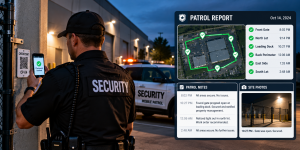
In practice, a well-integrated commercial security setup runs like this. Cameras and analytics watch the whole property, including the zones an officer is not standing in. Access control manages who moves where. Alarms cover the after-hours exposure. And the officer works with all of it: monitoring where it makes sense, responding to what the system flags, controlling the lobby and access points in person, and patrolling the areas a fixed camera cannot follow.
The officer uses the technology as a force multiplier, and the technology uses the officer as its response. Access control and visitor management get the human verification they need, which we cover in office building access control and visitor policies. After-hours, the alarm and camera coverage pairs with patrol so a flagged event gets a real response, not just a recording, which we cover in after-hours commercial property security.
Why This Matters When You Are Buying Security
Plenty of building owners invest heavily in cameras and access control and assume they are covered. They have bought an excellent detection system and no response. The result is a building that documents its losses beautifully and prevents fewer of them than the owner thinks.
The better question when you are planning security is not “guards or technology,” it is “how do the two work together here.” That is how we approach a commercial property: we look at what the building already has, what it detects, and where the response gap is, then staff to close it. For what to ask when you are comparing providers, see questions to ask before hiring a commercial security company.
If you want a security plan where the technology and the officers actually work as one system, talk to us about commercial security in Houston.
Frequently Asked Questions
If I already have cameras and access control, do I still need security guards? Usually yes. Cameras and access control detect and record, but they do not respond, exercise judgment, or physically deter. A guard is the response layer that acts on what the system flags. Together they cover detection and response; alone, the technology covers only detection.
What is the difference between what technology and a guard do? Technology detects and documents: it notices a forced door, a tailgater, or an alarm and raises a flag. A guard decides and acts: investigates the flag in real time, applies human judgment, deters by presence, and coordinates a response. The technology extends the officer’s reach; the officer gives the technology a response.
What are the 5 D’s of physical security? Deter, detect, delay, deny, and defend. Technology handles detection well and contributes to deter, delay, and deny. The defend layer, where something actually acts on a threat, has no technology equivalent; that is the part a security officer provides.
How do guards and technology work together in a commercial building? The cameras, access control, alarms, and analytics watch the whole property and flag events. The officer monitors where useful, responds to what is flagged, controls the lobby and access points in person, and patrols the blind spots. Each covers what the other cannot, as one system.
Can you work with my building’s existing security system? Yes. We assess what the building already detects and where the response gap is, then integrate officer coverage with the existing cameras, access control, and alarms rather than duplicating them. Tell us about your property.