Hiring a commercial security guard company is one of the most important risk-management decisions a property manager, building owner, or facility director will make. A competent security team safeguards physical assets, protects employees, reduces shrinkage, and shields commercial property from premises liability claims. Conversely, partnering with an under-insured, under-trained, or non-compliant guard service introduces legal exposure, reputational fallout, and operational disruption.
In Texas, the private security industry is heavily regulated, yet commercial buyers frequently sign contracts based solely on lowest hourly billing rates. Discount security providers often cut corners on state licensing compliance, background screenings, supervisory support, and proper insurance endorsements. When an incident occurs such as a parking lot assault, unauthorized forced entry, or unlawful detention—the property owner is frequently named alongside the security vendor in civil negligence litigation.
To ensure your facility receives compliant, professional protection, procurement teams must look past promotional brochures and conduct structured vendor vetting. Asking the right questions hiring security company personnel requires examining operational capabilities, legal safeguards, and training frameworks. This procurement guide details the ten essential questions every commercial property decision-maker should ask before signing a guard services contract.
Phase 1: Security Vendor Vetting Matrix: The 10 Essential Questions
Use this evaluation matrix to assess candidate security providers during the RFP and interview process:
| # | Vetting Question | Key Compliance Standard | Red Flag to Watch For |
|---|---|---|---|
| 1 | Are you licensed by the Texas DPS Private Security Bureau? | Active Texas Class B or Class C license under Texas Occupations Code Ch. 1702. | Operating under an individual license rather than a licensed guard contractor entity. |
| 2 | What specific insurance coverage and limits do you carry? | $2M+ Commercial General Liability, Workers’ Comp, and explicit Assault & Battery riders. | Policies that contain policy exclusions for firearms or third-party intentional acts. |
| 3 | What is your pre-employment background and drug screening process? | FBI fingerprint check via Texas DPS, 10-panel drug panel, and verification of employment history. | Relying solely on fast county-level instant online background searches. |
| 4 | What training beyond the state minimum do your officers receive? | Verbal de-escalation, CPR/First Aid, post orders execution, and emergency egress management. | Guards deployed immediately after passing baseline Level II online training without site orientation. |
| 5 | How do you track officer patrols and verify attendance on site? | Real-time GPS guard tour verification, NFC checkpoint scans, and cloud incident software. | Relying on manual paper logbooks that can be backfilled or forged. |
| 6 | What is your field supervisor-to-guard operational ratio? | Dedicated mobile field supervisors conducting regular unannounced on-site post inspections. | No roving field supervision; relying solely on remote phone dispatch check-ins. |
| 7 | What are your post order development and onboarding procedures? | Site-specific, custom post orders drafted with facility management and updated annually. | Using generic template post orders that do not reflect building access points or alarm codes. |
| 8 | How do you handle shift call-offs and open post coverage? | Contractual fill-rate guarantees backed by dedicated on-call floaters within 60 to 90 minutes. | No reserve staffing, leaving commercial buildings unprotected when guards call out sick. |
| 9 | What is your officer turnover rate and wage philosophy? | Competitive wages above local median, healthcare benefits, and transparent retention stats. | Minimum-wage billing models yielding 200%+ annual guard turnover and revolving personnel. |
| 10 | Can you provide commercial property references in our local market? | Verifiable references from local commercial office towers, industrial parks, or retail plazas. | Hesitation to connect prospective clients with long-term property managers. |
When selecting a guard service for multi-tenant retail or office properties, ensure costs can be properly apportioned under commercial leases; review financial frameworks in our guide on shared security cost models for strip malls and shopping centers.
Phase 2: Licensing and Regulatory Verification in Texas
In Texas, private security is regulated under Texas Occupations Code Chapter 1702 by the Texas Department of Public Safety (DPS) Regulatory Services Division. Operating with an unlicensed security provider invalidates commercial insurance policies and creates strict liability hazards for the hiring entity.
Before entering contract negotiations, verify these regulatory requirements:
- Company License (Class B or Class C): The vendor must hold an active security contractor license issued by Texas DPS. A Class B license covers guard companies, while a Class C covers combined guard and private investigation operations. You can verify active status through the Texas DPS TOPS (Texas Online Private Security) database.
- Individual Officer Commission Tiers: Security personnel must hold valid individual registrations corresponding to their operational duties:
- Level II (Non-Commissioned): Unarmed security officers who have completed state-mandated baseline training and FBI criminal history clearances.
- Level III (Commissioned): Armed security officers who have completed firearm proficiency qualifications, state defensive tactics, and weapon retention certification.
- Level IV (Personal Protection Officer): Bodyguards and executive protection agents who hold Level III commissions plus advanced psychological evaluations and specialized close-protection training.
- DPS Registration Pocket Cards: Every working officer on your commercial property must have their state-issued physical or digital DPS registration pocket card on their person while in uniform.
Phase 3: Critical Insurance Coverages and Endorsements
One of the most dangerous oversights in security procurement is accepting a basic Certificate of Insurance (COI) without verifying underlying policy language. Commercial security carries inherent operational hazards, and standard commercial general liability (CGL) policies often contain exclusions that leave the client completely unprotected.
Mandate that your security contractor provides proof of the following coverages:
1. Commercial General Liability ($2M+)
Ensure minimum limits of $1,000,000 per occurrence and $2,000,000 aggregate, naming your entity as an Additional Insured on a primary and non-contributory basis.
2. Assault and Battery Endorsement
Standard CGL policies routinely exclude intentional acts. If a guard detains a trespasser or uses physical force, your property could face litigation without defense coverage unless an explicit Assault & Battery endorsement is present.
3. Statutory Workers’ Compensation
While Texas does not mandate workers’ comp for all private employers, your contract should require statutory Workers’ Compensation coverage with a Waiver of Subrogation in your favor.
4. Firearms Liability (For Armed Posts)
If deploying armed Level III officers, confirm that the policy explicitly includes firearms liability and does not contain exclusion riders for armed personnel operations.
When physical stops or customer detentions occur on commercial grounds, ensure guard conduct complies with state law; explore statutory parameters in our reference on Texas shoplifting laws and security guard authority.
Phase 4: Operational Capabilities: Supervision, Technology, and Training
A security officer is only as effective as the management system supporting them. During your vendor interviews, look closely at the operational setup that ensures consistent shift performance:
1. Guard Tour Verification and Incident Tech
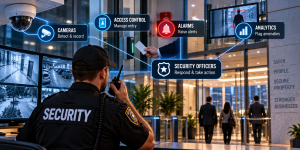
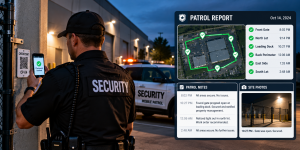
Eliminate paper logbooks. Professional security contractors equip officers with ruggedized mobile devices utilizing GPS tracking, NFC checkpoint scanning, and cloud-based incident reporting software. These systems timestamp patrol rounds, verify that high-risk perimeter doors are physically checked, and provide property managers with digital incident logs and high-resolution photo documentation every morning.
2. Field Supervision and Post Inspections
Guards stationed at remote commercial facilities without supervisory oversight frequently suffer from operational drift, inattention, or unapproved departures. Ask how frequently mobile field supervisors conduct unannounced, randomized post inspections. Top-tier contractors maintain designated mobile supervisors who inspect officer uniforms, verify post order adherence, and test situational readiness on a weekly or daily basis.
3. Conflict De-Escalation and Customer Interaction Training
Commercial office buildings, healthcare facilities, and shopping plazas demand strong customer service skills. Officers must be capable of diffusing disputes with disgruntled tenants, visitors, or trespassers without immediately resorting to physical restraint. Inquire whether the vendor provides certified verbal de-escalation and crisis communication training; learn core techniques in our operational manual on de-escalation techniques for retail security officers.
Phase 5: Transparent Billing and Service Level Agreements (SLAs)
Commercial security proposals frequently look attractive on paper until hidden surcharges and unfulfilled shifts degrade service quality. Clarify commercial terms before executing a vendor agreement:
- Overtime and Holiday Billing Rates: Define exactly which holidays incur premium bill rates (e.g., 1.5x) and verify that the contractor cannot bill overtime incurred due to their own scheduling mismanagement.
- Billable Equipment Fees: Ensure that uniform costs, duty gear, radios, patrol vehicle mileage, and reporting software fees are bundled into the flat hourly bill rate rather than added as separate monthly line items.
- Contractual Fill-Rate Guarantees: Mandate a minimum shift fulfillment rate (e.g., 99.5%). Establish clear financial liquidated damages or invoice credits if a post is abandoned or left vacant due to an unaddressed guard call-out.
- Short-Notice Cancellation Terms: Avoid multi-year locked contracts without escape clauses. Protect your organization by demanding a 30-day termination for convenience clause and an immediate 24-hour termination for cause clause in the event of gross negligence or licensing lapses.
For properties evaluating whether dedicated on-site officers or vehicle patrols provide the best financial value, review our operational comparison of foot patrol vs mobile vehicle patrol for large commercial lots.
Partner with God’s Armour Security for Commercial Property Protection
Selecting the right security guard contractor safeguards your physical property, preserves your commercial brand reputation, and protects your bottom line. God’s Armour Security provides fully licensed, rigorously vetted, and professionally supervised security personnel for commercial office towers, industrial distribution centers, healthcare facilities, and retail plazas across Greater Houston, Harris County, and statewide Texas.
Our operations team delivers complete contractual transparency, real-time GPS patrol verification, Texas DPS compliance, and dedicated field supervision on every shift. Explore our specialized commercial property security services in Houston and our responsive mobile security patrol services.
Ready to audit your property’s safety needs and interview a compliant security partner? Request a commercial security consultation and vendor evaluation or call our Houston operations desk directly at (713) 878-9984.
Frequently Asked Questions
How do I verify if a security guard company is licensed in Texas?
You can verify a security company’s license online through the Texas Department of Public Safety (DPS) TOPS (Texas Online Private Security) public search portal. A contract guard company needs an active Class B (Security Services Contractor) license with guard service; a company that also provides investigations holds a Class C license. Confirm the license is active and the qualifying manager is in good standing.
What is the difference between Level II, Level III, and Level IV security guards in Texas?
Under Texas DPS regulations, Level II security officers are unarmed guards trained in basic security duties and report writing. Level III officers are commissioned armed guards who have passed state handgun proficiency and defensive tactics training. Level IV officers are personal protection officers (PPOs) certified to provide executive protection and close-protection bodyguard services.
Why is an Assault and Battery insurance endorsement essential for security contractors?
Most standard Commercial General Liability policies contain specific exclusions for intentional acts or physical altercations. An Assault and Battery endorsement ensures the insurance policy defends and indemnifies both the security company and the hiring property owner if an officer is sued following a physical altercation, detention, or ejection on site.
How does real-time GPS tour tracking protect property managers?
GPS tour tracking systems require officers to scan digital NFC tags or log checkpoints using mobile devices during their rounds. This provides property managers with verified digital timestamps, proves that rounds were executed, eliminates guard sleep-on-duty risks, and creates defensible evidence in premises liability disputes.
Key Takeaways
- Always verify Texas DPS licensing through the TOPS database to ensure candidate companies hold active Class B or Class C certifications under Texas Occupations Code Ch. 1702.
- Require proof of at least $2,000,000 in General Liability insurance, statutory Workers’ Compensation, and explicit Assault & Battery endorsements.
- Mandate FBI fingerprinting and 10-panel drug screenings rather than basic online background checks.
- Require cloud-based GPS patrol verification software to eliminate falsified paper logs and confirm round completion.
- Insist on transparent Service Level Agreements with contractual fill-rate guarantees and 30-day termination for convenience clauses.