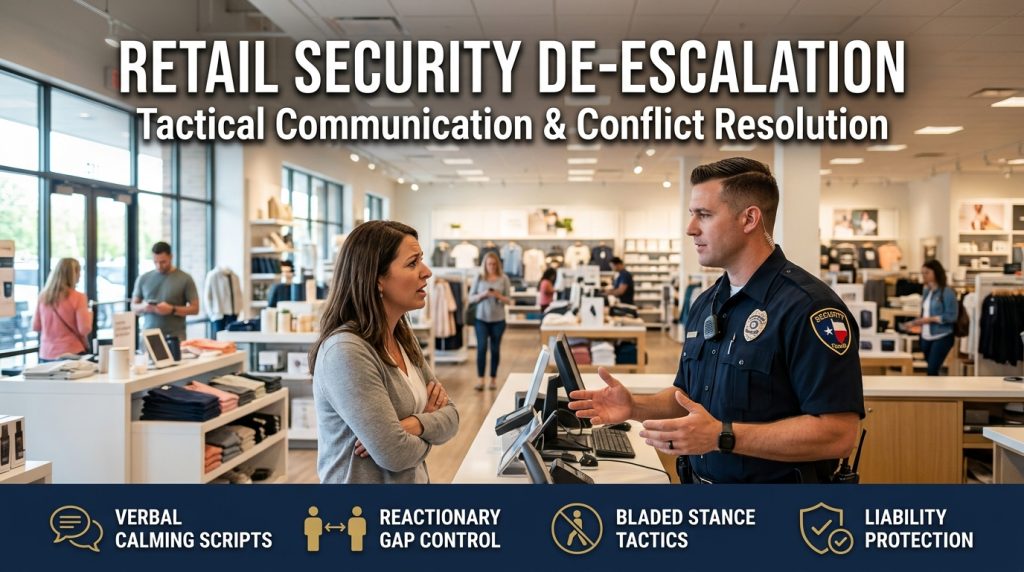
High foot traffic retail environments such as busy shopping centers, department stores, lifestyle centers, and retail strip malls across Greater Houston and Texas are high-pressure zones. Crowded aisles, long checkout queues, disputed returns, and suspected shoplifting stops can quickly turn a routine interaction into a heated confrontation. For a retail security officer, the ability to control and resolve these tense moments without physical contact is the single most valuable operational skill.
When an officer escalates a confrontation through harsh words, aggressive posture, or premature physical contact, the fallout is severe. A minor dispute can erupt into a violent altercation, endangering nearby shoppers and store staff while exposing the business to multi-million-dollar lawsuits for assault, battery, or unlawful restraint under Texas law. Furthermore, viral mobile phone footage of security mishandling customers can permanently damage a retail brand’s reputation.
Professional retail security de-escalation is not passive weakness; it is a tactical discipline. It involves using verbal persuasion, controlled body language, emotional pacing, and spatial management to lower emotional intensity and gain voluntary compliance. This operational guide outlines proven de-escalation techniques designed specifically for retail security officers operating in high-volume commercial stores.
Phase 1: The Escalation Continuum in High-Traffic Retail
Conflict in retail rarely happens instantaneously; it builds along a recognizable behavioral continuum. Recognizing these phases allows officers to intervene before physical intervention becomes necessary:
| Behavioral Phase | Observable Indicators | Officer De-Escalation Response |
|---|---|---|
| 1. Frustration / Agitation | Pacing, sighing loudly, clenched jaw, crossed arms, muttering complaints about service or pricing. | Supportive approach: open demeanor, calm acknowledgment, offering assistance to resolve the customer’s bottleneck. |
| 2. Verbal Defiance / Bluster | Raised voice, profanity, challenging store policy, questioning the officer’s authority directly. | Verbal redirection: low vocal pitch, slow speech tempo, active listening, isolating the individual away from audience crowds. |
| 3. Intimidation / Pre-Assault | Clenched fists, target glancing, blading body stance, stepping within personal reactionary space (under 4 feet). | Boundary setting: step back into a tactical stance, present open protective palms, issue clear choices, alert backup via radio. |
| 4. Physical Confrontation | Pushing, swinging, lunging, attempting to grab merchandise or weapons. | Defensive containment: lawful non-deadly reasonable restraint within Texas legal limits, immediate law enforcement dispatch. |
When detaining or confronting a suspected shoplifter, officers must understand the legal parameters established under Texas law. Review statutory boundaries in our legal analysis of Texas shoplifting laws and security guard authority.
Phase 2: Tactical Body Language and Spatial Control
A large share of communication during high-stress encounters is non-verbal, and agitated customers tend to mirror an officer’s posture. Officers should master these physical positioning rules:
1. Maintain the Reactionary Gap
Never stand within arms’ reach of an agitated individual. Maintain a buffer of 6 to 8 feet. This distance allows adequate time to react to sudden lunges and reduces the individual’s feeling of physical entrapment.
2. The Interview Stance (Bladed Stance)
Stand at a 45-degree angle with your non-dominant side forward. This reduces your physical exposure, keeps your duty gear protected away from the subject, and looks non-confrontational rather than an aggressive, squared-up combat posture.
3. Open, Non-Threatening Hands
Keep hands visible at waist level with open palms facing outward while speaking. Avoid folding arms, clenching fists, or resting hands on duty belts, which signals hostility and sparks defensiveness.
4. Eye Contact Calibration
Maintain calm, intermittent eye contact. Avoid intense, unbroken staring contests, which escalate tensions into dominance challenges, but never look completely away, which signals disinterest or vulnerability.
For large multi-store plazas, maintaining composure during retail disputes prevents panic from spilling into shared pedestrian breezeways; review property-wide coordination in shared security cost models for strip malls and shopping centers.
Phase 3: Verbal De-Escalation Tactics: The Universal Calming Script
Words can either pour fuel on a conflict or systematically drain its energy. Officers operating on retail sales floors should apply these four verbal techniques:
1. Vocal Pitch and Tempo Regulation (Tone Down, Slow Down)
When a customer or suspect shouts, human instinct is to match their volume and tempo. Professional security guards intentionally do the exact opposite. By speaking at a lower pitch and a slower, measured speed, officers force the other individual’s autonomic nervous system to slow down to process the conversation.
2. Tactical Empathy and Active Paraphrasing
Agitated individuals often shout because they feel unheard. Using phrases like: “I hear your frustration with the checkout process, sir,” or “Let me make sure I understand what happened here…” acknowledges their emotion without conceding store policy or legal violations.
3. Removing the Audience Factor
People behave more aggressively when they have an audience of other shoppers filming or watching. Acknowledge the dispute and gently redirect: “I want to get this sorted out for you away from this crowded doorway. Let us step over here to the customer care desk so we can talk quietly.” Removing the audience immediately drops the subject’s adrenaline.
4. Offering Binary, Dignity-Preserving Choices
Backing someone into an absolute corner invites explosive resistance. Give the individual structured choices that preserve their dignity while achieving store compliance: “We can either take a look at the receipt right here quietly, or we can wait for the police department to review the footage together. I’d prefer to clear this up with you directly. Which would you prefer?”
When managing volatile crowds during holiday rushes and Black Friday doorbusters, apply structured line control outlined in our guide on creating a high-volume holiday season retail security plan.
Phase 4: De-Escalating Organized Retail Crime (ORC) Boosters
De-escalating professional ORC theft syndicates differs substantially from handling an ordinary disgruntled customer. Professional boosters operate with planned escape routes and occasional weapon access:
1. Avoid Direct Physical Cornering
Never trap an ORC crew in a dead-end aisle or block exit double-doors with your physical body alone. When cornered, theft crews frequently turn violent or draw cutting tools used for booster bags. Maintain your reactionary gap, illuminate the area, and maintain visual custody while alerting store management and police dispatch.
2. Focus on Merchandise Recovery Over Apprehension
In many commercial retail environments, deterring the theft and encouraging the crew to abandon the merchandise is a decisive operational victory. Announcing your presence clearly: “Security is on site, police have been notified, drop the merchandise,” often causes crews to discard stolen items and flee without physical conflict.
3. Documenting for Texas Penal Code § 31.16 Prosecution
If a booster flees, do not engage in foot pursuits through active parking lots, which creates vehicle collision hazards. Focus on gathering intelligence: suspect physical descriptions, getaway vehicle license plates, direction of travel, and time-stamped CCTV footage to support felony charges under Texas organized retail theft statutes; see our operational playbook on how store owners can combat organized retail crime.
Phase 5: Post-Incident Protocols and Debriefing
Once a situation has been safely defused, the operational process is not finished. Security officers and store managers must execute strict post-incident procedures:
- Immediate Digital Incident Logging: Document the encounter within 60 minutes while details are fresh. Record exact verbal statements made by both parties, suspect behavioral cues, timestamps, and names of observing witnesses.
- CCTV Footage Archival: Export and preserve video recordings from multiple camera angles, ensuring coverage covers the sales floor display, the interaction area, and exterior vehicle departure paths.
- Employee and Staff Debriefing: Check in with retail floor staff who witnessed or were involved in the dispute. Providing a brief operational debrief restores staff confidence and identifies training gaps in floor loss prevention; see store auditing steps in how to reduce retail shrinkage.
- Continuous Patrol Coordination: If an agitated individual was escorted off the property, notify exterior mobile vehicle patrols to monitor the parking perimeter and prevent retaliatory vandalism; compare coverage methods in foot patrol vs mobile vehicle patrol for large commercial lots.
Partner with God’s Armour Security for Professional Retail Defense
Effective retail security requires more than a uniform it demands disciplined officers trained in conflict de-escalation, customer service excellence, and legal compliance. God’s Armour Security provides Texas DPS-licensed security officers, retail loss prevention specialists, and marked mobile patrols for shopping centers, commercial boutiques, and retail malls across Greater Houston, Harris County, and statewide Texas.
Our supervisory personnel train every officer in non-violent crisis intervention, verbal de-escalation scripts, and lawful detention protocols under Texas law. We protect your inventory while preserving a welcoming atmosphere for your shoppers. Explore our specialized retail security services in Houston and our broader commercial property security solutions.
Looking to strengthen safety and customer protection in your retail store? Request a commercial retail security consultation and training review or contact our Houston operations team directly at (713) 878-9984.
Frequently Asked Questions
What is verbal de-escalation in retail security?
Verbal de-escalation is the use of calm speech, measured tone, active listening, and structured choices to reduce emotional agitation and resolve conflicts with customers or suspected shoplifters without using physical force.
Why is physical confrontation risky for retail security guards in Texas?
Physical altercations create serious safety hazards for bystanders and staff, while exposing retail merchants and security contractors to civil lawsuits for assault, battery, and false imprisonment under Texas law if the detention violates the Shopkeeper’s Privilege.
What is the reactionary gap in security?
The reactionary gap is a safety buffer of at least 6 to 8 feet maintained between an officer and an agitated individual. This distance allows the officer sufficient time to perceive, evaluate, and react to sudden physical movements or concealed weapons.
How should a retail security guard handle an aggressive customer?
An officer should maintain an interview stance, keep open palms visible, speak in a calm, low tone, actively acknowledge the customer’s frustration, remove the individual from crowded spectator areas, and provide clear, positive choices to resolve the issue peacefully.
Key Takeaways
- Conflict escalates through predictable phases: agitation, verbal defiance, intimidation, and physical action. Intervening early prevents violence.
- Maintain a 6-to-8-foot reactionary gap, adopt a 45-degree bladed stance, and keep palms open to project calm, ready authority.
- Lower vocal pitch and speech tempo, use tactical empathy, and move disputes away from crowds to eliminate the spectator effect.
- When confronting organized retail crime boosters, prioritize merchandise recovery and safe documentation over high-risk physical scuffles.
- Thorough post-incident documentation and CCTV preservation protect Texas store owners from civil liability and wrongful arrest claims.