Organized retail crime is not a teenager slipping a candy bar into a pocket. It is coordinated theft run by crews who hit stores in a planned sweep, move the merchandise to a fence, and resell it through scrap channels or online marketplaces. For store owners and shopping center operators across Greater Houston, this is now one of the most costly threats to the business, and it keeps growing because the payoff is high and the risk to the crew has been low.
Organized retail crime drives billions of dollars in losses each year and makes up a growing share of overall retail shrink nationwide. For store owners, boutique operators, and strip mall retailers, the impact extends beyond direct inventory loss: employee turnover spikes, insurance premiums rise, and recurring crime creates severe premises liability exposure. When repeat theft patterns are ignored, business owners risk legal scrutiny under Texas liability standards.
The good news is that ORC crews follow patterns, and patterns can be disrupted. Beating them takes a plan that combines trained staff, smart store design, the right technology, visible security presence, and consistent reporting. This guide breaks down how organized retail crime works and the concrete steps a store owner can take to shut it down.
Phase 1: Opportunistic Shoplifting vs Organized Retail Crime (ORC)
Understanding the distinction between amateur shoplifters and professional theft rings determines the defensive posture required to protect your store:
| Operational Dimension | Opportunistic Shoplifting | Organized Retail Crime (ORC) |
|---|---|---|
| Primary Motivation | Personal use, impulse acquisition, or peer pressure. | Commercial financial gain through structured resale networks and fences. |
| Group Coordination | Usually solo individuals or small uncoordinated groups. | Disciplined crews with assigned roles: scouts, distractors, boosters, and drivers. |
| Equipment & Tactics | Concealment in pockets, purses, or personal coats. | Booster bags (foil-lined to defeat EAS sensors), magnetic detachers, and sweep tools. |
| Theft Volume & Value | One or two items; low aggregate dollar value. | Bulk shelf sweeps targeting hundreds or thousands of dollars per strike. |
| Confrontation Risk | Often flees or drops merchandise when verbally approached. | Higher risk of physical resistance, push-outs, or weapons during escape. |
When theft rings target commercial centers, their activity frequently spills into exterior parking corridors; examine liability exposure in our guide on parking lot crime liability for property owners.
Phase 2: Texas Penal Code § 31.16: Organized Retail Theft Laws
Texas law treats professional theft rings with greater severity than standard petty theft. Under Texas Penal Code § 31.16 (Organized Retail Theft), a person commits a distinct statutory offense by acting with others to steal retail merchandise, by stealing from a merchant on two or more occasions within a 180-day period, or by knowingly profiting from that stolen merchandise. The statute was substantially rewritten by Senate Bill 1300, effective September 1, 2025, which broadened the conduct it covers.
Key points every Texas store owner should know:
- Aggregation of value: The value of merchandise stolen across multiple incidents within a 180-day period can be combined to raise the charge level, which is how a series of smaller thefts becomes a felony case.
- Value-tiered penalties: Charges scale with the total value involved: a Class B misdemeanor under $100, Class A from $100 to $750, a state jail felony from $750 to $2,500, a third-degree felony from $2,500 to $30,000, a second-degree felony from $30,000 to $150,000, and a first-degree felony at $150,000 or more.
- Overwhelming store security: The 2025 update also reaches crews who act together to overwhelm a store’s security response, which is the model behind smash-and-grab and flash-mob thefts.
- Documentation drives charges: To support a § 31.16 case, owners should give law enforcement consistent incident logs, clear camera timestamps, and itemized retail values that show a coordinated pattern.
This section is general information, not legal advice. Statutes change, so consult a licensed Texas attorney about a specific incident or your store’s policies.
Phase 3: Store Layout Hardening (Retail CPTED Principles)
Crime Prevention Through Environmental Design (CPTED) modifies the interior retail footprint to limit theft opportunities and expose illicit behavior:
1. Low-Profile Fixture Sightlines
Keep center sales-floor shelving below 54 inches. High gondola shelving creates isolated blind alleys where theft crews can conceal items in booster bags without staff observation.
2. Hardened Entrance & Exit Corridors
Avoid staging high-value, grab-and-go inventory within 15 feet of front doors. Establish physical choke points using electronic security gates and one-way turnstiles to prevent rapid push-out escapes.
3. Cash Wrap Positioning
Position primary point-of-sale cash wraps with an unobstructed line of sight across main entrances, fitting room corridors, and premium merchandise displays.
4. Restricted Fitting Room Access
Never leave fitting rooms unlocked. Enforce strict item-count tags, lock doors between uses, and ensure staff visually check garments upon entry and exit.
For strip mall operators managing shared customer walkways and parking bays, review perimeter defense measures in our manual on how to stop car break-ins in commercial parking lots.
Phase 4: Loss Prevention Technologies to Deploy
Physical store modifications should be supported by interconnected electronic asset protection tools:
1. Electronic Article Surveillance (EAS) Pedestals and Acousto-Magnetic Tags
Modern EAS detection pedestals at store entrances identify active security tags attached to apparel, tools, and electronics. Utilize multi-frequency acousto-magnetic (AM) or radio-frequency (RF) tags with ink-dye vials or steel lanyard wraps that make forced in-store removal impractical.
2. Eye-Level Public View Monitors (PVMs)
Conspicuously mounted PVM screens installed at main retail entrances and high-theft aisles display live, eye-level video feeds of entering customers. This creates immediate psychological deterrence by signaling that optical recognition cameras are recording facial features upon entry.
3. Smart Keepers, Cable Locks, and Time-Delay Fixtures
For high-value cosmetics, over-the-counter pharmaceuticals, designer apparel, and power tools, utilize acrylic lock boxes (keepers), aircraft-grade tether cables, or electronic shelf sweep restrictors that dispense one item every 15 seconds to prevent rapid shelf clearing.
Phase 5: The Role of Uniformed Security Guards in ORC Interdiction
While technology and store design build defensive friction, organized theft rings operate on speed and deterrence avoidance. A visible, professional security guard at the entrance alters the criminal risk calculus:
1. High-Impact Visual Deterrence at Entry
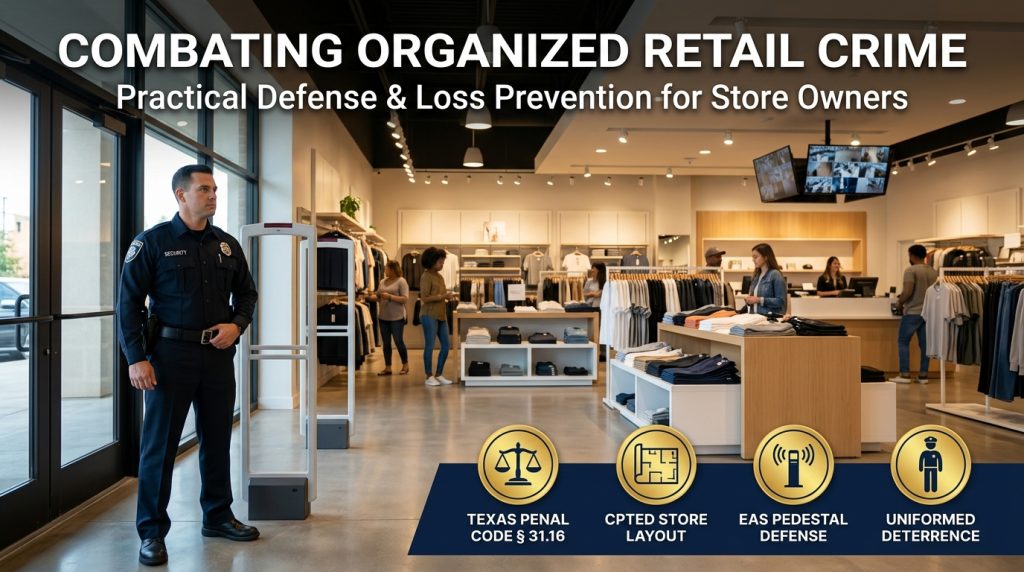
Professional ORC boosters target stores with minimal supervision where exit paths are unobstructed. A uniformed, licensed Texas security officer stationed at the entrance signals that the business actively monitors inventory and can communicate with local law enforcement instantly.
2. Differentiating Booster Behavior from Genuine Shoppers
Trained security officers identify the distinct behavioral markers of ORC syndicates: individuals avoiding eye contact with staff, carrying oversized structured bags, continuously monitoring store employees, coordinating with off-site lookouts via earpieces, or congregating in high-theft display areas.
3. Safe De-Escalation and Safe Hands-Off Deterrence
Untrained retail floor staff should never attempt physical contact with suspected ORC crews, as theft syndicates often carry knives, screwdrivers, or firearms. Professional security guards provide a trained physical presence, manage safe disengagement, gather license plate numbers from getaway vehicles, and secure evidence for felony prosecution under Texas Penal Code § 31.16.
For large shopping plazas weighing deployment methods across buildings and walkways, compare patrol options in our guide on foot patrol vs mobile vehicle patrol for large commercial lots.
Partner with God’s Armour Security for Retail Loss Prevention
Dismantling organized retail crime requires reliable on-site deterrence and disciplined security operations. God’s Armour Security provides Texas-licensed uniformed security guards, loss prevention officers, and mobile patrol sweeps tailored for retail centers, shopping malls, and specialty boutiques across Greater Houston, Harris County, and statewide Texas.
Our supervisory leadership collaborates directly with retail business owners and asset protection managers to assess store layout vulnerabilities, deploy front-door visual deterrence, and establish documented security operations that protect staff and inventory. Explore our commercial property and retail security services in Houston and our specialized retail mobile patrol security.
Ready to harden your retail business against organized theft rings? Request a retail security consultation and risk assessment or call our Houston operations desk directly at (713) 878-9984.
Frequently Asked Questions
What is organized retail crime (ORC)?
Organized retail crime refers to coordinated, professional theft operations where groups systematically steal retail merchandise with the intent to resell it through illicit channels, online marketplaces, or fencing operations. Unlike opportunistic shoplifters, ORC syndicates use specialized equipment, distraction tactics, and getaway vehicles.
What is Texas Penal Code 31.16?
Texas Penal Code § 31.16 makes organized retail theft a distinct criminal offense, separate from ordinary shoplifting. The value of merchandise stolen across multiple incidents within a 180-day period can be aggregated to raise the charge, and penalties scale by total value from a misdemeanor up to a first-degree felony. A 2025 update also targets crews who act together to overwhelm a store’s security response.
How do booster bags work, and how can retailers detect them?
Booster bags are shopping bags, backpacks, or coats lined with multiple layers of aluminum foil designed to create a Faraday cage that blocks electromagnetic signals from Electronic Article Surveillance (EAS) security tags. Retailers combat them using specialized metal-detecting EAS pedestals and trained security officers who monitor oversized bags.
Can retail employees physically detain shoplifters in Texas?
While Texas Civil Practice and Remedies Code § 124.001 provides a limited “shopkeeper’s privilege” allowing merchants to detain suspected shoplifters for a reasonable time to investigate ownership, many corporate retailers enforce strict “no-touch” policies for employee safety. Deploying licensed, insured security officers is the safest approach to manage retail theft.
Key Takeaways
- Organized retail crime involves disciplined, coordinated theft rings focused on bulk merchandise theft for commercial resale.
- Texas Penal Code § 31.16 lets prosecutors aggregate stolen value over a 180-day period, with penalties scaling by value from a misdemeanor up to a first-degree felony.
- Apply CPTED interior design: maintain shelving below 54 inches, clear front-entry sightlines, and establish physical checkout choke points.
- Combine EAS security tags, eye-level Public View Monitors, and acrylic locked keepers to increase operational friction for theft crews.
- Uniformed on-site security guards provide real-time deterrence, protect retail employees from confrontation, and preserve evidence for law enforcement.