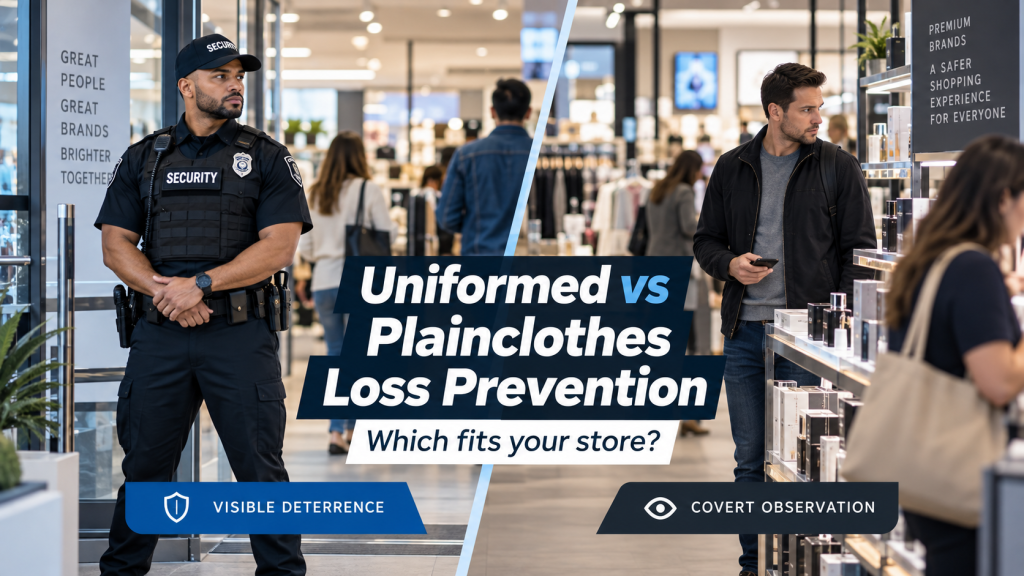
Every retailer trying to cut shrink runs into the same question: do you want the security people can see, or the security they cannot? A uniformed officer at the door and a plainclothes loss prevention agent on the floor solve the same problem from opposite directions, and the right answer is rarely one or the other. It depends on what is driving your loss, how your store is laid out, and what you are willing to trade.
This guide breaks down what each approach does well, where each one falls short, and how Houston stores combine them into a plan that fits the floor.
What a Uniformed Officer Actually Does
A uniformed security officer works by being seen. The uniform is the deterrent. A shopper deciding whether to conceal an item, or a crew sizing up a store to hit, both read the same signal: someone is watching, and there will be a response.
That visibility pays off in specific ways:
- ✓ Stops opportunistic theft before it starts, which is most casual shoplifting
- ✓ Reassures honest shoppers and staff, who feel safer with an officer present
- ✓ Handles the front of the store, where entry, exit, and confrontation happen
- ✓ Gives you a clear, documented presence if an incident ends up in a claim or a police report
The limit is in the word itself. A uniform tells everyone where the security is, which means it also tells an organized crew exactly who to avoid and which aisle is unwatched. A uniformed officer deters the casual thief and signals the professional one.
What Plainclothes Loss Prevention Does
A plainclothes loss prevention agent works by not being seen. They move through the store like a shopper, watch the high-theft departments, and catch concealment and organized activity in the act, after the thief has already decided the coast is clear.
Where it earns its place:
- ✓ Catches theft that a visible officer would only have scared into a different aisle
- ✓ Works the high-value departments, where professional and repeat theft concentrates
- ✓ Observes the behavior that leads to an apprehension, built the right way with documentation
- ✓ Reads organized retail crime that is deliberately staged away from the uniform
The trade-off is that plainclothes does nothing as a deterrent. It is a catch-and-document tool, not a prevent-it-from-happening tool, and apprehensions carry more procedure and more liability than simply turning a thief away at the door. Plainclothes needs trained people who know your policy and the law, because the risk sits in the stop, not the sighting.
The Honest Comparison
| Uniformed Officer | Plainclothes LP | |
|---|---|---|
| Main job | Deter before it happens | Catch while it happens |
| Visible to thieves | Yes, by design | No, by design |
| Best against | Casual and opportunistic theft | Professional, repeat, and organized theft |
| Shopper experience | Reassuring, feels safe | Invisible, no effect |
| Liability profile | Lower, mostly deterrence | Higher, tied to the apprehension |
| Weak spot | Organized crews route around it | Does nothing to prevent the first attempt |
Reading that table, the pattern is clear. The two approaches are not competitors. Each one covers the exact gap the other leaves open.
When to Lean Uniformed
A uniformed presence is usually the right primary choice when:
- Your main problem is everyday, opportunistic shoplifting rather than organized hits
- Shopper and staff safety is a concern and a visible presence reassures the floor
- You have a single main entrance and want the front controlled
- You want the strongest everyday deterrent for the lowest liability
Grocery, convenience, and most neighborhood retail fit here. The loss is spread and casual, and visibility does most of the work. If that is your store, start with the money page for retail security guard services in Houston and build from a uniformed post.
When to Add Plainclothes
Plainclothes earns its cost when:
- You have high-value departments where professional theft concentrates
- Your shrink is not casual, it is organized, and a uniform clearly moves it rather than stops it
- You are seeing the same loss patterns repeat despite a visible presence
- You need apprehensions and the documentation that supports them
This is the fastest-growing retail threat, and it does not look like ordinary shoplifting. If crews are the problem, read how store owners can combat organized retail crime alongside this, because the counter to organized theft is a layered plan, not a single officer.
The Answer Most Stores Land On: Both
In practice, the strongest retail plan uses a uniformed presence at the entrance and on the floor to deter, and plainclothes observation in the high-theft departments to catch what the uniform pushes out of sight. The uniform handles the front and the casual threat. The plainclothes agent handles the departments and the professional one. Together they close the gap that either one alone leaves open.
The right mix is set to the store, not to a template. A small boutique may need only a uniformed officer. A big-box floor with high-value electronics may need both, with plainclothes weighted toward the departments that bleed the most. The way to find the mix is to match coverage to where the shrink actually comes from, which starts with understanding your own loss.
- ✓ Uniformed presence to deter at the door and across the floor
- ✓ Plainclothes observation in the departments that lose the most
- ✓ The mix set to your shrink pattern and loss prevention policy
- ✓ Both coordinated so the store is covered, not just one point of it
For the broader picture of where loss comes from and how to cut it, see how to reduce retail shrinkage. For what your officers can and cannot legally do during a stop in Texas, see Texas shoplifting laws and security guard authority.
Frequently Asked Questions
Is plainclothes loss prevention legal in Texas? Yes. Plainclothes loss prevention is legal, but the apprehension is where the rules apply. An officer or agent must follow the shopkeeper’s privilege standard and your store policy, and documentation matters. See our guide on Texas shoplifting laws and what security guards can legally do.
Does a uniformed officer or plainclothes agent cut more shrink? It depends on the source of the shrink. A uniform cuts casual, opportunistic theft most effectively because it deters before anything happens. Plainclothes cuts professional and organized theft because it catches what a uniform only relocates. Most stores cut the most by using both.
Can one person do both roles? No. The roles are opposites. The moment an officer puts on a uniform, the deterrent is on and the covert catch is off. Stores that need both staff them as separate posts.
Which is more expensive? Plainclothes loss prevention is usually quoted by assignment and carries more training and more procedure, so it often costs more per hour than a standard uniformed post. The right question is not which is cheaper, but which matches your loss. We set that in a walkthrough.
How do I decide for my store? Start with your shrink pattern. Casual and spread points to uniformed. Concentrated, repeat, or organized points to adding plainclothes. If you are not sure, a walkthrough of your floor and a look at your loss will make the call clear. Talk to us about retail security in Houston.