For store owners, retail chain operators, and commercial boutique managers across Greater Houston and Texas, retail shrinkage is one of the most persistent drains on net profitability. Retail shrink—the unexplained loss of inventory between wholesale receipt and point of sale—erodes profit margins and forces businesses to raise prices just to maintain operational viability.
According to retail industry benchmarks, shrinkage averages between 1.4% and 1.6% of total retail sales, translating into billions of dollars in losses across the commercial sector annually. While external shoplifting often captures headlines, total inventory loss stems from a broader spectrum of operational vulnerabilities: internal employee theft, administrative accounting mistakes, cashier sweethearting, and vendor receiving fraud.
Relying solely on post-incident inventory write-offs guarantees continuous profit leakage. Learning how to reduce retail shrinkage requires an integrated physical and administrative loss prevention framework. This practical operational guide details actionable best practices to audit inventory channels, harden retail floors, and deploy professional deterrents that protect your bottom line.
Phase 1: Breaking Down the Four Causes of Retail Shrinkage
To stop inventory loss, store operators must pinpoint exactly where product leaves the store without generating revenue:
| Shrink Category | Share of Overall Shrink | Common Modus Operandi | Primary Defense Strategy |
|---|---|---|---|
| External Shoplifting & ORC | ~36% to 38% | Concealment in bags, grab-and-run push-outs, and coordinated organized retail crime sweeps. | Uniformed entry security officers, EAS pedestals, and low-profile fixture sightlines. |
| Internal Employee Theft | ~28% to 30% | Cash drawer skim, fake returns, sweetheart discounts for acquaintances, and backroom staging. | Dual-authorization return rules, POS exception analytics, and clear employee bag checks. |
| Administrative & Paperwork Errors | ~25% to 27% | Misplaced stock intake, inaccurate SKU barcode scanning, unrecorded markdowns, and inventory sync lags. | Automated RFID cycle counts, regular inventory reconciliation, and intake standardization. |
| Vendor & Supplier Fraud | ~5% to 7% | Short-shipping invoices, staging stock theft during direct store delivery (DSD), and inaccurate bulk counts. | Strict loading dock escort protocols, blind piece-count check-ins, and locked rear service gates. |
For retail stores facing aggressive, organized theft crews targeting high-value inventory, review our companion playbook on how store owners can combat organized retail crime.
Phase 2: Architectural & Merchandising Hardening (Retail CPTED)
Store layouts can inadvertently encourage theft or naturally discourage it. Applying Crime Prevention Through Environmental Design (CPTED) principles makes illicit behavior conspicuous:
1. Enforce 54-Inch Fixture Height Limits
Tall gondolas and high product displays create blind canyons that shield shoplifters from cashier view. By capping center sales-floor shelving at 54 inches (eye level), retail employees and security officers maintain uninterrupted sightlines from cash registers across the entire selling footprint.
2. Eliminate Blind Recesses and Fitting Room Concealment
Fitting rooms represent the primary zone where merchandise tags are removed and concealed into personal bags. Keep fitting room entries restricted with numerical access control or staffed checkpoints. Issue customer garment count tags upon entry and inspect returns upon exit.
3. Anchor Cash Registers with Line-of-Sight Coverage
Position cash wraps with a commanding view of both store entrances and high-shrink aisles. Avoid positioning marketing banners, promotional displays, or seasonal towers that block cashier views of the main entrance vestibule.
When customer and inventory safety extends outside the glass doors, verify parking safety protocols in our guide on parking lot crime liability for property owners.
Phase 3: Inventory Controls and Point-of-Sale (POS) Auditing
Internal shrinkage often eclipses external theft in high-volume retail environments. Hardening back-office and checkout processes stops employee theft before it escalates:
1. POS Exception Reporting
Audit cashier anomalies: high void volumes, frequent manual price overrides, repeated post-sale refunds, and “no-sale” drawer openings that indicate sweethearting or cash drawer theft.
2. Dual-Custody Receiving
Never permit a single employee to sign for bulk supplier shipments alone. Implement mandatory two-person blind counts at the loading dock before invoices are confirmed into the ERP inventory system.
3. High-Frequency Cycle Counting
Replace annual stocktakes with continuous weekly cycle counts of the top 20% highest-theft items (designer denim, small electronics, cosmetics, tools) to detect discrepancies within 7 days rather than 12 months.
4. Backroom Access & Trash Compactor Rules
Internal thieves frequently hide stolen merchandise in dumpsters or trash compactors for later retrieval. Keep emergency exit doors alarmed and mandate manager supervision during evening trash disposal runs.
For strip mall retailers sharing common service corridors and parking bays, review operational defense strategies in our report on how to stop car break-ins in commercial parking lots.
Phase 4: Electronic Asset Protection: Hardware vs Human Guard Presence
Electronic security tools create friction, but human security presence delivers decisive loss reduction:
1. Electronic Article Surveillance (EAS) Pedestals
EAS detection pedestals at customer exits detect active RF or AM tags attached to merchandise. However, experienced shoplifters and booster crews frequently use foil-lined booster bags or stolen detachers to defeat EAS alarms. While essential, EAS functions primarily as an alert trigger, not an interdiction force.
2. Eye-Level Public View Monitors (PVMs)
Mounting eye-level screens at store entrances and high-theft retail bays forces shoppers to observe themselves on camera upon arrival. This removes the perceived anonymity that shoplifters rely upon when planning opportunistic theft.
3. The Visible Uniformed Security Guard Advantage
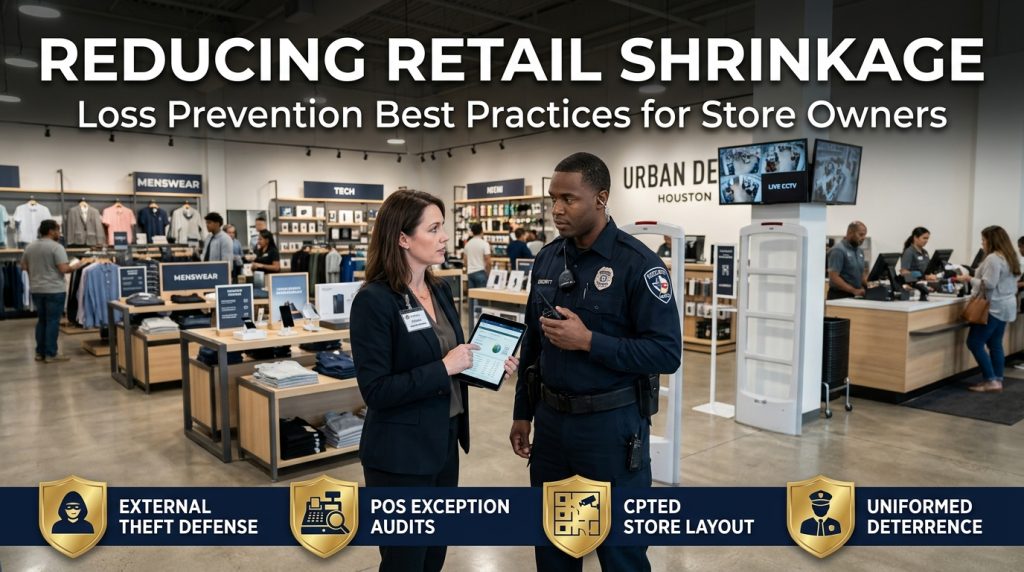
The single most powerful deterrent against both external shoplifters and internal stock room leakage is a licensed, uniformed security officer stationed at the entrance. Unlike passive cameras that record losses after the fact, an officer greets incoming patrons, identifies suspicious staged behavior, monitors customer bags, and stops push-out thefts at the threshold.
For larger commercial properties weighing security deployment options, examine our operational breakdown of foot patrol vs mobile vehicle patrol for large commercial lots.
Phase 5: Building a Consistent Loss Prevention Culture
A comprehensive shrinkage reduction plan requires clear employee guidelines and continuous enforcement:
- Customer Engagement as a Deterrent: Train floor associates to make eye contact and greet every shopper within 10 seconds of entry. Shoplifters seek neglected aisles; attentive customer service instantly removes their window of opportunity.
- Safe Disengagement Protocols: Instruct retail staff never to chase suspects out of the store or engage in physical confrontations in the parking lot. Chasing suspects creates extreme premises liability and employee injury risks.
- Mandatory Incident Logging: Document every recovered item, abandoned booster bag, and suspicious encounter in a standardized digital incident log with exact timestamps. Accurate logs provide law enforcement with the evidence needed for prosecution under Texas theft statutes.
- Clear Employee Bag Check Policies: Establish consistent, transparent bag inspection policies for all employees and contractors exiting the premises at the end of every shift.
Partner with God’s Armour Security for Retail Loss Prevention
Slashing retail shrinkage requires proactive, documented physical deterrence. God’s Armour Security provides Texas-licensed uniformed security officers, dedicated loss prevention personnel, and marked mobile patrols for retail shopping centers, department stores, and strip mall outlets across Greater Houston, Harris County, and statewide Texas.
Our security personnel are trained in customer-focused visual deterrence, conflict de-escalation, entry access management, and loading dock security. We help commercial store owners safeguard inventory, protect floor staff, and stop profit leakage. Explore our specialized commercial retail security services in Houston and our dedicated retail security patrol services.
Ready to audit your store’s vulnerabilities and reduce retail shrinkage? Request a commercial retail security consultation and loss prevention assessment or call our Houston command team directly at (713) 878-9984.
Frequently Asked Questions
What is retail shrinkage, and what is considered an acceptable rate?
Retail shrinkage is the difference between recorded inventory on balance sheets and the actual physical stock available, caused by external shoplifting, employee theft, paperwork errors, and vendor fraud. While the average retail industry shrinkage rate hovers around 1.4% to 1.6% of sales, top-performing loss prevention programs aim to keep shrink below 1.0%.
How can store owners prevent internal employee theft?
Preventing internal retail theft requires strict inventory controls: point-of-sale (POS) exception reporting for refunds and voids, dual-custody receiving counts at delivery docks, locked backroom exits, mandatory management oversight during evening trash disposal, and randomized employee bag inspections.
What are the most effective in-store design changes to reduce shoplifting?
The most effective CPTED design adjustments include maintaining central display shelves below 54 inches for clear sightlines, positioning cash wraps with direct visibility over entrances and high-theft displays, securing fitting rooms with attendant sign-ins, and installing Public View Monitors (PVMs) in high-value merchandise aisles.
Do security guards actually reduce retail shrinkage?
Yes. Data consistently shows that visible, uniformed security guards provide the highest visual deterrence against external shoplifters and organized retail crime (ORC) rings. On-site guards stop push-out theft attempts at the door, deter internal stock leakage, and allow floor associates to focus on sales without fear of confrontation.
Key Takeaways
- Retail shrinkage stems from four distinct drivers: external shoplifting, employee theft, administrative errors, and vendor receiving fraud.
- Lower sales-floor fixtures to 54 inches to eliminate blind spots and ensure uninterrupted sightlines from checkout registers.
- Deploy POS exception analytics and dual-custody receiving procedures to detect employee theft, sweethearting, and loading dock shortages.
- Combine electronic article surveillance (EAS) and eye-level Public View Monitors with visible, uniformed security guards at main entrances.
- Enforce strict customer greeting standards and employee bag checks to build a continuous, daily loss prevention culture.