Almost every property owner researching parking lot security starts in the same place: cameras. They are cheaper on paper, they run all night, and they feel like a complete answer. So the real question is rarely “cameras or nothing.” It is “cameras alone, a security officer, or both?”
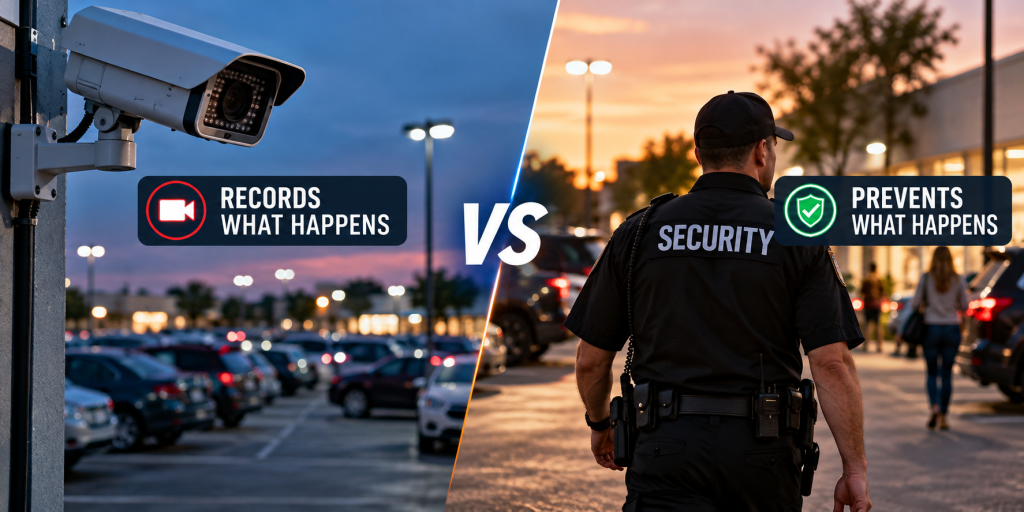
The honest answer depends on one distinction that most camera sales pages skip right past. A camera records what happens. An officer changes what happens. Once you see your lot through that difference, the decision gets a lot clearer.
This guide breaks down exactly what each one does, where each one fails, what they actually cost, and how Houston properties combine them into a plan that holds up.
What a Security Camera Actually Does (and Where It Stops)
A camera is a recording and visibility tool. A good system watches a wide area, flags motion, and gives you footage after the fact. That is genuinely useful, and no serious security plan throws cameras out.
What it does well:
- ✓ Records an incident for police, insurance, and your own review
- ✓ Covers a large area at once, cheaper than staffing every corner
- ✓ Supports a claim or a prosecution with evidence
- ✓ Lets one person monitor several zones from a screen
Here is the part the product pages gloss over. A camera is passive. It does not walk a tenant to her car, it does not move a loiterer along, and it does not step in when two people start arguing in row C. By the time anyone reviews the footage, the car is already gone and the catalytic converter is already cut out. A camera tells you what you lost. It does not stop you from losing it.
And footage only helps if someone is watching it live and can send a response, and if the plate is readable, the face is not covered, and the angle caught the act. In an open lot at night, that is a lot of ifs.
What a Security Officer Actually Does
A security officer is an active deterrent and a real-time response. The value is not in watching. It is in the fact that a thief can see a person who will notice them, approach them, and call it in right now.
What an officer does that a camera cannot:
- ✓ Deters the crime before it happens, because a visible presence changes the math for a thief
- ✓ Responds in the moment, on foot or by vehicle, instead of after the fact
- ✓ Escorts employees, shoppers, and residents to their cars after dark
- ✓ Moves loiterers and trespassers along before a theft starts
- ✓ Handles a dispute, a medical event, or a confrontation calmly on the spot
- ✓ Notices the developing problem, the circling car or the person testing door handles, that a fixed camera never flags
The trade-off is cost. An officer covers the hours you staff, not every hour by default, and a single officer cannot be everywhere in a large garage at once. That is exactly why the smartest plans do not treat this as either-or.
The Core Difference: Record vs Prevent
| Security Cameras | Security Officers | |
|---|---|---|
| Primary job | Record and document | Deter and respond |
| When it acts | After the incident | During, and before |
| Deters a thief | Weakly, easy to defeat | Strongly, a person is watching |
| Escorts people to cars | No | Yes |
| Handles a live confrontation | No | Yes |
| Evidence after the fact | Strong | Strong (officer plus report) |
| Covers every hour | Yes, passively | Only staffed hours |
| Cost | Lower ongoing | Higher, by the hour |
Read down that table and the pattern is obvious. Cameras are strongest where officers are weakest (every hour, wide coverage, cheap documentation), and officers are strongest where cameras are useless (deterrence, response, and the human problems a lot actually produces).
Do Parking Lot Cameras Actually Deter Crime?
Partly, and less than owners hope. A visible camera gives a casual, first-time offender a reason to pause. But a determined thief, and certainly an organized crew, knows the truth: a camera is not going to leave its mounting and stop them. They wear a hood, angle away from the lens, work fast, and accept that they might be on film, because being on film has never once pulled a catalytic converter back out from under a truck.
A security officer deters differently. The deterrent is not a recording that might be reviewed later. It is a person, right there, who will see them and act now. That is a risk a thief cannot plan around, and it is why a patrolled lot is a far less inviting target than a merely watched one.
What Guards and Cameras Cost in Houston
Cost is usually what pushes owners toward cameras, so here are the real Houston ranges to compare honestly.
| Option | Typical Houston cost | What you get |
|---|---|---|
| Cameras (system) | One-time install plus monitoring fees | Coverage and footage, no response |
| Mobile patrol | From about $40 per visit | Scheduled or random officer checks |
| Dedicated on-site officer | About $25 to $38 per hour | Continuous presence and response |
A camera system looks cheaper because the big cost is upfront and the ongoing fee is small. But that price buys you a record, not a response. Mobile patrol is the move for owners who want a real deterrent without the cost of a full-time post: an officer shows up on scheduled and random rounds, which is often enough to break the pattern that thieves rely on. A dedicated officer is for lots with steady exposure, heavy foot traffic at night, or an incident history.
The question is not which is cheaper. It is which actually prevents the loss you are paying to avoid. For most lots, the cheapest real security is cameras plus some level of officer presence, not cameras alone.
When Cameras Alone Are Enough
Cameras by themselves can be a reasonable plan when:
- The lot is low-risk, low-traffic, and has no incident history
- You mainly need documentation for insurance or disputes, not prevention
- The property is small and well-lit with clear sightlines
- Budget genuinely does not allow any officer coverage yet
If that is you, invest in good cameras and good lighting, and revisit the moment incidents start.
When You Need an Officer
Add officer coverage, at minimum mobile patrol, when:
- You are seeing repeat break-ins, catalytic converter theft, or vandalism
- The lot runs late and people cross it after dark
- It is a multi-level garage, where blind spots and stairwells defeat fixed cameras
- You have had a confrontation, an assault, or a safety complaint
- A negligent security claim is a real exposure if something happens
Houston makes several of these the norm rather than the exception. Catalytic converter theft takes only a couple of minutes under a vehicle, which is exactly the window a roving officer disrupts and a camera only films. See how we prevent catalytic converter theft in commercial lots and how to stop car break-ins in commercial parking lots for the detail.
The Answer Most Lots Land On: Both, Layered
The strongest parking lot security is not guards instead of cameras, or cameras instead of guards. It is both, with each doing the job it is good at. Cameras give you wide coverage and a record. Officers give you deterrence, response, and the human judgment a camera will never have. Together, an incident is both stopped and documented, instead of only documented.
In practice that means an officer on the ground, on foot, by vehicle, or by bike, coordinated with your camera system and lighting so the whole lot is covered. The officer deters and responds in real time, and the cameras back them up with evidence and extra eyes on the zones a patrol is not standing in at that second.
- ✓ Cameras for coverage, documentation, and evidence
- ✓ Officers for deterrence, response, and escorts
- ✓ The two coordinated, not duplicated
- ✓ Coverage model matched to the lot and its real risk
How you weight the mix depends on the property. A small surface lot may need cameras plus mobile patrol. A multi-level garage needs an officer working it level by level, because that is where fixed cameras fail hardest. See why a parking garage is the hardest part of a lot to watch and foot patrol vs mobile patrol for commercial lots to size the officer side.
There is also a liability reason to put a person in the lot. When something happens, a property with cameras and no presence can still face a negligent security claim, because footage of the incident is not the same as reasonable steps to prevent it. A documented, patrolled lot is a far stronger position. We cover that in parking lot crime liability for property owners.
Frequently Asked Questions
Do I still need security guards if I already have cameras? Often yes. Cameras record an incident, but they do not stop it, walk a tenant to her car, or move a loiterer along. A patrolling officer is a visible deterrent that acts in the moment. The strongest lots layer both: officers on the ground, with cameras and lighting for coverage and evidence.
Do parking lot cameras actually stop crime? They deter casual, first-time offenders and they document everything, but they do not physically stop a determined thief. A camera films the catalytic converter theft. An officer on patrol prevents it. For real prevention, cameras need to be paired with presence.
Which is cheaper, cameras or guards? Cameras have a lower ongoing cost because the spend is mostly upfront, but that buys documentation, not prevention. Officer coverage costs more per hour, and mobile patrol from about $40 per visit is the middle option that adds real deterrence without a full-time post. The cheapest effective plan for most lots is cameras plus some officer presence.
What is the minimum officer coverage for a parking lot? For many lots, scheduled and random mobile patrol is the practical minimum. An officer arrives on rounds, checks the perimeter, gates, and problem rows, and reports after each visit. It breaks the predictability thieves count on, for far less than a full-time post.
Can God’s Armour work alongside my existing cameras? Yes. We patrol the lot and coordinate with your camera system and lighting so an incident is both stopped and documented, rather than duplicating coverage. Tell us about your lot and we will build the right mix.