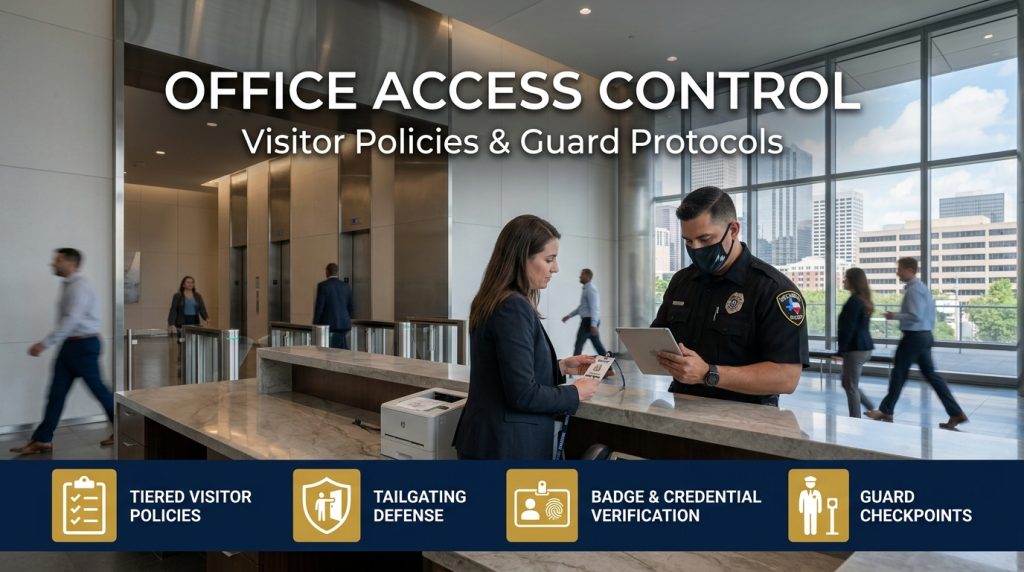
Access control is the first thing that decides who gets into an office building and who does not, and it is where most security either holds or fails. For property managers, building owners, and facility directors across Greater Houston, the goal is straightforward: let the right people in quickly and keep the wrong people out, without turning the lobby into a bottleneck.
Good access control has two halves that have to work together. One is the technology: badges, card readers, turnstiles, and locked doors. The other is the human layer: a trained officer at the point of entry and a clear visitor policy that everyone follows. A building with great hardware and no protocol is as exposed as one with a guard and no system. This guide covers both halves and how to run them as one.
Phase 1: The Layers of Office Building Access Control
Access control is not a single door. It is a series of layers, and a gap in any one of them undoes the rest. Knowing the layers shows you where to focus.
| Layer | What It Controls | Common Gap |
|---|---|---|
| Perimeter and entrances | Who can approach and reach the building’s doors. | Side and loading doors left unlocked or propped open for convenience. |
| Lobby and reception | The single monitored point where visitors are screened. | No one stationed to check visitors during busy or off-peak hours. |
| Credential and badge control | Which people and cards can open which doors. | Shared badges and cards that are never deactivated when someone leaves. |
| Internal zones | Access to floors, server rooms, and restricted areas. | Everyone holding all-floor access rather than only what their role needs. |
| After-hours access | Who can enter when the building is closed. | No log or coverage of who comes and goes overnight. |
After-hours entry is its own risk and deserves a dedicated plan: a clear log of who enters when the building is closed, and either coverage or patrol checks during those hours so an empty building is never left open.
Phase 2: Building a Visitor Management Policy
Most unauthorized entry into an office building comes through the front door during business hours, not through a forced break-in. A written visitor policy, applied consistently, is what closes that gap. A workable policy covers four things:
1. Pre-Registration
Where possible, have tenants register expected visitors in advance. A known guest list lets the front desk verify quickly and flags anyone who is not expected.
2. ID Check and Badging
Verify a photo ID, log the visit, and issue a temporary, visibly dated badge. A visitor who cannot be identified does not get past reception.
3. Escort and Access Limits
Decide which visitors are escorted and which areas they may enter. Contractors and vendors in sensitive zones should be accompanied, not left to roam.
4. Sign-Out and Badge Return
Close the loop: visitors sign out and return badges, so you always know who is still in the building, which matters most during an evacuation.
A visitor policy is also a first line of threat screening. When someone arrives agitated, or has been barred from the property, the front desk is the point where that is caught and handled before it ever reaches the workspace.
Phase 3: Guard Protocols at the Point of Entry
Technology checks a credential. An officer checks the person. The value of a trained guard at the entry point is judgment that a card reader cannot provide.
1. Verify, Do Not Assume
An officer confirms that the person matches the credential and belongs where they are headed, rather than waving through anyone in business attire. Confident behavior is not authorization, and a good officer checks anyway.
2. Stop Tailgating
The most common way people bypass access control is tailgating: slipping through a secured door behind an authorized person. An officer at the entry point watches for it and stops it, which no badge system can do on its own.
3. Manage Deliveries and Contractors
Couriers, tradespeople, and vendors are a frequent blind spot. Officers verify them against expected deliveries or work orders, log them, and route them to the right contact instead of granting open access.
4. Deny Entry and Escalate Calmly
When someone should not be admitted, the officer has to hold that line without escalating it into a confrontation, and know the legal limits on refusing entry or removing someone who will not leave. That calm, firm handling is a trained skill, covered in our guides on de-escalation techniques for security officers and what security guards are legally allowed to do in Texas.
Phase 4: Where Office Access Control Breaks Down
Access control rarely fails because of a sophisticated attack. It fails through everyday shortcuts. These are the gaps that show up again and again:
- Propped and unlocked doors. A side or loading door wedged open for convenience quietly defeats the entire system.
- Tailgating. One authorized badge holds the door for several unverified people behind them.
- Stale credentials. Badges for former employees and vendors that were never deactivated remain live keys.
- Unstaffed reception. Gaps when no one is at the desk let visitors walk straight in unscreened.
- No visitor record. Without a log, no one can say who is in the building when it matters.
Phase 5: Running Technology and Officers as One System
The strongest access control pairs reliable hardware with a trained officer, because each covers the other’s weakness. Card readers, turnstiles, and locked doors enforce the rules at scale and never get tired. Officers supply the judgment, catch the tailgater, question the out-of-place visitor, and respond when something is wrong.
Run together, they also produce a record: who entered, when, and on whose authority. That log supports investigations, and it demonstrates reasonable care if a security incident is ever questioned. Officers should also know the building’s emergency and lockdown procedures, so access control can shift instantly from routine screening to securing the building in a crisis. For buildings weighing how to staff that coverage, our guide on the questions to ask before hiring a commercial security guard company helps you choose a provider that runs this well.
Secure Your Building’s Entry with God’s Armour Security
Access control only works when the people running it are trained to. God’s Armour Security provides Texas-licensed officers for lobby posts, visitor screening, and access control at office buildings, corporate campuses, and mixed-use properties across Greater Houston, Harris County, and statewide Texas, working alongside your existing badge and camera systems.
Our supervisory team reviews your entrances, visitor flow, and after-hours exposure, then sets clear post orders and visitor protocols so your front desk is a real checkpoint, not a formality. Explore our commercial security services in Houston and our commercial security patrol services.
Ready to tighten who gets into your building? Request a commercial access control consultation and building assessment or call our Houston operations desk directly at (713) 878-9984.
Frequently Asked Questions
What is office building access control?
Office building access control is the combined system of technology and procedures that governs who can enter a building and its internal areas. It spans perimeter doors, lobby screening, badges and card readers, restricted internal zones, and after-hours entry, supported by a visitor policy and, at staffed buildings, an officer at the point of entry.
What should a visitor management policy include?
A workable policy covers pre-registration of expected guests, photo ID verification with a dated temporary badge, clear rules on which visitors are escorted and where they may go, and a sign-out step with badge return so the building always knows who is still inside.
Why do office buildings still need guards if they have badge systems?
A badge system verifies a credential, not the person carrying it, and it cannot stop tailgating, question an out-of-place visitor, or respond to a problem. A trained officer at the entry point supplies the judgment and response that hardware cannot, and the two work best together.
What is tailgating in access control?
Tailgating is when an unauthorized person slips through a secured door behind someone who used a valid credential. It is one of the most common ways access control is defeated, and a staffed entry point is the most effective way to prevent it.
Key Takeaways
- Office access control is a series of layers, perimeter, lobby, credentials, internal zones, and after-hours, and a gap in any one undoes the rest.
- Most unauthorized entry happens through the front door during business hours, so a consistent visitor management policy is essential.
- A visitor policy should cover pre-registration, ID and badging, escort limits, and sign-out with badge return.
- A trained officer adds what hardware cannot: verifying the person, stopping tailgating, managing deliveries, and denying entry calmly.
- Technology and officers run best as one system, enforcing the rules at scale while producing a record that supports investigations and shows reasonable care.