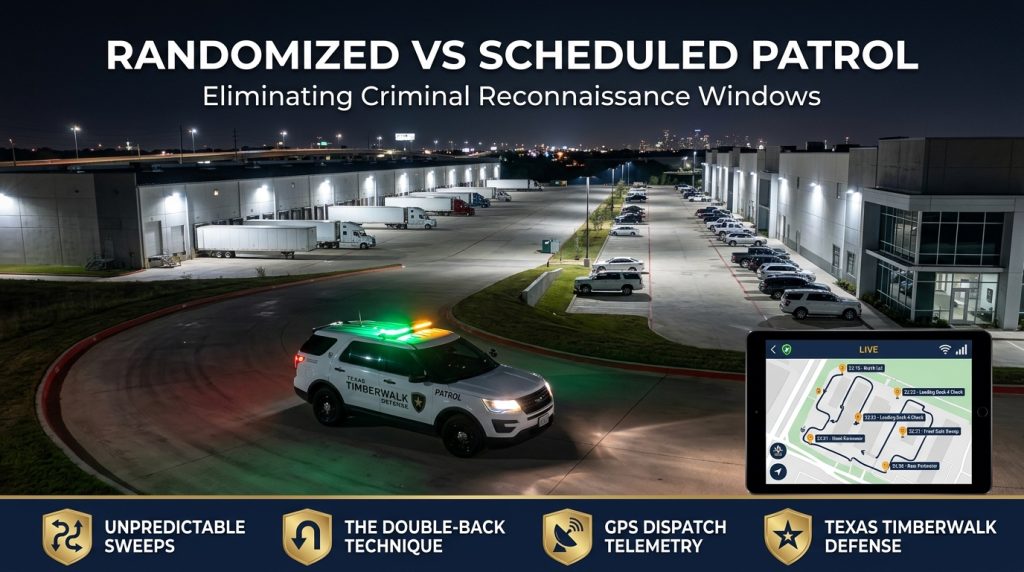
When commercial property owners and facility managers invest in mobile security patrols or on-site guard forces across Greater Houston, they expect physical deterrence. Yet, many commercial sites discover that despite paying for regular nightly security visits, property crimes such as copper theft from commercial HVAC units, catalytic converter stripping, and targeted burglaries continue to occur. The underlying issue is rarely guard absenteeism; it is patrol predictability.
Criminals do not strike blindly. Professional thieves, commercial trespassers, and organized burglary crews routinely conduct surveillance (casing) on targeted commercial facilities. If a security patrol cruiser arrives at a retail center or industrial yard like clockwork at 10:15 PM and 2:15 AM every night, offenders do not view the security patrol as a deterrent. Instead, they treat the patrol as a reliable timer, executing their crimes within the predictable 3-to-4-hour operational window between visits.
Deciding between randomized vs scheduled patrol rounds is a pivotal tactical choice in commercial asset protection. While fixed schedules serve administrative tasks such as opening gates and tenant lockouts, randomized patrol sweeps dismantle offender reconnaissance and deliver superior crime deterrence. This guide explores the behavioral psychology of commercial offenders, algorithmic patrol dispatching, GPS telemetry verification, and Texas premises liability standards.
Phase 1: The Criminology of Commercial Reconnaissance
To understand why scheduled patrols frequently fail to stop commercial property crime, facility directors must analyze the behavioral mechanics of criminal reconnaissance:
1. Routine Activity Theory and the Target Window
In modern criminology, Routine Activity Theory establishes that a predatory crime requires three converging elements: a motivated offender, a suitable target, and the absence of a capable guardian. When a security patrol follows a rigid, scheduled timetable, the “capable guardian” element exists only during brief, predictable moments. As soon as the patrol cruiser departs down the access road, the capable guardian vanishes, creating an open target window.
2. The Danger of “Clockwork” Guard Routes
Offenders targeting commercial assets such as distribution logistics yards, commercial retail plazas, or corporate campuses—observe security habits before committing a break-in. They time guard gate visits, track how long a cruiser spends behind rear delivery alleys, and note departure directions. If an officer always arrives from the north driveway, drives clockwise around the building, and exits south within 12 minutes, the offender knows exactly where the officer’s blind spots are at every second of the sweep.
3. Psychological Uncertainty as an Active Shield
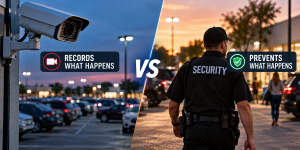
Randomized patrol sweeps leverage operational unpredictability. When patrol arrival intervals, approach directions, and internal walking sequences vary constantly, opportunistic and organized offenders cannot establish a safe execution window. The psychological risk shifts entirely to the perpetrator: Will the marked security cruiser return in three hours, or will it round the corner in four minutes? That uncertainty drives criminals toward softer, predictable commercial targets.
For a detailed breakdown of how mobile vehicle sweeps compare directly to stationary guard deployments, review our guide on mobile patrol vs dedicated stationed guards.
Phase 2: Tactical Comparison: Randomized vs. Scheduled Rounds
While randomized patrols offer superior criminal deterrence, scheduled patrols maintain specific operational utilities. The matrix below outlines how both methods compare across commercial environments:
| Operational Dimension | Scheduled Patrol Rounds | Randomized Patrol Sweeps |
|---|---|---|
| Arrival Cadence | Fixed, predictable time slots (e.g., exactly at 11:00 PM, 2:00 AM, and 5:00 AM). | Variable time intervals generated by dispatch algorithms within defined shift windows. |
| Deterrence Durability | Low durability; deterrence collapses the minute the officer leaves the property. | High durability; leaves offenders in perpetual uncertainty regarding guard return times. |
| Internal Sweep Trajectory | Linear, repetitive routes (e.g., perimeter loop ➔ front entry ➔ rear dock). | Dynamic routes utilizing reverse loops, figure-eight vehicular sweeps, and staggered foot stops. |
| Primary Operational Utility | Time-sensitive tasks: locking access gates at 9:00 PM, arming facilities, meeting couriers. | Active crime interdiction, trespasser disruption, asset protection, copper theft deterrence. |
| Vulnerability to Casing | Extremely high; criminal lookouts can map the patrol schedule within 48 to 72 hours. | Virtually immune to timing surveillance; frustrates criminal reconnaissance plans. |
When budgeting for shared vs dedicated mobile patrols across commercial shopping centers, examine per-sweep pricing structures in our resource on how much mobile security patrol costs in Houston.
Phase 3: Operational Execution: Algorithmic Dispatch & Route Variation
True randomization requires structured operational discipline. If left to human intuition, patrol drivers naturally default to habitual routines taking the same freeway exits, driving identical loops, and stopping at the same coffee shops at identical times. Professional security providers use technology to enforce true randomness:
1. Dynamic Time-Window Dispatching
Instead of assigning an officer to visit a property at 1:00 AM, central dispatch software assigns a flexible window (e.g., 3 visits between 9:00 PM and 5:00 AM). Dispatch algorithms scramble the sequence nightly so no two nights look alike.
2. The “Double-Back” Tactical Maneuver
A highly effective patrol technique where an officer clears a commercial site, drives away into the street network, and abruptly returns 8 to 15 minutes later. This catches opportunistic offenders who emerged from hiding as soon as the cruiser departed.
3. Alternating Entry Points & Vectors
Officers vary their physical approach. If an officer entered via the main commercial boulevard on sweep one, they enter via the secondary rear service road on sweep two, turning auxiliary roof strobes on or off dynamically to surprise trespassers.
4. Randomized NFC Wand Checkpoints
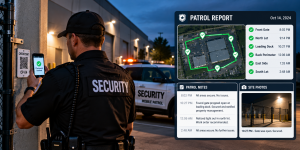
On-site handheld tour software prompts officers to scan physical Near Field Communication (NFC) RFID tags in randomized sequences, preventing walking guards from falling into mechanical, repetitive footpaths.
For industrial properties combining vehicular surveillance with exterior physical barriers, examine night perimeter defense standards in commercial property security after-hours: preventing vandalism and trespassing.
Phase 4: Texas Premises Liability: The Legal Value of Randomized Patrols
Beyond stopping petty theft, patrol scheduling plays an important evidentiary role in defending property owners against civil litigation under Texas premises liability law:
1. Overcoming the “Foreseeability” Hurdle under the Timberwalk Doctrine
Under landmark Texas Supreme Court precedent (Timberwalk Apartments, Partners, Inc. v. Cain), commercial property owners owe a duty of ordinary care to protect tenants and invitees from third-party criminal violence if that conduct was reasonably foreseeable. When a crime occurs on site, plaintiff attorneys routinely argue that the landlord’s security measures were merely “cosmetic” and negligent because the patrol was predictable and easily circumvented by criminals.
2. Establishing Defensible Ordinary Care
Demonstrating that a property employed randomized, GPS-verified security patrols provides robust legal defense evidence. It proves that ownership did not merely contract a passive drive-by, but deployed an active, tactically sound deterrent specifically engineered to disrupt criminal planning. Time-stamped GPS telematics and randomized NFC checkpoint logs show that security was present at unpredictable hours, fulfilling the standard of reasonable care under Texas tort law.
3. Enforcing Texas Penal Code § 30.05 Warnings
When randomized patrols interdict trespassers, officers can issue lawful verbal or written warnings under Texas Penal Code § 30.05 (Criminal Trespass). Because visits are unpredictable, loiterers cannot establish permanent unauthorized encampments in loading bays or stairwells; review statutory boundaries in our guide on Texas shoplifting laws and security guard authority.
When drafting commercial leases, defining who funds and supervises common area patrol schedules prevents tenant disputes; review lease mechanics in commercial lease security responsibilities: tenant and landlord roles.
Phase 5: The Hybrid Scheduling Framework: Balancing Tasks with Deterrence
While randomized patrols are superior for crime deterrence, commercial facilities still require certain tasks to occur at exact times. The industry standard solution is the Hybrid Scheduling Framework:
- Fixed Anchor Milestones (Scheduled): Assign fixed times only for operational necessities: locking vehicle gates at 9:00 PM, escorting retail staff during store closing at 10:00 PM, or disarming mechanical perimeter barriers for morning cleaning crews at 5:30 AM.
- Randomized Deterrence Sweeps (Unscheduled): Fill all remaining operational hours with randomized sweeps. Between 10:30 PM and 5:00 AM, marked cruisers execute unpredictable visits, varying the dwell time from 10 minutes to 35 minutes per inspection.
- Immediate Follow-Up Checks: Train patrol officers to execute occasional “double-back” inspections after high-risk operational milestones, catching criminals who monitor closing staff departures; review de-escalation protocols for unexpected contacts in de-escalation techniques for retail security officers.
To ensure contract security vendors possess the dispatch technology and vehicle fleets required to execute true randomization, utilize our vetting checklist in 10 questions to ask before hiring a commercial security guard company.
Deploy Unpredictable Deterrence with God’s Armour Security
Predictable security is an open invitation to commercial crime. God’s Armour Security delivers high-impact, tactically randomized mobile vehicle patrols, dedicated security officers, and rapid alarm response services for commercial properties across Greater Houston, Harris County, and statewide Texas.
We are licensed by the Texas Department of Public Safety as a security contractor and guard company (license no. B07347101). Our operations center utilizes algorithmic dispatch scheduling, GPS geofencing, body-worn cameras, and digital NFC checkpoint systems to ensure your property receives unpredictable, verified patrol coverage that stops crime before it happens. Explore our specialized commercial security patrol services and our dedicated commercial property security services in Houston.
Ready to eliminate security blind spots and upgrade to randomized patrol protection? Request a commercial property security assessment and randomized patrol consultation or call our Houston command center directly at (713) 878-9984.
Frequently Asked Questions
Why do randomized patrol rounds deter more crime than scheduled rounds?
Randomized patrols eliminate predictability. Criminals casing a commercial site cannot establish a safe execution window when security visits occur at varying, unpredictable times. The constant psychological risk that a marked security vehicle might return at any moment discourages offenders from attempting break-ins or vandalism.
When should a commercial property use scheduled patrol rounds instead?
Scheduled patrol rounds are necessary for time-critical operational tasks, such as locking exterior gates at a specific closing time, escorting employees during late-night cash drops, arming facility alarms, or unlocking loading dock gates for morning deliveries.
How do security companies ensure randomized patrols are actually performed?
Reputable security contractors utilize automated GPS geofencing and Near Field Communication (NFC) RFID checkpoint tags. When a patrol cruiser enters the property, GPS logs record the exact arrival time, vehicular route, speed, and dwell duration. Handheld mobile scanners verify that officers physically inspect designated doors and perimeter assets.
What is the double-back patrol technique?
The double-back is an unpredictable patrol maneuver where an officer clears a property, exits onto the roadway, and returns unexpectedly 5 to 15 minutes later. This catches trespassers or burglars who were hiding nearby and waited for the security vehicle to leave before emerging.
Key Takeaways
- Scheduled security patrols create predictable target windows that criminals observe and exploit during reconnaissance.
- Randomized patrols create psychological uncertainty, denying offenders a reliable time window to commit property crimes.
- Deploy a Hybrid Model: schedule time-critical lock-ups and staff escorts, while randomizing all intermediate overnight sweeps.
- Utilize tactical maneuvers like the “double-back” and reverse perimeter loops to catch offenders emerging from concealment.
- Enforce accountability using GPS telematics and NFC digital checkpoint scans to build defensible evidence under Texas premises liability law.