
Large-scale music festivals, arena concerts, and open-air live events present some of the most dynamic physical security challenges in the live entertainment industry. When thousands of excited fans gather in front of a performance stage, herd psychology takes over. Without a structured, professional crowd management plan, high-density gatherings can deteriorate rapidly into structural crushes, perimeter breaches, and catastrophic compressive asphyxiation tragedies.
Most venue production failures do not occur because security was absent. They happen because organizers confuse passive security presence with proactive crowd flow engineering. The Event Safety Alliance standards and ANSI ES1.9-2020 define crowd management as an active, comprehensive discipline that governs site layout, barrier design, ingress flow rates, crowd density metrics, and coordinated emergency extraction.
Whether you are producing a multi-stage outdoor music festival in Harris County or hosting a high-capacity indoor concert in Greater Houston, this comprehensive operational blueprint covers every phase of concert crowd control planning.
Phase 1: Crowd Dynamics and Critical Risk Assessments
An effective crowd control operational footprint begins weeks before stages and sound rigs are erected. Organizers must evaluate crowd demographics, artist performance styles, and physiological density limitations.
1. Audience Demographics and Performance Volatility
Different musical genres and performer profiles attract distinct crowd behaviors. A seated classic rock performance creates low mobility with predictable ingress patterns. In contrast, high-energy rap, hip-hop, electronic dance music, or heavy metal concerts feature intense mosh pits, stage rushing, high alcohol intake, and sudden crowd surges toward the stage barrier. Your risk audit must define the operational intensity required from the start.
2. Critical Crowd Density Thresholds
Crowd density determines the physical boundary between a safe audience and a life-threatening crowd crush. Crowd science research outlines precise physical capacity metrics:
- Safe Fluid Movement (Up to 2 People per Square Meter): Attendees move independently without touching adjacent patrons. Normal walking velocity is maintained.
- Restricted Movement (3 to 4 People per Square Meter): Patrons experience close personal contact. Movement slows, and directional navigation requires deliberate effort.
- Critical Surge Danger (5 People per Square Meter and Above): The crowd loses individual control and begins acting as a single fluid mass. Lateral shockwaves travel through the audience. Involuntary movement makes it impossible for attendees to keep an upright footing, leading to crowd collapse and suffocation.
3. Security Staffing Calculations for Concert Venues
Concerts require a specialized, multi-tiered security ratio that accounts for standing general admission zones. Seated events typically manage with 1 guard per 100 attendees, but high-energy standing concerts demand 1 guard for every 35 to 50 patrons. Use our comprehensive formula guide on how many security guards per person for an event to calculate your exact roster of roaming monitors, fixed entrance bag searchers, and stage pit teams.
Phase 2: Ingress Screening and Outer Perimeter Defense
Securing the outer boundaries and controlling the flow of entry prevents the sudden influx of contraband, weapons, and unticketed gatecrashers.
| Checkpoint Zone | Primary Vulnerability | Required Security Infrastructure | Operational Protocol |
|---|---|---|---|
| Exterior Parking and Transit Lanes | Vehicle intrusion, tailgating fights, catalytic converter theft | Concrete water barriers, mobile security patrols, high-output LED floodlights | Establish continuous vehicle sweeps and maintain clear ambulance access corridors. |
| Secondary Outer Boundary Fence | Unticketed fence jumpers, perimeter breach stampedes, thrown contraband | Eight-foot anti-climb welded wire fencing, perimeter bike rack buffers | Position stationary guards every 50 yards with rapid roving golf cart units to catch trespassers. |
| Main Ingress Queue Corridors | Sidewalk crushing, line jumping, impatient crowd surges | Serpentine metal stanchions, crowd holding pens, clear visual signage | Mete ingress flow so that patrons approach metal detection in controlled, single-file groups. |
| Physical Inspection Checkpoints | Concealed weapons, outside narcotics, counterfeit tickets | Walk-through magnetometers, handheld wands, clear bag policy tables | Maintain a processing throughput of 180 to 240 patrons per lane per hour without taking shortcuts on weapon screening. |
To accurately plan vendor budgets for these high-volume entry lanes, examine our breakdown of event security costs in Houston, covering hourly rates for armed perimeter guards and unarmed guest-screening officers.
Phase 3: Stage Pit Engineering and Barricade Architecture
The area directly in front of the main performance stage is the highest-risk zone at any festival or concert. When headliner artists step on stage, the entire audience surges forward simultaneously. Your barricade layout must withstand extreme horizontal pressure while providing security staff with instant patron extraction paths.
1. Installing Certified Mojo and Pressure-Relief Barricades
Standard bike racks or temporary crowd fences must never be used in front of performance stages. Staging guidelines mandate certified pressure-relief barricades (such as aluminum Mojo barriers). These systems feature an integrated floor plate where the audience stands on the barrier structure itself, making it physically impossible for the crowd to overturn the wall.
2. The T-Barricade and D-Ring Crowd Segmentation Strategy
Never allow a standing general admission audience of more than 3,000 patrons to form a single, unbroken mass. Implement barrier segmentation:
- The Central T-Barricade: An enclosed corridor running perpendicular from the center of the main stage out into the crowd. It splits the crowd in half, prevents horizontal cross-surges, and gives security a rapid rescue lane into the heart of the audience.
- Secondary D-Ring Pens: For mega-festivals exceeding 10,000 attendees, cross-barricades separate front standing pits from rear general admission zones. Capping the front pit at 1,500 patrons eliminates the compounding forward pressure from the rear tens of thousands.
- The Front-of-Stage Moat: Maintain an unobstructed security moat of at least 6 to 8 feet between the front barrier and the performance stage elevation. Security officers stationed inside this pit stand on elevated step-plates, continually scanning faces for medical distress, exhaustion, or dehydration.
3. Rapid Patron Extraction Protocols
Stage pit security officers must be trained in coordinated physical extraction techniques. When a patron signals for help, faints, or suffers an injury, two pit officers reach over the barrier padding, lift the individual under the armpits, bring them over the barrier into the secure moat, and immediately hand them off to on-site emergency medical technicians.
Phase 4: Venue Flow, Beverage Control, and Egress Management
A safe concert environment requires clear circulation routes and tight control over alcohol distribution points.
1. Concession, Restroom, and Medical Access Corridors
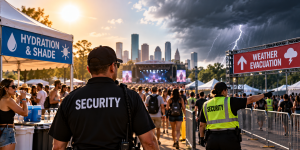
Crowds must be able to move freely from performance viewing fields to auxiliary services without encountering dangerous bottlenecks. Keep food truck clusters, portable restrooms, and hydration stations positioned along the outer flanks of the venue rather than near primary exit doors. Mark all medical tents with illuminated green flags and elevate them above crowd sightlines.
2. Strict Alcohol and TABC Compliance Enforcement
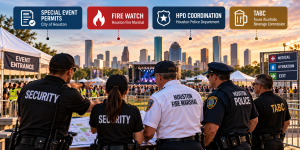
Alcohol service exacerbates crowd aggression, impairs spatial awareness, and accelerates physical dehydration. In Texas, serving alcohol at large live events triggers mandatory compliance under the Texas Alcoholic Beverage Commission and Texas Dram Shop liability statutes. Station dedicated security personnel at all beer and cocktail tents to manage queues and prevent intoxicated individuals from returning to active stage pits. Review our legal analysis on Texas liquor law event security requirements for state guidelines.
3. Egress Flow Rates and Emergency Exit Clearances
The International Building Code and NFPA 101 Life Safety Code require exit capacity calculations based on 0.2 inches of clear exit width per person. An outdoor concert field hosting 10,000 attendees requires multiple wide, distributed exit gates equipped with panic hardware. Never chain, padlock, or obstruct exit gates during an event. Pair this with our comprehensive event security checklist for venue managers to audit exit readiness prior to doors opening.
Phase 5: Emergency Action Plan (EAP) and Show-Stop Authority
The most critical element of concert safety is establishing clear operational authority before an incident escalates into a mass-casualty event.
1. Designated Show-Stop Authority
Tragedies frequently unfold because production staff, stage managers, and promoters hesitate to pause a live show out of fear of financial penalties or artist resistance. Your operational security plan must legally designate a single Lead Security Commander or Incident Commander who holds absolute show-stop authority.
If crowd density exceeds dangerous thresholds, if barricades breach, or if a severe weather front approaches, this commander triggers the show-stop protocol:
- House lights are brought up to 100 percent immediately.
- Audio feeds from the stage microphones and musical instruments are muted.
- The safety commander uses a dedicated override microphone to instruct the crowd calmly to step back, clear pathways, or follow evacuation instructions.
2. Severe Texas Weather and Lightning Protocols
Texas outdoor events face extreme heat, sudden microburst winds, and severe lightning storms. High-wind gusts can destabilize custom temporary staging, overhead lighting trusses, and speaker arrays. The Incident Action Plan must mandate weather radar monitoring. If lightning strikes occur within an 8-mile radius, outdoor stages must be evacuated and attendees directed toward hardened shelters or parked vehicles.
3. Executive Protection for Headliner Talent
Headliner artists, celebrity performers, and VIP attendees require isolated, secure transit paths. Coordinating backstage loading dock lockouts, artist transport escorts, and green room access control prevents enthusiastic fans from trespassing into restricted performance spaces. For specialized VIP protocols, review our guidelines for discreet executive protection in Houston.
Partner with Gods Armour Security for Live Event Protection
Producing a live concert or public festival requires disciplined crowd management, skilled security personnel, and uncompromising safety standards. Gods Armour Security delivers certified, Texas DPS licensed, and insured security officers trained specifically for large-scale live event environments across Houston, Harris County, and surrounding Texas regions.
Our experienced command team develops custom crowd management plans, integrates physical barricade strategies, manages credentialed ingress, and provides calm, authoritative incident oversight.
Planning an upcoming concert, live festival, or open-air public gathering? Request a free concert crowd control consultation or call our Houston command center directly at (713) 878-9984 to review your site map and production safety parameters.
Key Takeaways
- Effective crowd control relies on proactive site engineering, pressure-relief barricades, and clear ingress metering rather than passive guarding.
- Audience density must never exceed 4 persons per square meter; crossing 5 persons per square meter triggers involuntary crowd surges and suffocation hazards.
- Standing general admission audiences must be segmented using central T-barricades and front D-ring pens to eliminate compounding forward pressure.
- All large live events must establish clear, non-negotiable show-stop authority to halt performances during structural failures or crowd surges.
- Always ensure your security provider is fully licensed through the Texas DPS Private Security Bureau and carries comprehensive commercial general liability insurance.