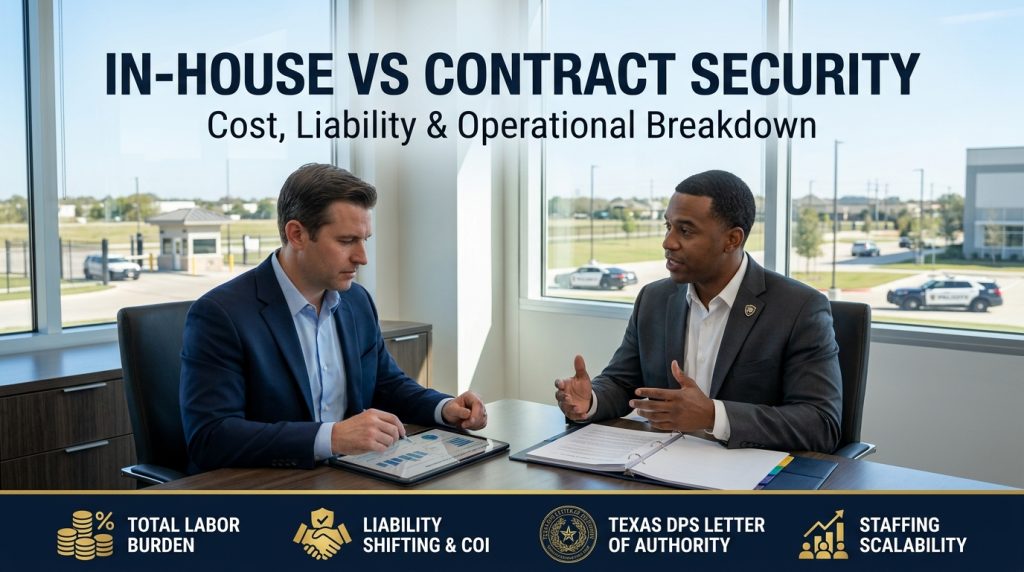
When commercial property managers, corporate facility directors, and enterprise business owners decide to protect their physical assets, they face a fundamental operational dilemma: should they hire proprietary (in-house) security employees or contract with a licensed private security guard company? On the surface, building an in-house security team appears to offer greater control over company culture, loyalty, and daily tasks. Conversely, hiring a contract guard agency promises operational flexibility and reduced administrative overhead.
However, evaluating this choice based purely on base hourly wages is a costly mistake. An in-house guard earning $18 per hour often costs an employer between $26 and $32 per hour once mandatory employer payroll taxes, healthcare benefits, overtime coverage, uniform provisioning, workers’ compensation insurance, and state licensing compliance are factored in. More significantly, in-house security leaves the hiring organization directly exposed to civil liability under Texas employment and tort laws when physical force, detention disputes, or property incidents occur.
Choosing the right framework requires analyzing total cost of ownership, risk transfer mechanisms, and operational scalability. This guide provides a detailed financial and legal breakdown of in-house vs contract security guards to help Texas commercial facility leaders make an informed, defensible decision for their properties.
Phase 1: Financial Comparison: Direct Wages vs. True Labor Burden
While an invoice from a contract guard vendor displays a single, predictable hourly billing rate, the actual cost of employing an in-house security team includes hidden operational and regulatory overhead:
| Cost Component | Proprietary (In-House) Security | Contract Security Provider |
|---|---|---|
| Base Hourly Wage | Direct hourly payroll paid to individual employees ($16 to $22/hr). | Bundled into a contracted flat hourly bill rate ($24 to $32/hr). |
| Payroll Taxes & Benefits | Adds 25% to 35% on top of wages (FICA, FUTA, SUTA, health coverage, 401k, paid sick leave). | 100% absorbed by the security vendor; zero direct employer tax burden. |
| Overtime & Call-Out Relief | Overtime rates (1.5x) paid directly by the business when officers call out sick or take vacation. | Vendor provides on-call reserve floaters at the agreed standard hourly contract rate. |
| Recruitment, Onboarding & Churn | Internal HR costs for advertising, screening, interviewing, and replacing churned officers. | Continuous pipeline managed by contractor; turnover replacement costs absorbed by vendor. |
| Uniforms, Radios & Duty Gear | Direct capital expense ($800 to $1,500 per guard) plus maintenance and replacement cycles. | Fully supplied and maintained by the security contractor under the service agreement. |
| Supervision & Management Overhead | Requires dedicated in-house security director or shifts burden onto facility/property managers. | Field supervisors, 24/7 dispatch centers, and quality audits provided by the contractor. |
When multi-tenant shopping centers or business parks allocate guard costs, billing transparency is vital; review lease mechanics in our analysis of shared security cost models for strip malls and shopping centers.
Phase 2: Legal Exposure & Liability Shifting
The financial difference between in-house and contract security is measurable in dollars, but the liability difference can determine the survival of your enterprise. When a security officer is involved in a physical altercation, a vehicle collision, an unauthorized detention, or a premises injury, who holds legal responsibility?
1. Respondeat Superior (Vicarious Liability)
Under the common law doctrine of respondeat superior, an employer is held strictly liable for the negligent or intentional acts committed by its employees within the scope of their employment. If an in-house security guard uses excessive force on a customer or falsely detains a shopper, the building owner or company faces direct civil litigation for assault, battery, and false imprisonment.
2. The Independent Contractor Liability Buffer
When you hire a licensed third-party security contractor, the guards are employees of that contractor—not your company. Under Texas law, property owners generally are not held vicariously liable for the tortious acts of an independent contractor, provided the property owner does not exercise direct, minute operational control over how the officer performs their tactical duties.
3. Insurance Indemnification and Additional Insured Status
A professional contract guard service shifts financial risk away from your balance sheet through formal contractual indemnification:
1. Contractual Defense & Indemnity
The security contractor formally agrees in writing to defend, indemnify, and hold harmless your business and property ownership against third-party claims arising from guard operations.
2. Additional Insured Endorsement
Your organization is added as an Additional Insured on the contractor’s Commercial General Liability (CGL) policy on a primary and non-contributory basis, protecting your own corporate insurance policy.
3. Assault & Battery Coverage
Contractors carry dedicated Assault and Battery policy riders, ensuring insurance funds are available to resolve use-of-force litigation without draining corporate reserves.
4. Workers’ Compensation Shield
If an officer is injured confronting a violent trespasser, the contractor’s workers’ comp carrier handles medical bills and disability, preventing direct claims against your business.
When selecting a guard vendor, verifying these specific policy riders is essential; review procurement vetting standards in our guide on 10 questions to ask before hiring a commercial security guard company.
Phase 3: Texas Regulatory and Licensing Mandates
Texas law imposes strict regulatory frameworks on private security under Texas Occupations Code Chapter 1702, enforced by the Texas Department of Public Safety (DPS) Private Security Bureau. Operating an in-house security department does not exempt an employer from state oversight:
1. The Letter of Authority (LOA) Requirement
Under Texas Occupations Code § 1702.181, the security department of a private business may not employ a commissioned (armed) security officer unless it holds a Letter of Authority (LOA) from the Texas DPS Private Security Bureau. In other words, a business that runs its own in-house security and wants to deploy armed officers must apply for and maintain an LOA. Employing a commissioned officer without one is a violation.
2. In-House Compliance Burden
Holding a Letter of Authority makes the employer responsible for the compliance work a contractor would otherwise carry: maintaining records, coordinating fingerprint-based background checks, securing and renewing each armed officer’s security officer commission, and submitting ongoing filings to the state. Even an unarmed in-house program still has to keep its officers’ individual DPS registrations and background clearances current.
3. The Contract Guard Alternative
By partnering with an established, licensed security contractor holding an active Class B (Security Services Contractor) or Class C license, all regulatory licensing, officer commissions, firearms re-qualifications, and DPS reporting remain entirely with the vendor.
For armed retail or commercial settings where customer stops occur, statutory boundaries must be strictly observed; review Texas detention laws in Texas shoplifting laws and what security guards are legally allowed to do.
Phase 4: Operational Flexibility and Performance Management
Beyond costs and legal exposure, commercial facilities must evaluate everyday operational effectiveness:
1. Staffing Scalability and Surge Capacity
In-house security teams are structurally rigid. If your facility hosts an executive conference, undergoes a major construction project, or faces seasonal holiday crowds, an in-house department cannot suddenly double its workforce without embarking on an expensive, months-long hiring cycle. A contract security provider can instantly scale guard posts up or down based on operational need.
2. The Unfilled Shift Dilemma
In a small in-house department (e.g., 3 to 5 officers), a single illness or resignation immediately creates an emergency. The facility manager is forced to cover the desk personally or mandate costly 16-hour double shifts that lead to guard fatigue and sleep-on-duty incidents. Contract providers maintain dedicated on-call floaters to guarantee post fulfillment.
3. Terminations and Performance Management
Removing an underperforming or unprofessional in-house guard involves progressive disciplinary reviews, documentation trails, HR investigations, and the risk of wrongful termination or EEOC complaints. With a contract provider, managing underperformance requires a single phone call: “Please replace officer X on our post by tomorrow morning.”
For corporate office buildings managing reception checkpoints, compare guard duties with electronic hardware in office building access control: visitor policies and guard protocols.
Phase 5: Decision Matrix: Which Model Fits Your Organization?
While contract security is the optimal solution for most commercial facilities, proprietary models can make sense in niche operational scenarios:
- Choose In-House Security If: Your facility is an ultra-high-security research laboratory, specialized defense contractor, or enterprise corporate campus where guards must undergo proprietary top-secret clearances, possess specialized industrial skills, and integrate deeply into daily proprietary manufacturing workflows over a multi-year horizon.
- Choose Contract Security If: You manage commercial office towers, multi-tenant retail shopping centers, warehouses, residential communities, or industrial parks where controlling labor overhead, eliminating vicarious liability, maintaining 24/7 shift fulfillment, and relying on professional security supervision are paramount.
- Choose a Hybrid Model If: Your enterprise employs a dedicated in-house Director of Security or Asset Protection Manager who develops strategic policies, but relies on a contracted security firm to provide the uniformed guard force, patrol vehicles, and shift supervision.
When training officers to manage volatile customer disputes without physical conflict, ensure teams utilize proven communication tactics covered in our guide on de-escalation techniques for retail security officers.
Partner with God’s Armour Security for Commercial Protection
Building and managing an internal security department consumes organizational focus, inflates administrative budgets, and introduces significant legal risk. God’s Armour Security provides Texas DPS-licensed uniformed security officers, access screening personnel, and marked mobile patrols that deliver reliable protection without employer overhead.
We handle all background vetting, DPS state licensing, tactical training, shift relief, supervisory oversight, and insurance indemnification. Explore our specialized commercial security services in Houston and our high-visibility mobile security patrol services.
Ready to assess your facility’s security model and compare contract pricing? Request a commercial property security assessment and cost evaluation or call our Houston command center directly at (713) 878-9984.
Frequently Asked Questions
What is the difference between proprietary and contract security?
Proprietary (in-house) security guards are direct W-2 employees of the company or property where they work. Contract security guards are employed by an independent, licensed private security company that provides personnel, supervision, insurance, and equipment to the client facility under a commercial service contract.
Is contract security cheaper than an in-house security department?
Yes, in the vast majority of commercial settings. While an in-house guard’s base wage might look lower than a contractor’s hourly bill rate, an employer must add 25% to 35% in payroll taxes and benefits, plus recruitment fees, overtime backfills, uniform costs, and administrative supervisory salaries, making in-house security significantly more expensive overall.
Does hiring contract security eliminate all liability for property owners?
Contract security shifts the primary vicarious liability for an officer’s day-to-day actions, use of force, and employment claims to the security contractor. However, property owners still maintain a legal duty to exercise reasonable care under Texas premises liability law and must ensure they select a fully licensed, vetted, and properly insured security vendor.
Do in-house security guards in Texas need a license?
Under Texas Occupations Code Chapter 1702, a private business that runs its own in-house security department and employs a commissioned (armed) security officer must hold a Letter of Authority (LOA) from the Texas DPS Private Security Bureau, and each armed officer must hold a security officer commission. In-house officers must also complete state background checks and hold valid individual DPS registrations.
Key Takeaways
- True labor burden (taxes, benefits, overtime, gear, and turnover) adds 30% or more to an in-house guard’s base hourly wage.
- Under the doctrine of respondeat superior, in-house security exposes businesses to direct civil liability for guard use-of-force incidents and unlawful detentions.
- Contract security providers shift operational risk through contractual indemnification, Additional Insured endorsements, and dedicated Assault & Battery coverage.
- Running an in-house security department with armed officers in Texas requires a Letter of Authority (LOA) under Texas Occupations Code § 1702.181, plus a commission for each armed officer.
- Contract security provides reliable surge capacity, eliminates unstaffed shift emergencies, and simplifies performance management to a single vendor request.