When violent crime, armed robbery, carjacking, or physical assault occurs in a commercial parking garage or surface retail lot, victims frequently look beyond the criminal perpetrator to seek financial recovery. Across Greater Houston and statewide Texas, injured patrons, tenants, and visitors routinely file multi-million-dollar negligent security lawsuits against commercial property owners, property management corporations, and commercial landlords.
The core legal premise behind these lawsuits is parking lot liability under Texas premises liability law. While property owners are generally not insurers of visitor safety, Texas common law dictates that when third-party criminal conduct is reasonably foreseeable, property owners owe an affirmative legal duty to implement reasonable protective security measures.
A single catastrophic incident in an unpatrolled, poorly illuminated commercial parking lot can lead to crippling jury verdicts, brand damage, and canceled commercial liability insurance policies. Understanding how Texas courts evaluate criminal foreseeability and establishing documented, defensible security counter-measures is essential for every commercial asset manager.
Phase 1: The Legal Duty of Care Under Texas Premises Liability
Texas tort law classifies individuals entering private real estate into three distinct categories: trespassers, licensees, and invitees. Commercial property owners owe their highest legal duty to business invitees:
| Visitor Status | Legal Definition in Texas | Property Owner Legal Obligation |
|---|---|---|
| Business Invitee | Shoppers, commercial tenants, office employees, and paying guests entering for mutual economic benefit. | Duty to exercise ordinary care to protect against known or reasonably discoverable dangerous conditions and foreseeable third-party crimes. |
| Licensee | Individuals on site with express or implied consent for their own convenience (social guests, delivery drivers off duty). | Duty to warn of known dangerous hidden conditions; no proactive affirmative duty to inspect the property for criminal hazards. |
| Trespasser | Individuals entering private parking property without legal right, consent, or economic invitation. | Duty not to injure willfully, wantonly, or through gross negligence. |
For multifamily communities and residential apartment compounds facing the same premises liability scrutiny, examine our operational manual on overnight security patrols for multifamily complexes.
Phase 2: The Timberwalk Standard: How Foreseeability Is Judged in Texas
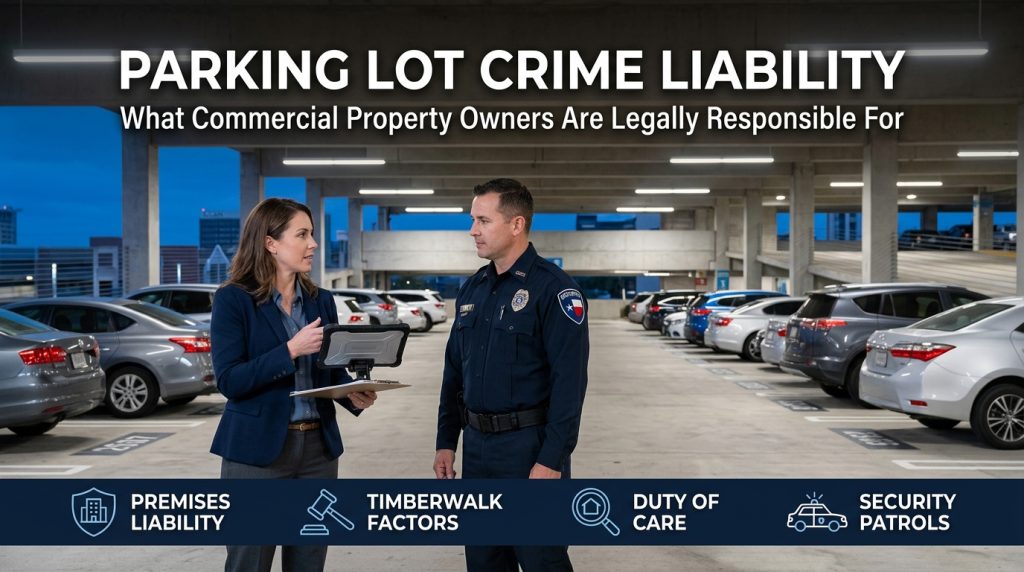
The landmark Texas Supreme Court decision in Timberwalk Apartments, Partners, Inc. v. Cain (1998) established the legal benchmark for determining when third-party crime is foreseeable. In a negligent security lawsuit, Texas judges and juries evaluate five statutory factors known as the Timberwalk Factors:
1. Proximity
Did previous crimes occur directly on the property, or in the immediate neighborhood? Courts examine municipal police call logs from the property ZIP code and adjacent commercial parcels.
2. Recency
How recently did earlier crimes occur? Offenses that took place within the preceding 12 to 24 months carry substantial evidentiary weight in proving notice to property management.
3. Frequency
Is there a persistent, recurring pattern of criminal activity? A single isolated offense three years ago differs legally from repeated weekly car burglaries or monthly robberies.
4. Similarity
Prior crimes must be sufficiently similar to the crime at issue. Prior violent crimes put an owner on notice of violent risks, whereas minor property crimes alone do not always establish violent foreseeability.
5. Publicity
Did the property owner know or should have known about the crimes? Police reports, tenant complaints, and local media coverage establish actual or constructive notice.
When multiple vehicle break-ins occur repeatedly without management intervention, plaintiff attorneys argue that escalating violence was foreseeable; review operational countermeasures in our guide on proven strategies to stop car break-ins in commercial parking lots.
Phase 3: Common Conditions That Trigger Negligent Security Claims
Plaintiffs claiming negligent security in commercial parking lots generally present evidence that specific physical and operational deficiencies created an unreasonable hazard:
1. Sub-Standard and Broken Exterior Lighting
Darkness is a criminal accomplice. Burned-out high-pressure sodium fixtures, unlit stairwells, or uneven lighting below Illuminating Engineering Society (IES) standards prevent natural surveillance. Proving that light fixtures were out of service for weeks before an assault is standard trial practice for plaintiff attorneys.
2. Failure to Maintain Access Control and Physical Perimeters
Broken mechanical gates, missing security fencing, unlatched pedestrian doors, and unmonitored rear corridors allow trespassers to stage ambushes undetected. Discover physical barrier techniques in our manual on access control best practices for commercial facilities.
3. Ignoring Verified Tenant and Customer Complaints
A fatal flaw in commercial defense litigation is the paper trail of ignored complaints. When commercial tenants, employees, or patrons submit written notices citing aggressive loitering, broken car windows, or poor lighting, and property management takes no recorded corrective action, courts find gross negligence.
4. Deploying Non-Working Security Cameras
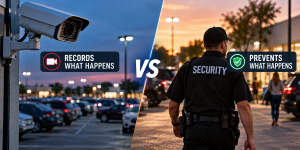
Installing dummy cameras or failing to service broken CCTV systems actively damages an owner defense. Non-working cameras create a false sense of security for patrons while providing zero deterrent value or real-time response capability; compare cameras with dedicated personnel in security guards vs surveillance cameras for commercial facilities.
Phase 4: Establishing a Defensible Security Posture
To defend against negligent security liability, commercial property managers must construct a documented paper trail demonstrating ordinary, reasonable care:
1. Conduct Regular Documented Lighting and Security Audits
Facility maintenance staff or contracted security personnel must perform monthly foot-candle lighting surveys across surface bays, garage ramps, and entry gates. Every burned-out ballast must be logged, with work orders showing rapid replacement within 24 to 48 hours.
2. Implement GPS-Logged Marked Mobile Patrols
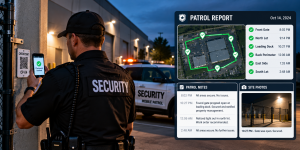
Randomized vehicle and foot patrols provide real-time deterrence that cameras cannot replicate. Utilizing a licensed security company that provides real-time GPS tracking logs, electronic checkpoint scans, and daily incident reports creates admissible evidence proving continuous property supervision.
3. Align With CPTED Architectural Standards
Apply Crime Prevention Through Environmental Design fundamentals: trim tree canopies above 7 feet and shrubs below 3 feet, eliminate hidden alcoves, channelize vehicle pathways with bollards, and install conspicuous warning signage designating private commercial property.
When contracting guard personnel to protect your commercial grounds, utilize our structured security vendor evaluation checklist to verify active state licensing, adequate general liability coverage, and supervisor oversight.
Phase 5: Texas Regulatory Licensing: Chapter 1702 Compliance
Employing informal, unlicensed in-house security personnel or unvetted subcontracted bouncers introduces extreme legal peril under Texas law:
1. Private Security Act (Chapter 1702) Mandates
Under Chapter 1702 of the Texas Occupations Code, anyone providing security guard, patrol, or armed protection services must be licensed through the Texas Department of Public Safety (DPS) Private Security Bureau. Utilizing unlicensed security guards can void commercial liability insurance policies after an incident.
2. Armed vs Unarmed Officer Deployment
In high-risk commercial parking structures subject to gang presence or violent carjacking threats, property managers often require Texas DPS Level III Commissioned Armed Officers. For lower-risk suburban plazas, Level II non-commissioned officers deliver strong visual deterrence; review tier differences in our financial guide on armed vs unarmed security officers.
For pricing models and hourly budget expectations across Texas commercial markets, examine our detailed reference on security officer hourly costs in Houston.
Partner with God’s Armour Security for Commercial Property Protection
Mitigating parking lot liability requires proactive, professionally managed physical deterrence. God’s Armour Security provides marked mobile vehicle patrols, foot patrol officers, and Texas DPS licensed armed security guards engineered specifically for commercial shopping centers, industrial logistics yards, and corporate facilities across Greater Houston, Harris County, and statewide Texas.
Our command team works directly with asset managers, property management corporations, and risk directors to conduct site security audits, document patrol activity, eliminate premises vulnerabilities, and keep your property defensible under Texas law. Explore our complete commercial property security services in Houston and specialized parking lot security patrol services.
Ready to audit your parking facility risk and establish documented security deterrence? Request a commercial property security consultation and liability audit or call our Houston operations desk directly at (713) 878-9984.
Frequently Asked Questions
Are commercial property owners liable for parking lot crime in Texas?
Not automatically. Under Texas premises liability law, property owners can be held liable for third-party crime only when the criminal conduct was foreseeable. If owners knew or should have known about a recent pattern of similar crime and failed to take reasonable protective measures such as adequate lighting or security patrols, injured victims may bring a negligent security claim.
What are the Timberwalk factors in Texas negligent security cases?
Established by the Texas Supreme Court in Timberwalk v. Cain, the five factors used to determine whether a crime was foreseeable are Proximity (how close prior crimes were), Recency (how recently they occurred), Frequency (how often they occurred), Similarity (whether prior crimes resembled the current incident), and Publicity (how widely known the prior criminal activity was).
Does installing security cameras eliminate parking lot liability?
No. Cameras are passive recording devices that rarely deter determined offenders or stop a crime in progress. Cameras that are broken, poorly positioned, or non-functional can also weaken an owner’s position, because they suggest the property relied on the appearance of security rather than real protection.
How do marked security patrols protect owners from liability?
Marked mobile patrols provide active, visible deterrence that discourages criminals from targeting the lot. A professional security vendor also generates GPS-stamped patrol logs, incident records, and maintenance deficiency alerts that help show the property owner exercised ordinary and reasonable care.
Key Takeaways
- Commercial property owners owe business invitees a legal duty to protect against foreseeable third-party criminal attacks under Texas premises liability law.
- Criminal foreseeability in Texas is governed by the five Timberwalk factors: proximity, recency, frequency, similarity, and publicity of prior crimes.
- Broken lighting, neglected fences, non-working cameras, and ignored tenant complaints are primary evidence used against property owners in negligent security trials.
- Documented, GPS-verified marked mobile security patrols provide real deterrence while creating clear legal proof of reasonable care.
- All commercial security personnel operating in Texas must hold active credentials under Chapter 1702 of the Texas Occupations Code.