
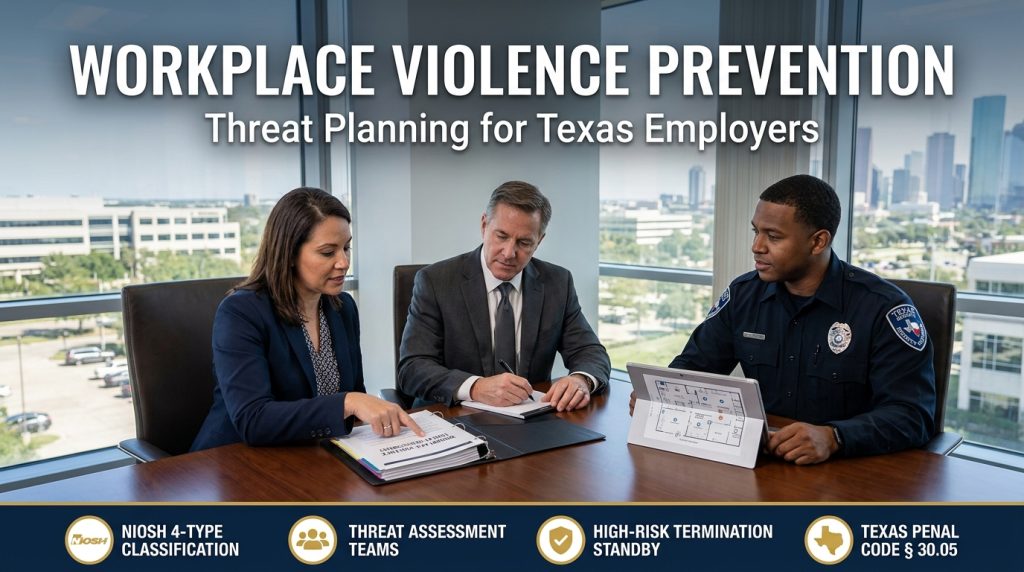
Workplace violence is one of the most destructive operational and legal hazards facing commercial property managers, corporate employers, and facility directors across Greater Houston and Texas. An incident can erupt in seconds arising from an armed robbery, an agitated client, a bitter domestic dispute spilling onto the sales floor, or a hostile employee termination. Beyond the tragic human cost, businesses face severe regulatory scrutiny, civil negligence lawsuits, and long-term brand damage.
Under the Occupational Safety and Health Act (OSHA) General Duty Clause, employers have a federal legal obligation to furnish a workplace free from recognized hazards likely to cause death or serious physical harm. In Texas, civil courts consistently hold commercial property owners and employers accountable under premises liability and negligent security doctrines when violence was foreseeable yet unaddressed by reasonable physical safeguards.
Relying on generic emergency pamphlets is insufficient. A defensible workplace violence prevention plan in Texas requires an active operational framework: formal threat assessment teams, clear reporting channels, structured de-escalation training, and trained on-site security officers. This operational guide outlines how commercial facilities can build, implement, and maintain a compliant prevention program.
Phase 1: The Four NIOSH Workplace Violence Typologies
Workplace threats originate from different sources, each requiring distinct prevention controls and guard responses. Commercial facilities must align their prevention plan against the four standard classifications established by NIOSH and the FBI:
| Violence Type | Perpetrator Relationship | Typical Commercial Scenarios | Primary Security Countermeasures |
|---|---|---|---|
| Type 1: Criminal Intent | No legitimate commercial relationship with the business or staff. | Armed robbery, commercial burglary, after-hours trespassing, parking lot carjackings. | Visible uniform deterrence, perimeter access barriers, high-output lot lighting, CCTV monitoring, mobile security patrols. |
| Type 2: Customer / Client / Visitor | Legitimate relationship as a customer, patient, vendor, or client. | Disputed retail returns, contested legal filings, denied healthcare claims, customer service altercations. | Verbal de-escalation protocols, front-desk visitor badging, physical separation barriers, panic duress buttons. |
| Type 3: Worker-on-Worker | Current or former employee, contractor, or temporary worker. | Hostile terminations, workplace bullying, disciplinary grievances, retaliatory active threat incidents. | Threat assessment teams, immediate credential revocation, standby security during high-risk dismissals. |
| Type 4: Personal Relationships | Personal connection to an employee (spouse, partner, domestic relation); no link to the business. | Domestic disputes, stalking, protective order violations occurring inside the office or parking structure. | BOLO notices provided to lobby officers, parking escorts, enforcement of protective orders under Texas law. |
For corporate office parks and Class A towers, controlling who enters the facility is the foundational barrier against external threats; see detailed lobby checkpoints in our guide to office building access control: visitor policies and guard protocols.
Phase 2: Establishing a Multidisciplinary Threat Assessment Team (TAT)
Workplace violence rarely occurs without warning signs. In most Type 3 and Type 4 incidents, the perpetrator displays pre-attack indicators—such as escalating grievances, direct threats, fixation on weapons, or dramatic personality shifts—weeks before acting. A Threat Assessment Team provides the cross-functional oversight needed to identify and address these warning behaviors.
A robust Threat Assessment Team should meet regularly and include:
- Human Resources Director: Monitors employee performance issues, disciplinary actions, attendance anomalies, and confidential employee assistance program (EAP) referrals.
- Security Director / Guard Contractor Lead: Evaluates physical site vulnerabilities, manages building access logs, coordinates guard standby details, and interfaces with local law enforcement.
- Legal Counsel / Risk Management: Advises on employment law constraints, Americans with Disabilities Act (ADA) compliance during fitness-for-duty evaluations, and liability mitigation under Texas tort law.
- Facility Operations Manager: Controls door access credentials, keycard deactivations, internal panic alarms, and CCTV camera coverage.
Whether your organization uses in-house personnel or an outsourced guard provider, clear supervisory oversight is vital; compare staffing and liability structures in our breakdown of in-house vs contract security guards: cost and liability.
Phase 3: High-Risk Employee Terminations: Security Standby Protocols
Hostile employee terminations represent the highest statistical risk window for Type 3 violence in commercial settings. When an organization must terminate an employee who has exhibited volatile behavior, made threats, or demonstrated weapon fixation, security cannot be an afterthought.
Execute this four-step termination security protocol:
1. Pre-Meeting Threat Briefing
HR and security meet 24 hours prior to review the employee’s history, evaluate exit paths, and designate an interview room located near an exterior exit away from common employee zones.
2. Physical Guard Standby
A uniformed or discreet plainclothes security officer is positioned immediately outside the room. The officer remains in visual contact or within immediate earshot to intervene if voices escalate.
3. Instant Credential Revocation
The exact minute the termination meeting begins, IT and facilities revoke all badge access, server credentials, building parking gate tags, and remote VPN connections.
4. Monitored Property Departure
The officer escorts the former worker to their vehicle. Personal desk belongings should be packed in advance or shipped via courier to prevent the worker from wandering back into office suites.
When interacting with an agitated former employee during exit processing, guards must use calm, respectful communication to prevent confrontation; review tactical guidance in de-escalation techniques for retail security officers.
Phase 4: Physical Hardening & Environmental Design (CPTED)
Policies alone cannot stop an active threat; physical security layers slow down an attacker and buy critical response time for law enforcement. Commercial properties should incorporate Crime Prevention Through Environmental Design (CPTED) principles:
1. Access Choke Points and Optical Turnstiles
Eliminate unmonitored secondary entrances. Exterior doors must default to fail-secure lock modes, forcing all visitors through a staffed lobby reception checkpoint. Card readers and optical turnstiles prevent unauthorized individuals from tailgating directly into upper-level work floors.
2. Concealed Panic and Duress Alarms
Install silent, hardwired duress buttons beneath reception desks, cash-handling counters, executive offices, and HR conference rooms. Activating the duress system must immediately send an alert to the building monitoring station, dispatch on-site security, and notify local police dispatch.
3. Safe Havens and Physical Reinforcement
Identify internal office rooms equipped with solid-core doors, heavy-duty deadbolts, and no exterior glass as designated lockdown safe havens. In high-threat facilities, reception desks should incorporate heavy-gauge protective paneling to safeguard frontline security personnel.
When vetting professional security vendors to evaluate your property’s physical defenses, use the procurement standards outlined in our guide on 10 questions to ask before hiring a commercial security guard company.
Phase 5: Legal Framework: Texas Law and OSHA Obligations
A structured workplace violence plan is not only an operational necessity—it is a core legal defense against liability claims under state and federal law:
- OSHA General Duty Clause [Section 5(a)(1)]: Federal OSHA cites employers who fail to establish feasible physical security measures and training in workplaces with known violence hazards. Documented training, incident logs, and regular drills prove an employer’s active compliance.
- Texas Healthcare Workplace Violence Law (SB 240 / Health & Safety Code Ch. 331): While enacted specifically for healthcare facilities, Texas SB 240 established a clear legal benchmark across Texas for what constitutes a competent workplace violence plan: mandatory annual facility audits, written reporting systems, responsive security details, and zero-retaliation policies for reporting threats. Commercial corporate facilities are increasingly evaluated against similar standards during premises liability civil trials.
- Texas Penal Code § 30.05 (Criminal Trespass): When an individual issues threats or displays unstable behavior, employers can issue a formal Criminal Trespass Warning (CTW). Once notice is served by security or police, returning to the property constitutes a Class B misdemeanor under Texas Penal Code § 30.05, authorizing officers to coordinate an immediate arrest.
- Protective Orders in the Workplace: When an employee secures a protective order against an abusive partner, Texas law allows the employer to assist in enforcing that boundary on corporate grounds. Providing security with a copy of the order, vehicle descriptions, and photo profiles ensures immediate interception if the subject arrives at the property.
Protect Your Workplace with God’s Armour Security
An effective workplace violence prevention plan requires professional, disciplined execution at the perimeter. God’s Armour Security provides Texas DPS-licensed security officers, access screening professionals, high-risk termination standby teams, and marked mobile patrols for corporate office parks, medical facilities, and commercial centers across Greater Houston, Harris County, and statewide Texas.
Our operations team partners directly with your HR and risk managers to evaluate facility access points, establish response protocols, train frontline staff, and maintain an authoritative, reassuring presence. Explore our specialized commercial security services in Houston and our dedicated mobile security patrol services.
Ready to audit your corporate facility and build a defensible workplace violence plan? Request a commercial security consultation and facility threat assessment or call our Houston command center directly at (713) 878-9984.
Frequently Asked Questions
What are the four types of workplace violence recognized by OSHA and NIOSH?
The four types are: Type 1 (Criminal Intent, where the perpetrator has no legitimate relationship to the business), Type 2 (Customer/Client/Visitor, where violence occurs during service delivery), Type 3 (Worker-on-Worker, involving current or former employees), and Type 4 (Personal Relationships, where domestic disputes spill into the workplace).
Does Texas state law require businesses to have a workplace violence prevention plan?
Under Texas Health and Safety Code Chapter 331 (added by SB 240 in 2023), licensed healthcare facilities must maintain a formal workplace violence prevention plan. For general commercial businesses, having a written plan is essential to satisfy the federal OSHA General Duty Clause and defend against negligent security claims under Texas premises liability law.
How should security guards handle a high-risk employee termination?
Security officers should conduct a pre-termination briefing with HR, position themselves immediately outside the meeting room, monitor the interaction, ensure immediate credential and digital access revocation, and professionally escort the terminated individual to their vehicle without incident.
What legal authority do security guards have to bar threatening individuals in Texas?
Under Texas Penal Code § 30.05, licensed security guards acting as authorized agents of property ownership have the legal authority to issue verbal and written criminal trespass warnings. If the individual refuses to depart or returns after receiving notice, guards can coordinate immediate arrest by local law enforcement for criminal trespass.
Key Takeaways
- Workplace violence threats fall into four distinct categories: criminal intent, customers, employees, and personal relationships.
- Establish a multidisciplinary Threat Assessment Team (HR, Security, Legal, and Facilities) to detect early warning signs and intervene before violence occurs.
- Manage high-risk employee terminations using structured protocols: pre-meeting threat reviews, guard standby, immediate credential revocation, and escorted departure.
- Harden physical facilities using access choke points, optical turnstiles, and concealed duress panic alarms.
- Comply with OSHA General Duty guidelines and leverage Texas Penal Code § 30.05 criminal trespass warnings to legally bar threatening individuals from your property.