For retail bank branches and credit unions operating across Greater Houston and Texas, opening and closing windows represent the most dangerous operating intervals of the business day. During these vulnerable transition periods, vault time locks are cycling, alarm systems are disarmed, teller cash drawers are populated or reconciled, and minimal staff are on site. Criminal ambush crews target these exact minutes to execute morning hostage takeovers or evening closing stickups before local law enforcement can be summoned.
A breakdown in daily routine compromises life safety, invites devastating financial loss, and triggers severe regulatory scrutiny under federal standards outlined in our Bank Protection Act compliance guide. Inadequate opening and closing security protocols expose institutions to regulatory enforcement actions by the FDIC, OCC, or Federal Reserve, while multiplying civil premises liability exposure in the aftermath of an armed incident.
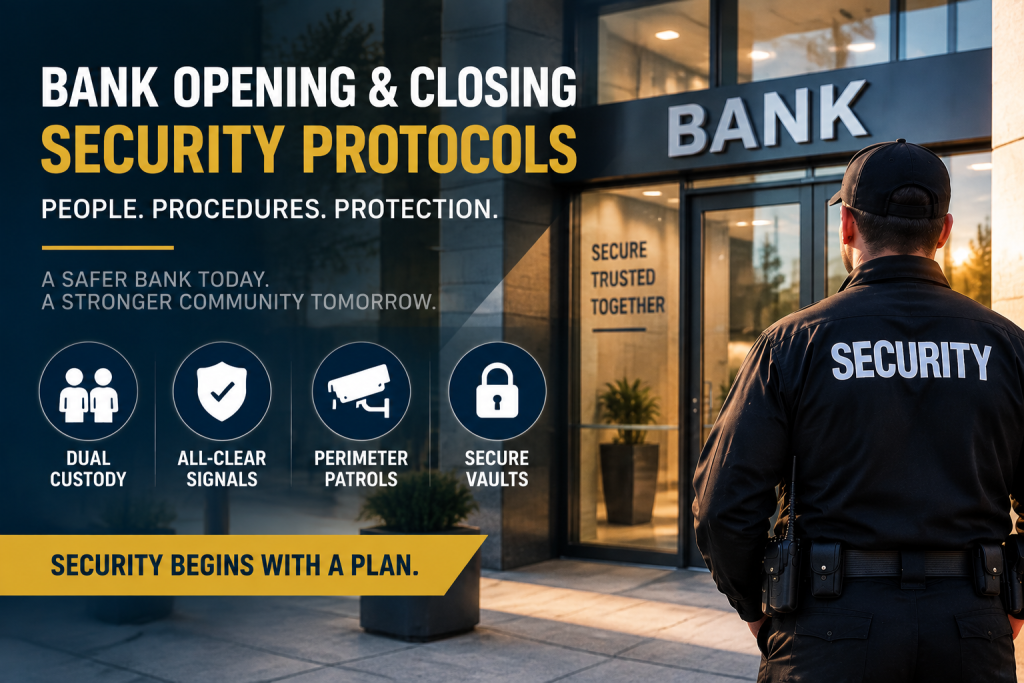
Eliminating branch vulnerability requires enforcing strict dual-custody discipline, uncompromised all-clear signaling, exterior perimeter counter-surveillance, and certified on-site security presence. This operational manual outlines step-by-step procedures designed to protect financial personnel, secure vault cash, and harden bank facilities from dawn to dusk.
Phase 1: High-Risk Vulnerability Windows (The Ambush Timeline)
Bank robberies rarely occur spontaneously. Professional syndicates conduct extensive counter-surveillance, exploiting predictable employee habits during the bookends of the workday:
| Operational Phase | Critical Vulnerability Window | Primary Criminal Ambush Method | Required Procedural Defense |
|---|---|---|---|
| Morning Opening | 30 to 45 minutes prior to public lobby opening hours. | Hostage ambush at employee entrance; forcing first employee to disarm alarm and open main cash vaults under duress. | Mandatory two-person dual-custody opening, vehicle counter-surveillance, and hidden all-clear visual signals. |
| Midday Operating | Lunch shifts (11:30 AM to 1:30 PM) and peak customer queues. | Note-pass robberies, lobby grab-and-runs, and fraudulent ATM skimming installations; review skimmer defense in our ATM skimming detection manual. | Cash drawer balance caps, silent duress buttons, and stationed Texas DPS armed security officers. |
| Evening Closing | At lobby lockup through final cash balancing and departure. | Tailgating through doors as late customers exit; ambushing staff during vault lock-in or parking lot exit. | Strict customer lock-out at close, dual-custody vault securing, parking lot surveillance, and armed guard vehicle escort. |
When selecting professional guard personnel to protect sensitive financial operations, review our comprehensive vetting guide on the security vendor evaluation checklist to audit regulatory compliance, insurance limits, and supervisory capacity.
Phase 2: Step-by-Step Dual-Custody Morning Opening Protocol
Opening a retail branch requires a non-negotiable two-person rule. Under no circumstances should a single employee ever possess the keys, codes, and physical authority to enter an unopened financial facility alone:
1. Arrival and Exterior Counter-Surveillance
Both opening employees (Designated Opener A and Observer B) must arrive at the property at the same designated time in separate vehicles. Before parking or exiting their vehicles, they must conduct a drive-around counter-surveillance sweep of the branch grounds. They must look for:
- Unfamiliar vehicles backed into parking spaces with engines running or tinted windows.
- Signs of forced entry along exterior doors, windows, roof ladders, or drive-thru lanes.
- Loiterers standing near the employee entrance or lingering by outdoor ATM kiosks.
- Pry marks, broken glass, or cut utility and alarm conduit lines on building exteriors.
2. The Controlled Entry by Opener A
If the perimeter sweep reveals no suspicious activity, Opener A exits their vehicle while Observer B remains locked inside their running car at a safe vantage point across the parking lot with a mobile phone in hand ready to dial 911 immediately. Opener A proceeds to the secure entrance, unlocks the exterior door, enters the building, and relocks the door immediately behind them.
3. Interior Facility Sweeps and Duress Disarming
Once inside, Opener A disarms the intrusion alarm panel within the preset grace period. If an armed assailant is hiding inside and coerces Opener A, the employee enters a designated Duress Disarm Code (which disarms the local buzzer while transmitting a silent panic alarm directly to the central monitoring station and local law enforcement). Opener A then conducts a physical sweep of all sensitive interior zones:
- Restrooms, janitorial closets, and mechanical utility rooms.
- Behind the teller line, under desks, and inside private customer conference offices.
- The exterior of the main cash vault and safety deposit viewing rooms.
4. Deploying the Concealed All-Clear Signal
If the interior sweep confirms the building is completely unoccupied and secure, Opener A displays the pre-arranged All-Clear Signal. This signal must never be obvious (such as a thumbs-up or waving through a window). It must be a subtle, everyday object or physical status visible from the parking lot:
- A specific window blind raised to a precise horizontal angle.
- A distinctive desktop item (such as a blue binder or branded desk lamp) turned on or placed on a designated counter.
- A digital exterior camera indicator or subtle LED exterior sign toggle.
The Golden Rule: The absence of the all-clear signal is an emergency distress alarm. If Observer B does not see the exact signal within 5 to 7 minutes, Observer B must not enter. Observer B must immediately drive away from the site and call local police dispatch.
5. Admitting Observer B and Secondary Entry Lockdown
Once Observer B verifies the all-clear signal, they park, walk directly to the employee entrance, and are admitted by Opener A. The door is immediately relocked behind them. The branch remains fully locked until all remaining staff arrive and the official opening hour strikes.
Phase 3: Step-by-Step Evening Closing and Vault Lockdown Protocol
Evening closing demands equal operational discipline to prevent ambush after hours when public visibility drops:
1. Strict Lobby Door Lockdown
At the exact minute of closing, a designated employee or on-site security guard locks the main entrance doors. An officer stands by the door to physically let remaining customers out, ensuring no incoming visitors slip inside behind departing patrons.
2. Cash Drawer Balancing & Vault Drop
Tellers count cash drawers out of sight of public windows. All cash, coin boxes, and negotiable instruments are returned immediately to the main vault or smart cash recyclers. No currency is ever left in drawers or counter surfaces overnight.
3. Vault Dual-Custody Lockdown
Two authorized vault custodians verify cash totals, set the vault mechanical or electronic time locks, spin the combination dials, and physically lock the outer vault door. Both custodians sign the official daily vault register.
4. Coordinated Group Exit & Vehicle Escort
Arm all interior alarm partitions. All closing employees assemble and exit the facility together in a single group. Staff members must never leave one by one in dark parking lots; an armed security officer provides direct visual escort to vehicles.
To audit building perimeters, locking hardware, and access control vestibules across commercial properties, explore our operational manual on the commercial security checklist for facility managers.
Phase 4: The Role of On-Site Texas DPS Armed Security Officers
While electronic systems and dual-custody procedures establish necessary operational structure, the physical presence of a dedicated security professional transforms branch defense:
1. Armed Deterrence During Opening and Closing Windows
Criminal crews avoid branches with active, vigilant human deterrence. Having a Texas DPS Level III Commissioned Armed Security Officer on site 30 minutes before opening and 30 minutes after closing provides external perimeter monitoring while staff are cycling vaults. Compare physical guarding against camera systems in our detailed analysis on security guards vs surveillance cameras for commercial sites.
2. Parking Lot Sweeps and Vehicle Counter-Surveillance
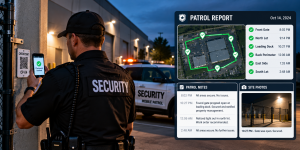
Robbery crews often park across street corners or adjacent retail lots to case staff movements. An armed guard conducting marked vehicle or foot sweeps of the surrounding parking apron prevents perpetrators from positioning ambush vehicles near rear employee exits; see multi-acre sweep procedures in our guide on overnight property security patrols.
3. Managing High-Exposure Cash Transfers
During morning branch openings or late afternoon closing runs, commercial clients drop heavy night-deposit bags, and armored couriers arrive for bulk cash pickups. On-site armed officers secure the perimeter, inspect commercial manifests, and clear transaction paths; review vehicle intake procedures in our manual on access control best practices for secure facilities.
For standard hourly rates and budget parameters for professional armed and unarmed officers in Texas, consult our pricing reference on security officer hourly costs in Houston.
Phase 5: Emergency Protocols: What to Do If an Ambush Occurs
If dual-custody protocols break down or employees are confronted by armed assailants during an opening or closing transition, strict life-safety rules govern:
1. Total Compliance and De-Escalation
Staff members must follow all robber commands without argument or physical resistance. Assailants during opening takeovers are exceptionally volatile because they know law enforcement response may be triggered at any second. Surrender funds smoothly, avoid sudden movements, and do not attempt to protect company assets at the risk of personal safety.
2. The Duress Code and Silent Alarms
If forced to enter the vault or disarm an alarm panel, staff should enter the designated duress code only if it can be done without alerting the assailants. Never activate audible alarms or audible panic sirens while robbers remain inside the facility, as noise can trigger panic-driven violence.
3. Immediate Post-Robbery Crime Scene Isolation
The instant the robbers exit the facility:
- Lock all exterior branch doors immediately to prevent perpetrators from re-entering.
- Call 911 immediately, stating clearly: “We have just experienced an armed bank robbery at this location; suspects have fled.”
- Isolate the teller line and counters: do not touch surfaces, pens, doors, or counters touched by the suspects to preserve fingerprint and DNA evidence for FBI and Houston police investigators.
- Instruct all employees to write down individual physical descriptions of the suspects (height, build, clothing, weapons, tattoos, vehicle make/model/direction of travel) independently before talking to each other.
For bank executives, wealth management directors, or corporate banking officers facing contentious litigation or targeted personal threats, review our diagnostic assessment on 7 signs you need a personal security detail.
Partner with Gods Armour Security for Financial Institution Protection
Safeguarding retail bank branches, credit unions, and corporate cash vaults requires an uncompromising standard of physical vigilance. Gods Armour Security provides Texas DPS certified security officers, Level III commissioned armed guards, and marked mobile patrol services tailored to the operational demands of financial institutions across Greater Houston, Harris County, and statewide Texas.
Our supervisory leadership collaborates directly with bank security directors and branch managers to design custom opening and closing security protocols, eliminate retail branch vulnerabilities, conduct staff training drills, and maintain comprehensive audit readiness.
Need to assess your branch opening security procedures or schedule professional armed security officers? Request a financial institution security consultation and vulnerability audit or contact our Houston command operations desk directly at (713) 878-9984.
Key Takeaways
- Branch opening and closing hours represent the highest statistical risk windows for armed ambush robberies and hostage takeovers.
- Always enforce a strict two-person dual-custody rule: Opener A enters and clears the building while Observer B watches from a running vehicle at a safe distance.
- Utilize concealed, subtle all-clear signals; the absence of the signal must be treated as an active emergency distress event.
- Evening closings require strict entrance door lockouts, dual-custody vault time-lock setting, and group employee departures with security escorts.
- Stationing a Texas DPS Level III commissioned armed security officer provides active physical deterrence that eliminates criminal pre-operational planning.