Few places in the country concentrate energy infrastructure like Greater Houston. The Houston Ship Channel, the Energy Corridor, and the industrial belt through Baytown, Pasadena, Texas City, and La Porte hold refineries, tank farms, terminals, pipelines, and production sites that are enormous in footprint and enormous in value. That combination, high-value assets spread across large, often remote ground, makes physical security a foundational concern for every operator in the region, not an afterthought.
Oil and gas facilities do not fit the mold of a typical commercial property. They run day and night, mix employees with a constant flow of contractors and drivers, hold product and equipment worth targeting, and carry safety stakes that most businesses never face. Securing them takes protocols built for that reality. This guide walks through the physical security layers that protect an energy facility, from the fence line to the gate to the far corners of the site.
Phase 1: Why Oil and Gas Sites Are a Unique Security Challenge
Before the protocols, it helps to understand why these facilities are harder to secure than a store or an office. The threats are different, and so are the countermeasures.
| Site Characteristic | Why It Raises Risk | Security Response |
|---|---|---|
| Large, spread-out footprint | Miles of fence line and remote corners no fixed post can watch. | Mobile patrols covering the full perimeter and remote assets on rounds. |
| Remote and unmanned assets | Wellheads, tank batteries, and metering skids sit far from staff. | Scheduled checks and monitoring of outlying equipment on each patrol. |
| High-value product and metal | Crude, condensate, copper, and equipment are targets for theft. | Access control, load verification, and visible deterrence at storage and loading areas. |
| Heavy contractor and driver traffic | Constant third-party access makes the gate a control point and a weak point. | Strict gate check-in, credential verification, and logging of every entry. |
| Safety-critical operations | Tampering or unauthorized entry can create a safety incident, not just a loss. | Trained officers who understand site hazards and coordinate with operations. |
Phase 2: Perimeter Hardening and Site Design
Security at an energy facility starts at the boundary. The perimeter is the first line, and on a large industrial site it is also the longest and hardest to hold. Applying Crime Prevention Through Environmental Design (CPTED) to the fence line makes the whole site tougher to breach.
1. Fencing and Clear Zones
A maintained perimeter fence with a clear zone on both sides, no vegetation, debris, or stacked material to hide behind or climb, is the baseline. Gaps, washouts under the fence, and cut sections are common breach points on sprawling sites and need regular inspection.
2. Lighting Built for the Footprint
Even, maintained lighting across gates, storage areas, loading zones, and pedestrian paths removes the darkness intruders rely on. Remote corners and tank areas are the ones most often left dark, and those are exactly where a breach is least likely to be seen.
3. Controlled, Channelized Access
Every unmonitored way onto the site is a liability. Traffic should be funneled through a limited number of controlled gates, with secondary and service entrances locked or actively managed rather than left open for convenience.
Phase 3: Gate Access Control and Contractor Management
On an oil and gas site, the gate is where security is won or lost. These facilities see a constant flow of employees, contractors, tanker drivers, and vendors, and every one of them is a person and a vehicle that has to be verified before entering a hazardous, high-value environment.
Strong gate control means checking credentials against expected arrivals, logging every entry and exit, verifying drivers and their loads, and directing each visitor to the right contact instead of granting open access. A trained officer at the gate does what an automated reader cannot: confirms the person matches the credential, spots the driver who does not belong, and stops tailgating through the gate. The full procedures for managing truck and driver flow are covered in our guide on industrial truck gate and loading dock check-in procedures, and the access-control principles behind it in our guide on office building access control.
Phase 4: Patrol Coverage Across a Large Site
No stationed guard can watch a multi-acre facility with miles of fence and scattered remote assets. That is the job of mobile patrols, and it is why energy facilities lean on them heavily.
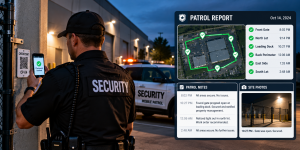
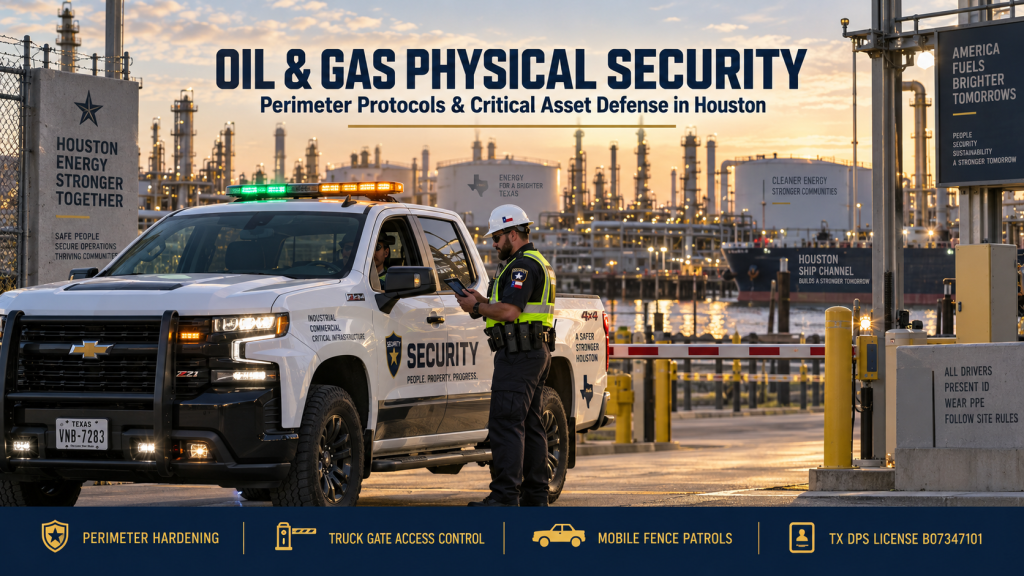
A marked patrol vehicle covers the perimeter, the tank areas, the loading zones, and the outlying wellheads or metering points that no fixed post can reach, checking each on its rounds. Randomized timing keeps the coverage unpredictable, so anyone scouting the site cannot learn a safe window, and the visible presence of a marked unit deters theft and trespassing across the whole footprint. For how the fixed-versus-roving choice plays out on a large site, see our guide on mobile patrol vs dedicated stationed guards, and for why unpredictable timing matters, our guide on randomized vs scheduled patrol rounds. The overnight hours, when a site is quiet and lightly staffed, are the highest-risk window, covered in our guide on commercial property security after-hours.
Phase 5: The Specific Threats to Guard Against
Energy facilities face a particular mix of threats, and a security plan should be built around the ones that actually hit these sites.
1. Copper and Metal Theft
Wiring, grounding, and equipment metal are stripped for scrap value, often from remote or unlit parts of the site. Visible patrols and lighting are the main deterrents.
2. Equipment and Tool Theft
Portable equipment, tools, and vehicles left on site overnight are targets. Access control and secured storage areas reduce the opportunity.
3. Product Theft
Crude, condensate, and fuel can be siphoned or diverted at tanks and loading points. Load verification and monitored loading areas are the defense.
4. Trespassing and Tampering
Unauthorized entry is not just a loss risk; on a hazardous site it is a safety risk. Fast detection and response keep a trespasser from becoming an incident.
Phase 6: Where Compliance Fits In
Physical security is one half of the picture; the other is regulatory compliance. Energy and chemical facilities in Texas sit under a layer of federal and state oversight, and for facilities that handle certain chemicals or sit on the water, those requirements shape what the security program has to include and document.
The protocols in this guide, hardened perimeter, controlled access, documented patrols, are the operational foundation that a compliant program is built on, and the documentation they produce supports it. The specific regulatory framework for chemical and perimeter security, and how it applies to Houston-area facilities, is covered in our guide on chemical plant and industrial perimeter security compliance in Texas. Because these requirements are specific and change over time, confirm what applies to your facility with the relevant agency or a qualified compliance advisor.
Secure Your Energy Facility with God’s Armour Security
Protecting an oil and gas site takes officers who understand the footprint, the hazards, and the threats these facilities actually face. God’s Armour Security, licensed by the Texas DPS as a security contractor and guard company (license no. B07347101), provides gate officers, marked mobile patrols, and documented coverage for refineries, terminals, tank farms, and energy facilities across the Houston Ship Channel, the Energy Corridor, and statewide Texas.
Our supervisory team assesses your perimeter, access points, and remote assets, then builds a coverage plan, gate control, patrols, or both, matched to the size and risk of your site. Explore our commercial security services in Houston and our security patrol services.
Ready to secure your energy facility? Request an industrial security consultation and site assessment or call our Houston operations desk directly at (713) 878-9984.
Frequently Asked Questions
Why do oil and gas facilities need specialized physical security?
These sites combine a large, spread-out footprint, remote and unmanned assets, high-value product and equipment, constant contractor and driver traffic, and safety-critical operations. That mix creates threats a standard commercial security setup is not built for, which is why energy facilities need protocols designed around perimeter, access control, and patrol coverage across a wide area.
What is the most important security layer for a large energy site?
There is no single layer; the strength is in combining them. A hardened perimeter, strict gate access control, and mobile patrols across the full footprint work together. On a large site, mobile patrols are essential because no fixed post can watch miles of fence line and scattered remote assets.
How is gate security handled at an oil and gas facility?
Every person and vehicle is verified before entering. Officers check credentials against expected arrivals, log entries and exits, verify drivers and their loads, and route visitors to the right contact rather than granting open access. A trained officer catches the driver who does not belong and prevents tailgating through the gate.
What are the biggest theft risks at energy facilities?
Copper and metal theft from wiring and equipment, theft of portable equipment and tools, and product theft such as siphoned crude, condensate, or fuel. Remote and poorly lit areas are hit most often, which is why visible patrols, lighting, and load verification are central to the defense.
Key Takeaways
- Oil and gas facilities in Greater Houston combine large footprints, remote assets, high-value product, and heavy contractor traffic, requiring purpose-built physical security.
- Perimeter hardening comes first: maintained fencing with clear zones, even lighting, and access channelized through a few controlled gates.
- The gate is the key control point, where officers verify credentials, log entries, and check drivers and loads.
- Mobile patrols with randomized timing are essential for covering miles of perimeter and remote assets no fixed post can watch.
- Physical security is the operational foundation that a compliant program is built on; specific regulatory requirements are covered separately and should be confirmed for your facility.