At an industrial site, a warehouse, a distribution center, a plant, or a port terminal, the truck gate is the single busiest and most consequential control point on the property. Every tractor-trailer that rolls up represents three assets to verify simultaneously: a driver, a vehicle, and a load. Implementing strict industrial truck gate security procedures ensures that this entry point serves as your strongest perimeter defense. If verification fails, the gate becomes an open door for cargo theft, bill-of-lading fraud, and site safety liabilities. For industrial operators across Greater Houston’s warehouse corridors and Ship Channel terminals, a disciplined driver check-in process is the dividing line between an audited facility and an exposed one.
A professional gate and dock procedure is not a casual wave-through with a clipboard. It is a repeatable, documented sequence that confirms who the driver is, whether the load was scheduled, what cargo is inside, and whether safety seals remain intact on entry and exit. This standard operating guide details those dock security procedures step by step.
Phase 1: Why Truck Gate Security Is the Critical Control Point
Everything of value entering or leaving an industrial site passes through the perimeter gate. That makes truck gate security the single operational checkpoint where a strict protocol prevents total load loss, and where an overlooked detail invites cargo diversion.
| What Passes the Gate | Risk If Unverified | The Check That Stops It |
|---|---|---|
| The driver | An impostor posing as an authorized carrier to commit strategic theft. | Government photo ID and carrier credentials cross-referenced with booking manifests. |
| The vehicle | An unauthorized, untracked, or cloned tractor entering the yard staging lanes. | Tractor unit, trailer, and license numbers recorded and matched to shipping documentation. |
| The load | Short, missing, tampered, or contraband freight entering or exiting undetected. | Bill of lading (BOL) verified and trailer security seal numbers cross-checked against records. |
| The appointment | An unscheduled pickup or drop-off slipping through during high-congestion shifts. | Every arrival matched to a scheduled appointment window before granting physical entry. |
The gate serves as the primary barrier of a site-wide gate access control industrial framework. The core principles of driver verification and perimeter control follow the same rigorous standards detailed in our guide on office building access control protocols, adapted specifically for heavy freight equipment and logistics environments.
Phase 2: Inbound Loading Dock Check-In Procedures
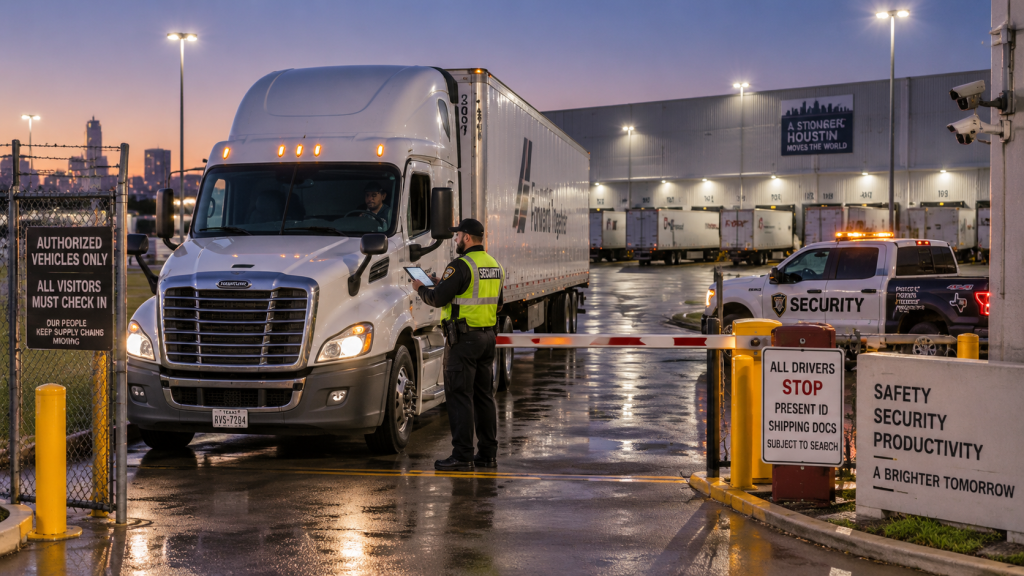
When a transport vehicle reaches the entrance, security personnel follow a fixed sequence under standard loading dock check-in procedures before releasing the barrier arm. Skipping steps creates operational blind spots:
1. Verify the Scheduled Appointment
Confirm the tractor’s arrival against the facility’s yard management schedule. Any vehicle lacking a confirmed delivery or pickup window must remain in an external staging lane until facility dispatch grants formal authorization.
2. Verify the Driver and Carrier
Examine the driver’s commercial driver’s license (CDL) or government-issued photo ID. Ensure the driver’s name, motor carrier details, and load reference align precisely with the dispatch manifest. Unverified subcontracted carriers or missing credentials require immediate operational escalation.
3. Record the Vehicle Identifiers
Log tractor unit numbers, trailer identifiers, license plates, and container codes. Establishing this physical link ties the exact commercial vehicle to the cargo and arrival time stamp.
4. Check the Seal and Paperwork
For loaded inbound trailers, physically inspect the high-security bolt or cable seal. Confirm that the seal is unbroken, untampered, and displays a serial number matching the Bill of Lading (BOL). Any broken or mismatched seal must be photographed and documented before the trailer is moved or opened at the dock.
5. Direct to the Assigned Dock
After clearance is validated, provide the driver with specific dock bay assignments, site speed limits, and yard navigation rules to prevent unauthorized wandering across the terminal.
Phase 3: The Outbound Check-Out Procedure
Check-out operations represent the final defense against fraudulent pickups and load diversion. Releasing outbound freight requires identical discipline to receiving.
Before an outbound tractor-trailer clears the yard, security officers confirm that shipping documents correspond exactly with the manifest. Officers must physically verify that a serialized, tamper-evident seal is locked onto the trailer latches and that its serial number is recorded on the finalized bill of lading. Re-confirming the driver’s identity and tractor number prevents load switches at the gate. Full procedural defenses against strategic freight theft are explored in our manual on logistics yard and distribution center theft prevention.
Phase 4: The Gate Log and Security Documentation
Operational security relies on complete documentation. A rigorous gate log creates an auditable chain of custody, serving as primary evidence during compliance reviews or freight investigations.
Every logged movement should document:
- Precise inbound and outbound timestamps.
- Driver full legal name, ID/CDL number, and contact details.
- Carrier name and DOT/MC registration numbers.
- Tractor, trailer, and container identification marks.
- Bill of Lading (BOL) or booking reference codes.
- Inbound and outbound seal serial numbers and condition notes.
- Assigned loading dock door or yard staging position.
Whether maintained via digital yard management software or hard-copy post logs, these records deter unlawful behavior, detect shipping discrepancies early, and defend operational liability during insurance claims and police investigations.
Phase 5: Special Access Procedures to Build Into Operations
Industrial terminals regularly encounter non-standard vehicle arrivals. Documented procedures ensure consistent processing without ad-hoc decisions:
1. Port & Maritime Facilities
At MTSA-regulated waterfront sites and marine terminals, drivers requiring unescorted access must hold a valid Transportation Worker Identification Credential (TWIC). The broader compliance picture for waterfront and chemical facilities is covered separately in our industrial security guides.
2. Hazmat & Regulated Cargo
Hazardous material loads require verified shipping papers, safety placards, and certified CDL endorsements. Security officers verify documents and route trucks per facility safety protocols.
3. Contractors & Service Vehicles
Maintenance, technical, and third-party vendor vehicles are matched against active work orders, logged into visitor records, and directed to designated parking bays.
4. Denied and Turned-Away Trucks
Vehicles failing credential or documentation checks are routed into dedicated turnaround lanes. Officers de-escalate situations, record entry refusals, and notify dispatch.
Phase 6: Combining Technology and Trained Security Personnel
Protocols succeed only when enforced consistently during busy peak-hour windows and overnight shifts alike. Gate automation, ALPR (Automated License Plate Readers), and appointment barcodes accelerate processing, but they evaluate digital credentials rather than physical reality.
An automated camera cannot detect a cut and glued bolt seal, evaluate an anxious or deceptive driver, or conduct a physical vehicle inspection. Pairing automated systems with professional security officers balances rapid vehicle throughput with critical human oversight. Reviewing operational guard requirements is covered in our analysis of in-house vs contract security guards.
Lock Down Your Gate with God’s Armour Security
The gate is where control of an industrial site is maintained or lost. God’s Armour Security, licensed by the Texas DPS as a security contractor and guard company (License #B07347101), provides gate security officers, dock access controllers, and full check-in personnel for distribution centers, manufacturing plants, and intermodal yards across Greater Houston, Harris County, and statewide Texas.
Our operational supervisors develop custom gate and dock protocols matched to your freight volume, train officers for rigorous post compliance, and deliver defensible gate records. Explore our specialized commercial security services in Houston and proactive security patrol services.
Ready to strengthen your facility’s truck gate and dock controls? Request an industrial security consultation and site assessment or contact our Houston operations center at (713) 878-9984.
Frequently Asked Questions
What is the standard truck gate check-in procedure at an industrial site?
The inbound process follows five steps: verify the appointment in the yard schedule, validate driver photo identification and carrier credentials, log tractor and trailer identifiers, inspect cargo seals against the bill of lading, and direct the driver to the assigned dock bay.
Why is outbound dock check-out as important as check-in?
Outbound check-out is the final opportunity to prevent cargo theft, load diversion, or unauthorized pickups. Security personnel match dispatch paperwork, inspect the newly applied trailer seal, verify driver identity, and record departure details before releasing the vehicle.
What details should be recorded in an industrial gate log?
A defensible gate log captures entry and exit timestamps, driver legal name and license numbers, motor carrier details, tractor and trailer identifiers, Bill of Lading numbers, and serialized seal records.
Do automated gate systems replace security officers?
No. While automation and license plate readers speed data logging, they cannot physically inspect high-security seals, detect altered paperwork, or handle vehicle turnaways. Combining automated gates with trained security officers provides maximum perimeter security.
Key Takeaways
- The industrial truck gate is the core perimeter control point where drivers, tractors, and cargo must be validated simultaneously.
- Systematic inbound procedures eliminate fraudulent carriers and unauthorized yard congestion.
- Outbound inspections ensure cargo matches manifests and verified security seals are locked before departure.
- Detailed, time-stamped gate logs establish an auditable record that protects against cargo theft and insurance liabilities.
- Deploying trained security officers alongside gate technology ensures consistent compliance during peak transit hours.