The stretch of chemical plants, refineries, and petrochemical terminals along the Houston Ship Channel and through Pasadena, Deer Park, Baytown, and Texas City is one of the densest concentrations of high-hazard facilities in the country. Securing them is not just good practice; for many of these sites it is, or has been, a matter of federal regulation. But the regulatory picture has shifted in recent years, and a lot of operators are unclear on what actually applies to them today.
The honest answer is that chemical facility security in Texas is governed at the federal level, and one of the two main programs is currently lapsed while the other remains fully in force. This guide clarifies where the regulations stand now, what still applies to waterfront facilities, and the physical perimeter security that protects a chemical site regardless of the regulatory flux.
Phase 1: The Regulatory Landscape at a Glance
Chemical facility security in Texas comes from federal programs, not a single state security statute. Here is where the main frameworks stand, and it is important to note that this landscape can change.
| Framework | What It Covers | Current Status |
|---|---|---|
| CFATS (DHS/CISA) | Security at high-risk facilities holding chemicals of interest. | Authority lapsed in July 2023; not currently enforceable. |
| MTSA (U.S. Coast Guard) | Security at waterfront and maritime facilities, including many on the Ship Channel. | Active and enforced under 33 CFR Part 105. |
| Voluntary programs (ChemLock, industry codes) | Voluntary chemical security guidance and best practices. | Available; not mandatory. |
| EPA RMP and OSHA PSM | Process safety and accidental-release prevention, not security. | Active, but safety-focused rather than security programs. |
The takeaway is that a Ship Channel facility on the water is likely under active MTSA requirements, while a landlocked plant that was previously CFATS-regulated may not have an enforceable federal security mandate at the moment, even though the underlying risk has not changed.
Phase 2: CFATS and Its Current Lapse
The Chemical Facility Anti-Terrorism Standards program, run by the Cybersecurity and Infrastructure Security Agency (CISA) under the Department of Homeland Security, was for years the primary federal chemical security regulation. Understanding both what it required and where it stands now is essential.
Under CFATS, facilities holding certain chemicals of interest above threshold quantities had to report their holdings, and those designated high-risk were assigned a tier and required to meet risk-based performance standards covering perimeter security, access control, personnel screening, cybersecurity, and more, documented in a site security plan.
The critical current fact: the statutory authority for CFATS lapsed on July 28, 2023, and CISA cannot enforce the CFATS regulations, require site security plans, or conduct CFATS inspections. The program’s online reporting tool has been taken offline. CISA has encouraged formerly covered facilities to maintain their security measures voluntarily and offers its voluntary ChemLock resources in the interim. Congress could reauthorize the program, which would bring the requirements back, so operators should confirm the current status rather than assume the lapse is permanent.
Regulatory status changes. The CFATS lapse described here is current, but Congress may reauthorize the program. Confirm the present status of CFATS and any other requirement with CISA and qualified compliance counsel before relying on it.
Phase 3: MTSA, the Framework Still in Force for Waterfront Facilities
For the many chemical and energy facilities along the Houston Ship Channel and other waterways, the more immediately relevant regulation is the Maritime Transportation Security Act, enforced by the U.S. Coast Guard. Unlike CFATS, MTSA is active and enforced.
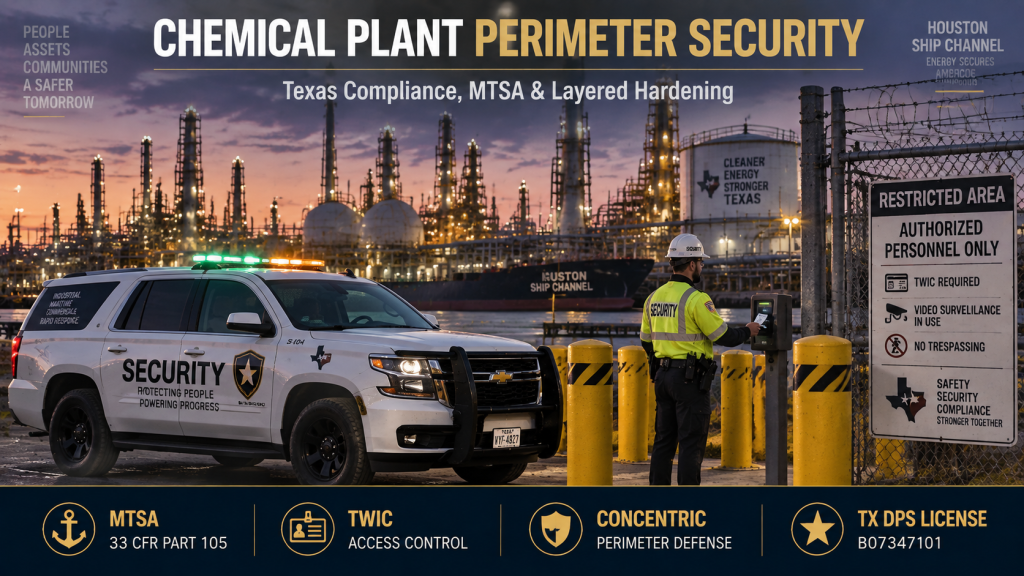
MTSA applies to facilities on or adjacent to navigable waterways that handle certain cargoes or vessels, which includes a large share of the Ship Channel’s petrochemical terminals. Covered facilities must conduct a facility security assessment, develop and maintain a Coast Guard-approved Facility Security Plan, designate a Facility Security Officer, and control access, including requiring a valid Transportation Worker Identification Credential (TWIC) for unescorted access to secure areas. That TWIC requirement is exactly what a gate officer verifies, as covered in our guide on industrial truck gate and loading dock check-in procedures. For a waterfront chemical facility, MTSA compliance, not CFATS, is usually the active federal security obligation.
Phase 4: The Physical Perimeter Security That Applies Regardless
Whatever the regulatory status, the physical threat to a chemical facility, theft, sabotage, trespassing, and worse, does not change. The core physical security measures below are what these facilities need on the ground, and they are the same measures the regulations describe when they are in force.
The most effective chemical-site security is layered in concentric rings rather than a single fence line: an outer secured perimeter, then controlled internal zones around restricted areas, and the tightest control around the highest-consequence assets such as tank farms, process units, and hazardous-material storage. This is the same logic the federal risk-based performance standards used, restrict the perimeter, secure site assets, and screen and control access, and it holds whether or not those standards are being enforced.
1. Hardened Perimeter
A maintained fence line with clear zones, intrusion detection where warranted, and no gaps or washouts is the first barrier. At approach roads and gates, crash-rated bollards and barriers add protection against a vehicle being used to force entry.
2. Controlled Access
Every person and vehicle verified at controlled gates, with credentials checked, entries logged, and unauthorized access stopped before it reaches the process area.
3. Detection and Monitoring
Lighting, cameras, and alarms across the perimeter and critical assets, tied to a response so a breach is caught, not just recorded.
4. Trained Officers and Patrols
Officers at the gate and patrols across the site provide the human judgment and response that hardware alone cannot, especially across a large footprint.
These are the same measures that protect any large industrial site, applied to a higher-consequence environment. The broader approach to securing sprawling energy and chemical footprints is covered in our guide on physical security protocols for oil and gas facilities. For sites utilizing marked cruisers to inspect outer boundaries, review vehicle standards in marked vs unmarked security patrol vehicles, and ensure rounds avoid predictability through randomized vs scheduled patrol rounds.
Phase 5: Why Security Still Matters With CFATS Lapsed
It would be a mistake to read the CFATS lapse as permission to ease off. The regulatory requirement may be paused for some facilities, but every other reason to secure a chemical site remains, and several are just as binding in practice.
| Reason Security Still Applies | Why It Holds Regardless of CFATS |
|---|---|
| The threat is unchanged | Theft, sabotage, and trespassing risks exist whether or not a program is enforcing rules. |
| MTSA may still apply | Waterfront facilities remain under active Coast Guard security requirements. |
| Insurance and liability | Insurers and premises liability standards expect reasonable security at a high-hazard site. |
| Reauthorization is possible | If CFATS returns, facilities that kept their measures in place are ready; others scramble. |
CISA itself has urged formerly covered facilities to keep their security measures running during the lapse. Maintaining a documented security program now is both the responsible position and the one that protects a facility against liability and prepares it for reauthorization.
Phase 6: The Texas and Local Picture
Because chemical facility security is federal, there is no separate Texas state security code that fills the CFATS gap. Texas agencies such as the TCEQ regulate the environmental side, air, water, and waste, not facility security, so they should not be mistaken for a security authority. What that leaves is a practical hierarchy: MTSA where a facility is on the water, CFATS if and when it is reauthorized, local fire and building codes for life safety, and the facility’s own risk-based physical security program filling the rest.
For chemical complexes undertaking heavy maintenance or experiencing alarm impairments, dedicated monitoring is legally mandated under local codes; review life-safety obligations in when is a fire watch legally required for industrial sites in Texas? Furthermore, when intrusion sensors trip on the fence line, immediate physical verification prevents false alarms; explore response protocols in private security alarm response vs local police dispatch. Many operators anchor their program to a recognized risk-assessment methodology such as API Standard 780 for petroleum and petrochemical facilities, which evaluates threats, vulnerabilities, and consequences before selecting countermeasures.
This article is general information, not legal or compliance advice. Chemical facility security requirements are set by federal law and agencies and can change, including any reauthorization of CFATS. Confirm the exact obligations for your facility with CISA, the U.S. Coast Guard where applicable, and qualified compliance counsel.
Secure Your Chemical or Industrial Facility with God’s Armour Security
Regulations may shift, but the need to physically protect a high-hazard site does not. God’s Armour Security, licensed by the Texas DPS as a security contractor and guard company (license no. B07347101), provides gate officers, access control, marked mobile patrols, and documented coverage for chemical plants, refineries, terminals, and industrial facilities across the Houston Ship Channel, Harris County, and statewide Texas.
Our supervisory team assesses your perimeter, access points, and critical assets, builds a physical security program suited to a high-consequence environment, and delivers the documented coverage that supports both your risk management and your compliance posture. Explore our commercial security services in Houston and our security patrol services.
Ready to secure your facility? Request an industrial security consultation and site assessment or call our Houston operations desk directly at (713) 878-9984.
Frequently Asked Questions
Is chemical plant security still legally required in Texas?
It depends on the facility. The main federal chemical security program, CFATS, lapsed in July 2023 and is not currently enforceable, so a formerly CFATS-regulated inland plant may not have an active federal security mandate right now. However, waterfront facilities remain under the Coast Guard’s MTSA requirements, and all high-hazard sites still face insurance, liability, and threat-based reasons to maintain strong security. Confirm current requirements for your site.
What is the current status of CFATS?
The statutory authority for the Chemical Facility Anti-Terrorism Standards program lapsed on July 28, 2023. As of this writing, CISA cannot enforce CFATS, require site security plans, or conduct CFATS inspections, and its reporting tool is offline. CISA encourages facilities to maintain security voluntarily. Congress could reauthorize the program, so confirm the present status before relying on the lapse.
Does MTSA apply to chemical facilities on the Houston Ship Channel?
Often, yes. The Maritime Transportation Security Act, enforced by the U.S. Coast Guard, applies to many waterfront and maritime facilities, including a large share of the Ship Channel’s petrochemical terminals. Covered facilities must maintain a Coast Guard-approved Facility Security Plan, a Facility Security Officer, and controlled access, including TWIC verification for unescorted entry to secure areas.
Does the TCEQ regulate chemical plant security in Texas?
No. The Texas Commission on Environmental Quality regulates environmental matters such as air, water, and waste, not facility security. Chemical facility security is governed by federal frameworks like CFATS and MTSA, so the TCEQ should not be treated as a security authority.
Key Takeaways
- Chemical facility security in Texas is governed by federal programs, not a single state security statute.
- CFATS, the main federal chemical security program, lapsed in July 2023 and is not currently enforceable, though it could be reauthorized.
- MTSA remains active and applies to many waterfront facilities on the Houston Ship Channel, requiring a Facility Security Plan, a Facility Security Officer, and TWIC-controlled access.
- Effective sites use layered, concentric security zones and, where warranted, crash-rated barriers, plus hardened fencing, controlled access, detection, and patrols, regardless of regulatory status.
- Insurance, liability, an unchanged threat, and possible CFATS reauthorization all make maintaining a documented security program the sound position.