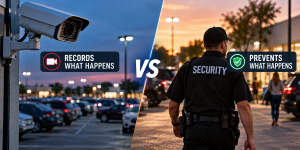
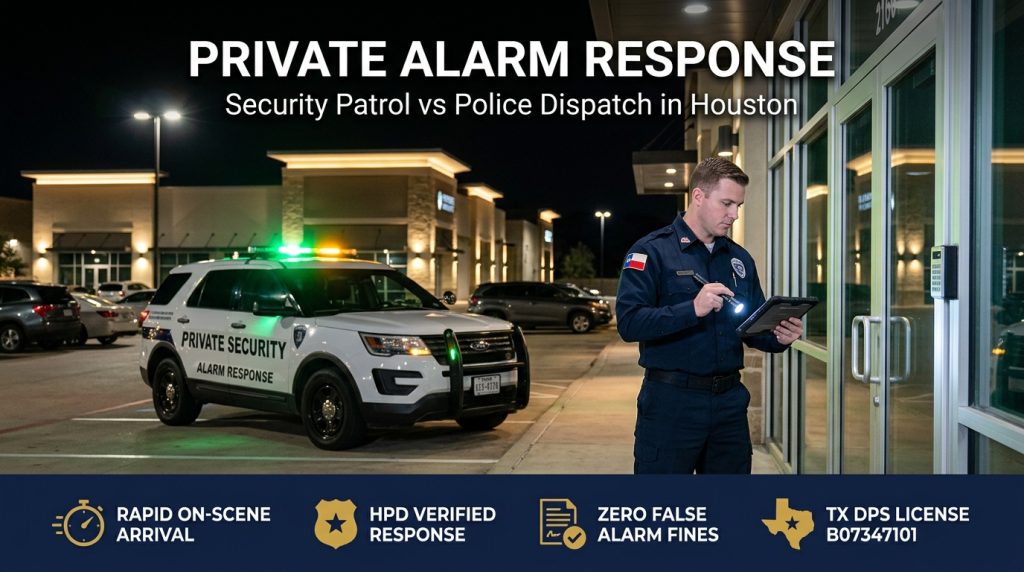
When a burglar alarm trips at a commercial property at two in the morning, the owner assumes the same thing most people do: the police are on their way. The reality is more complicated. Across Greater Houston and Texas, police response to unverified alarms is slow, deprioritized, and in some cities restricted outright, because the overwhelming majority of alarm calls turn out to be false. That gap between what owners expect and what actually happens is where private security alarm response comes in.
This is not a case of private security replacing the police. It is about understanding what police dispatch will and will not do for an alarm, what your city requires of you, and how a private response service closes the gap with fast, on-scene verification. This guide breaks down how each works, what Houston’s alarm rules mean for you, and how to build a response plan that actually protects your property.
Phase 1: The Reality of Police Response to Alarms
Police departments take real crimes seriously, but a burglar alarm is not proof of a crime, it is a signal that might mean one. And the numbers work against it. Law enforcement has long estimated that the large majority of burglar alarms they respond to, by some accounts well over 90 percent, are false. Every one of those pulls officers off the street for nothing, so alarm calls sit low on the priority list.
The result is predictable: an unverified alarm often draws a slow response, or in a growing number of jurisdictions, a limited one. Some Texas cities have moved toward verified response policies, where police will not dispatch to an alarm unless it is a panic signal or has been confirmed as a real event by a witness, a camera, or a person on scene. The takeaway for a property owner is simple: an alarm alone does not guarantee a fast police response, and increasingly does not guarantee one at all.
| Factor | Local Police Dispatch | Private Security Response |
|---|---|---|
| Priority of an unverified alarm | Low; ranked behind in-progress crimes and emergencies. | The core job; the alarm is the reason the officer is dispatched. |
| Typical speed | Variable and often slow for a routine alarm. | Fast, especially when a patrol is already nearby on a route. |
| What they do on arrival | Full law enforcement authority: arrest, use of force, criminal investigation. | Verify the scene, deter, secure the property, and call police if it is real. |
| False alarm consequence | City fines and, after repeats, loss of response. | Resolved on site without triggering a city false-alarm penalty. |
Phase 2: Houston’s Alarm Permit and False-Alarm Rules
Before relying on any police response to an alarm, Houston property owners have to meet the city’s requirements, and they are stricter than many owners realize.
Under the City of Houston’s burglar alarm ordinance, any alarm system that requests police response must have a valid alarm permit, and the police will not dispatch to an alarm without a permit number on file. Beyond that, the city charges escalating penalties for false alarms: after a small number of free false alarms in a 12-month period, each additional one carries a fee, and after repeated false alarms a permit can be revoked, which ends police response to that address entirely. A non-permitted alarm is charged a high per-incident fee or gets no response at all.
The practical effect is that a business relying only on an alarm and police dispatch is exposed on two sides: a real break-in may get a slow response, while a string of false alarms racks up city fines and can cost the property its police response altogether. This is precisely the problem a private response service is built to solve.
Alarm permit rules and false-alarm fees are set by city ordinance and change over time. Confirm the current requirements and fee schedule with the City of Houston or your local jurisdiction.
Phase 3: How Private Security Alarm Response Works
Private alarm response is a straightforward service with a specific job: get a trained officer to the property fast, find out whether the alarm is real, and act accordingly. The sequence usually looks like this:
1. Dispatch
When the alarm trips, the response service is notified and sends the nearest officer, often a patrol already working a route in the area, straight to the property.
2. On-Scene Verification
The officer checks the property: doors, windows, the perimeter, and points of entry, to determine whether this is a genuine break-in or a false trip.
3. Deter and Secure
A visible officer on scene deters anyone still present, and the officer can secure an open door or gate and document the condition of the property.
4. Escalate if Real
If it is an actual crime, the officer calls police, now as a verified, in-progress event that gets priority, and stays to brief them and preserve the scene.
That verification step is the heart of the value. A private officer turns an unverified alarm, which police may deprioritize, into a confirmed event that police will treat as urgent, while filtering out the false alarms that would otherwise cost you fines.
Phase 4: The False-Alarm Cost Problem It Solves
Most alarm activations are false: a door left unlatched, a faulty sensor, wind, an employee error. Under a police-only model, each of those can become a dispatched call that counts against your permit and, past the free threshold, costs a fee, with permit revocation waiting at the end of a bad run.
Private alarm response breaks that cycle. When the officer arrives and finds no real threat, the alarm is resolved on site. Police are never dispatched to a false alarm, so it never becomes a city penalty, and your permit standing stays clean. For a property that trips its alarm even occasionally, the fines avoided can offset a meaningful part of the response service’s cost, on top of the protection it provides.
Phase 5: Private Response Is Not a Police Replacement
It is important to be clear about the line here. A private security officer is not a police officer and does not carry police authority. The two roles are different, and the strongest setup uses both for what each does best.
A private officer’s job at an alarm is to respond fast, verify, deter, secure, and document, and to summon police the moment a real crime is confirmed. What they do not do is replace law enforcement: police carry arrest authority, handle violent crime, and conduct criminal investigations. The value of private response is speed and verification at the front end, getting eyes on the property quickly and making sure that when police are called, it is for a real, confirmed event rather than one more false alarm. Understanding the legal limits of what a private officer can do is part of using them correctly, which we cover in our guide on what security guards are legally allowed to do in Texas.
Phase 6: Building Alarm Response Into Your Security Plan
Alarm response works best as one layer of a plan, not a standalone fix. A few steps make it effective:
- Pair alarms with a response. An alarm that only makes noise or only pings a slow police queue is half a system. Tie it to a service that actually sends someone to verify.
- Combine it with patrols. A provider already running patrols in your area can respond fastest, since an officer may be minutes away. See how that coverage works in our guide on commercial property security after-hours.
- Keep your city permit current. Even with private response, maintain your alarm permit so police can still be dispatched when the officer confirms a real crime.
- Fix the false-alarm sources. Faulty sensors, unlatched doors, and staff errors drive most false trips. Reducing them lowers both risk and cost, and pairs with the access controls in our guide on office building access control.
Fast, Verified Alarm Response from God’s Armour Security
An alarm is only as good as who responds to it. God’s Armour Security, licensed by the Texas DPS as a security contractor and guard company (license no. B07347101), provides mobile alarm response and patrol coverage for retail centers, office parks, industrial sites, and commercial properties across Greater Houston, Harris County, and statewide Texas.
Our officers reach your property quickly, verify whether an alarm is real, secure the scene, and call police as a confirmed event when a crime is in progress, filtering out the false alarms that would otherwise cost you city fines. Explore our commercial security services in Houston and our security patrol services.
Want a real response when your alarm goes off? Request an alarm response consultation and property assessment or call our Houston operations desk directly at (713) 878-9984.
Frequently Asked Questions
Do police respond to burglar alarms?
Yes, but usually at a low priority, because the large majority of alarm calls turn out to be false. An unverified alarm is often ranked behind in-progress crimes and emergencies, and some cities have moved to verified response policies that limit or withhold dispatch to alarms that have not been confirmed as real by a person, camera, or panic signal.
What is private security alarm response?
It is a service where a trained security officer is dispatched to your property when an alarm trips. The officer arrives quickly, checks the property to verify whether the alarm is real, deters and secures the scene, and calls police as a confirmed event if an actual crime is in progress. False alarms are resolved on site without a police dispatch.
Does a private security guard replace the police?
No. A private officer does not have police authority and does not replace law enforcement. Police handle arrests, violent crime, and criminal investigations. Private alarm response provides fast on-scene verification and deterrence, and summons police for a real, confirmed event. The two work together.
Can private alarm response help avoid false-alarm fines in Houston?
Yes. Houston charges escalating fees for repeated false alarms and can revoke an alarm permit after too many. When a private officer verifies a false alarm on site, police are not dispatched, so it does not count against your permit or trigger a city penalty. Confirm current permit and fee rules with the city.
Key Takeaways
- Police treat unverified burglar alarms as low priority because most are false, so an alarm alone does not guarantee a fast, or in some cities any, police response.
- Houston requires an alarm permit for police dispatch, charges escalating false-alarm fees, and can revoke response after repeated false alarms.
- Private alarm response sends an officer to verify the alarm, deter, secure the scene, and call police as a confirmed event if it is real.
- Because false alarms are resolved on site, private response avoids the city fines and permit risk that police-only dispatch creates.
- Private response complements police rather than replacing them, and works best paired with patrols and a maintained alarm permit.