When planning a mobile security program for commercial real estate, corporate facilities, or industrial complexes, property managers face a strategic decision regarding fleet visibility: should patrol officers drive high-visibility marked security cruisers, or deploy in unmarked vehicles? Each vehicle configuration serves a fundamentally different security objective. Deploying the wrong vehicle profile can undermine your property’s security goals, either alerting wrongdoers too early or failing to provide the visible presence necessary to reassure legitimate tenants and customers.
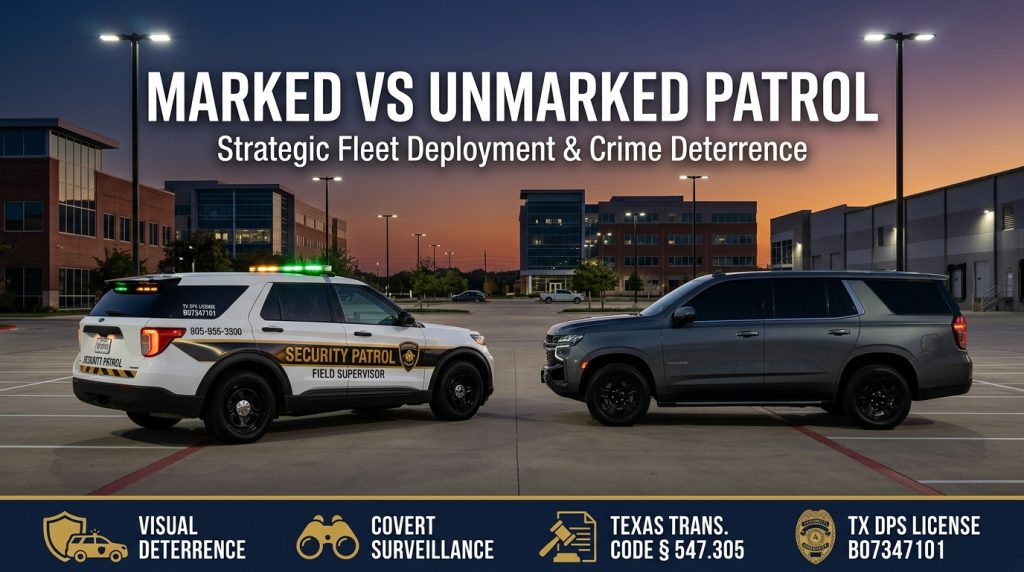
A marked security vehicle is built for psychological deterrence. With bold reflective lettering, amber or green auxiliary strobe arrays, and tactical spotlights, a marked cruiser projects authority across vast parking lots and perimeter fence lines, signaling that the property is actively defended. In contrast, an unmarked security vehicle is an investigative and covert observation tool, designed to blend into standard traffic flow to observe illegal dumping, persistent employee theft rings, or organized retail crime without tipping off perpetrators.
Evaluating marked vs unmarked security patrol vehicles requires balancing crime prevention against investigative detection. This operational guide provides commercial asset managers and facility directors across Greater Houston and Texas with a clear analysis of visibility dynamics, Texas vehicle lighting regulations, situational deployment use cases, and hybrid patrol strategies.
Phase 1: Tactical Objectives: Deterrence vs. Apprehension
The operational choice between marked and unmarked patrol fleets centers on whether your primary objective is stopping a crime before it begins, or capturing evidence while a crime is underway:
1. Marked Patrol Fleets: High-Impact Visual Deterrence
The primary purpose of a marked security vehicle is Crime Prevention Through Environmental Design (CPTED). Visible authority alters the risk calculation of opportunistic offenders. When a marked SUV with high-visibility graphics and active amber/green roof strobes enters a shopping center or apartment complex, its presence is obvious from hundreds of yards away. Opportunistic trespassers, loiterers, and vehicle burglars leave the property to seek softer, unmonitored targets.
Furthermore, marked patrol cruisers provide immense public relations and peace-of-mind value. For commercial office tenants walking to their vehicles after dark or retail customers shopping late, seeing a marked patrol unit provides tangible reassurance, directly supporting tenant retention and property reputation.
2. Unmarked Patrol Fleets: Covert Observation & Intelligence Gathering
While marked cruisers excel at deterrence, they possess an inherent limitation: offenders see them coming. When a marked vehicle turns into an industrial yard or commercial alley, trespassers and thieves quickly duck behind shipping containers or flee before an officer can identify them or record license plates.
Unmarked vehicles eliminate this warning buffer. Operating standard, unbadged commercial SUVs or sedans, plainclothes or uniformed officers can observe suspicious activity from a distance without alerting wrongdoers. Unmarked patrols are particularly effective for investigating ongoing internal shrinkage, identifying organized theft rings casing auto dealerships, documenting illegal trash dumping, and catching repeat vandals who time marked guard sweeps.
To compare the broader operational differences between roving vehicular assets and stationary post assignments, review our analysis of mobile patrol vs dedicated stationed guards.
Phase 2: Operational Comparison Matrix
The matrix below outlines the tactical, financial, and legal distinctions between marked and unmarked patrol operations across commercial sites:
| Tactical Dimension | Marked Security Patrol Vehicles | Unmarked Security Patrol Vehicles |
|---|---|---|
| Core Security Function | Overt crime deterrence, psychological denial, tenant peace of mind, public visibility. | Covert surveillance, incident documentation, internal theft interdiction, element of surprise. |
| Perimeter Presence Profile | 100% visible; high-contrast vinyl wraps, reflective badges, directional spotlights. | Concealed presence; standard civilian vehicle exterior; no overt commercial security lettering. |
| Texas Strobe Light Options | Equipped with green, amber, or white auxiliary roof bars under Texas Trans. Code § 547.305. | No exterior roof light bars; interior concealed dash lights only if authorized and required. |
| Tenant & Public Perception | High reassurance; clearly communicates active management protection of common areas. | Neutral or unnoticed; does not provide visible comfort to tenants or visitors. |
| Suspect Interaction Dynamics | Suspects scatter or avoid the site entirely; low direct physical interdiction rate. | Enables officers to witness offenses in progress and coordinate directly with local police. |
| Typical Billing Model | Standard shared per-hit sweeps ($15–$35/visit) or dedicated hourly billing ($30–$48/hr). | Dedicated hourly contracts or specialized short-term investigative surveillance retainers. |
For an overview of local billing rates, sweep costs, and contract structures in the regional market, see our detailed pricing guide on how much mobile security patrol costs in Houston.
Phase 3: Texas Legal & Statutory Framework for Patrol Vehicles
Operating security patrol fleets in Texas requires strict compliance with state transportation and licensing statutes:
1. Texas Transportation Code § 547.305 (Auxiliary Lighting)
Texas law strictly regulates vehicle lighting arrays to prevent private entities from impersonating law enforcement. Under Texas Transportation Code § 547.305, private security patrol vehicles are legally permitted to use only green, amber, or white auxiliary lighting. Flashing red or blue lights are strictly reserved for law enforcement, emergency medical services, and fire rescue. Using unauthorized lighting carries criminal penalties and creates immense civil liability for property owners.
2. DPS Vehicle Livery and Lettering Mandates
Under Texas Occupations Code Chapter 1702, private security companies must ensure that marked vehicles clearly display the word “Security” along with the licensed company name. Marked cruisers must never use seals, badges, or font treatments that simulate the Houston Police Department, Harris County Sheriff’s Office, or Texas Highway Patrol.
3. Authority Boundaries for Unmarked Units
Private security officers operating unmarked vehicles have no less legal authority than officers in fully marked units, and no more. Under Texas law, private security personnel operate as authorized agents of property owners, deriving their authority from property ownership rights and Texas Penal Code § 30.05 (Criminal Trespass). An officer in an unmarked unit can issue binding verbal trespass warnings, request identification, and summon municipal police, but holds no peace officer powers; review guard authority boundaries in our legal resource on Texas shoplifting laws and security guard authority.
When selecting a patrol vendor, confirming vehicle compliance and state licensing shields ownership from liability; review essential questions in 10 questions to ask before hiring a commercial security guard company.
Phase 4: Site-Specific Deployment Scenarios: When to Use Each
Selecting between marked and unmarked deployment depends entirely on the operational environment and the specific threats facing your commercial facility:
When to Deploy Marked Security Patrol Vehicles
- Commercial Shopping Centers & Strip Malls: High-visibility marked vehicles deter shoplifters, prevent vehicle break-ins in expansive parking lots, and deter overnight loiterers around rear service corridors; review shared retail cost structures in shared security cost models for strip malls and shopping centers.
- Class A Corporate Office Parks: Marked cruisers maintaining visible presence along driving lanes prevent after-hours auto burglary and provide reassuring escorts for employees working late.
- Industrial Yards & Distribution Hubs: Marked 4×4 patrol trucks with illuminated amber/green auxiliary lights deter copper thieves and perimeter fence breaches across multi-acre logistics yards.
- After-Hours Property Checks: Marked vehicles performing randomized passes signal that the site is actively defended; review tactical timing in randomized vs scheduled patrol rounds: which deters more crime?
When to Deploy Unmarked Security Patrol Vehicles
- Internal Warehouse & Employee Theft Investigations: If a logistics warehouse experiences inventory loss during third-shift loading docks, a marked cruiser will only cause dishonest workers to pause their operations. An unmarked vehicle allows investigators to monitor loading areas undetected.
- Organized Retail Crime (ORC) Surveillance: When professional theft crews target high-end retail districts, unmarked surveillance vehicles track suspect getaway cars and communicate live descriptions directly to local police dispatch.
- Chronic Illegal Dumping & Vandalism: If an unmonitored commercial alleyway is repeatedly targeted by midnight dumpers or graffiti crews who time marked patrol visits, an unmarked stationary vehicle can capture video evidence, log license plates, and coordinate immediate arrests.
- Executive & VIP Transit: High-profile corporate executives and private clients often require low-profile security escorts where drawing public attention is undesirable.
For facilities evaluating how mobile units respond to electronic perimeter trips, compare response workflows in our analysis of private security alarm response vs local police dispatch.
Phase 5: The Hybrid Fleet Model: Combining Overt Deterrence and Covert Intel
For high-risk commercial properties across the Houston metropolitan area, the most effective security strategy is not choosing exclusively between marked or unmarked vehicles, but combining both into a coordinated Hybrid Fleet Model:
- Primary Overt Footprint (Marked Fleet): Maintain daily and nightly marked patrol sweeps across parking fields, customer entries, and common areas. This provides standard CPTED deterrence, supports tenant satisfaction, and satisfies insurance standards under Texas premises liability doctrines.
- Targeted Covert Operations (Unmarked Units): When a property experiences a sudden spike in repeat offenses—such as targeted catalytic converter thefts or copper stripping—deploy unmarked observation vehicles for short-term tactical periods (e.g., 2 to 3 weeks). The unmarked unit observes patterns, tracks entry points, and provides real-time intel to on-site marked units and municipal police.
- Premises Liability Defense: Deploying visible patrols demonstrates ordinary care under the Texas Supreme Court Timberwalk doctrine, while covert follow-ups prove that ownership actively investigated specific recurring hazards; review landlord-tenant legal duties in commercial lease security responsibilities: tenant and landlord roles.
To eliminate parking area theft vectors before deploying covert surveillance, explore foundational parking lot safeguards in our guide on how to stop car break-ins in commercial parking lots.
Protect Your Commercial Assets with God’s Armour Security
Whether your commercial facility requires high-visibility marked security cruisers to establish commanding perimeter deterrence, or discrete unmarked units to investigate chronic property shrinkage, God’s Armour Security delivers tailored physical security solutions across Greater Houston, Harris County, and statewide Texas.
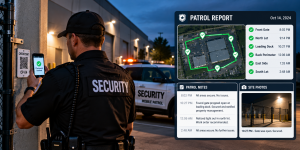
We are licensed by the Texas Department of Public Safety as a security contractor and guard company (license no. B07347101). Our modern patrol fleet complies fully with Texas Transportation Code § 547.305, utilizing green, amber, and white auxiliary lighting, cellular dispatch communications, GPS telematics, and digital NFC checkpoint reporting systems. Explore our specialized commercial security patrol services and our broader commercial security services in Houston.
Ready to design the optimal patrol fleet configuration for your commercial property? Request a commercial property security assessment and patrol fleet consultation or call our Houston command center directly at (713) 878-9984.
Frequently Asked Questions
What is the difference between marked and unmarked security patrol vehicles?
Marked security vehicles feature bold reflective lettering, company logos, and auxiliary green, amber, or white lighting to provide visible deterrence and reassure tenants. Unmarked security vehicles look like standard civilian vehicles without security branding, designed for covert observation, internal theft investigations, and surveillance without alerting suspects.
Are private security companies in Texas legally allowed to use flashing lights?
Yes, but with strict legal color restrictions. Under Texas Transportation Code § 547.305, private security patrol vehicles are permitted to use only green, amber, or white auxiliary lights. Flashing red or blue lights are strictly reserved for law enforcement and emergency vehicles.
When should a commercial property use unmarked security vehicles?
Unmarked security vehicles are ideal when investigating internal employee theft, monitoring chronic illegal dumping, tracking organized retail crime casing, or catching repeat vandals who time the arrival of marked patrol cruisers.
Do marked security vehicles deter more crime than unmarked vehicles?
Yes, for opportunistic property crimes. Visible marked patrol units create psychological deterrence, making potential offenders aware that the property is actively monitored and causing them to seek softer, unmonitored targets.
Key Takeaways
- Marked security patrol vehicles provide visible deterrence, tenant reassurance, and active property presence.
- Unmarked security vehicles provide covert observation, ideal for investigating internal theft rings, illegal dumping, and organized property casing.
- Private security vehicles in Texas are legally restricted to green, amber, or white auxiliary lighting under Texas Transportation Code § 547.305.
- Deploy a hybrid model: maintain marked patrol cruisers for routine deterrence while utilizing unmarked vehicles for specific investigative operations.
- God’s Armour Security operates under Texas DPS license B07347101, providing fully compliant marked and covert mobile patrol solutions across Greater Houston.