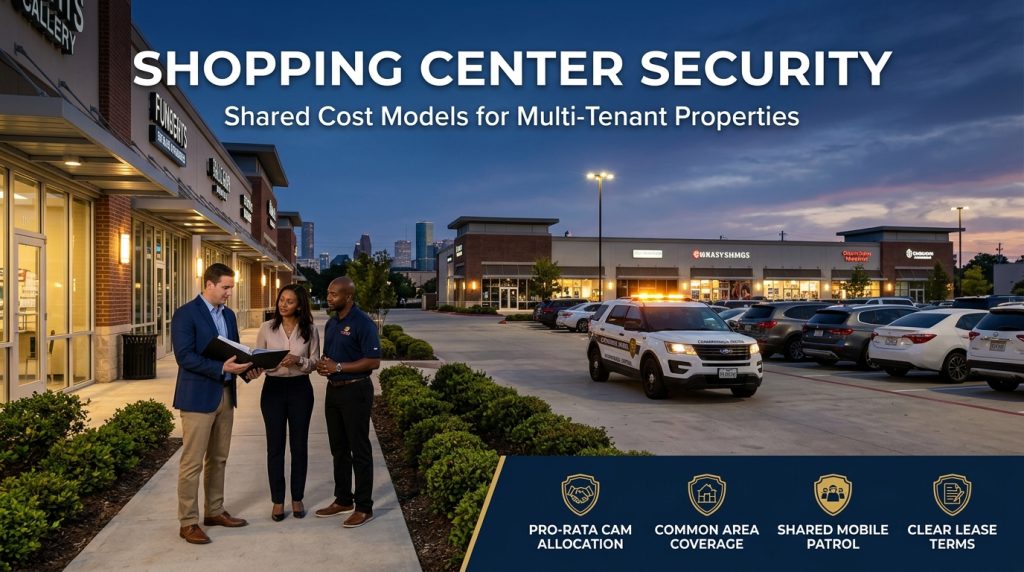
For independent retail operators, restaurant owners, and strip mall landlords across Greater Houston and Texas, contracting dedicated on-site security often feels cost-prohibitive for a single storefront. Yet an unsecured strip center quickly attracts vehicle break-ins, loitering, catalytic converter theft, and aggressive organized retail crime. When crime strikes one tenant, customer foot traffic drops for the entire shopping plaza.
The solution used by leading commercial developers and property managers is a structured cost-sharing framework. By distributing security expenses across all shopping center tenants through Common Area Maintenance (CAM) reconciliations or voluntary merchant consortiums, property owners can deploy marked vehicle patrols, uniformed officers, and surveillance upgrades at a fraction of the cost an individual retailer would pay alone.
However, dividing private security expenses among diverse tenants from anchor grocery stores to small nail salons presents operational and legal complexities. Structuring an equitable shared-cost model requires clear lease language, transparent service level agreements, and alignment with Texas premises liability standards. This practical guide breaks down the four primary shared-cost models, lease pass-through mechanics, and how to structure an effective security program for commercial shopping centers.
Phase 1: Comparing the Four Shared Security Cost Models
Shopping center operators and merchant associations typically structure shared security funding through one of four models:
| Cost-Allocation Model | How Costs Are Calculated | Best Suited For | Operational Drawback |
|---|---|---|---|
| Pro-Rata Square Footage (CAM) | Each tenant pays based on their percentage of Total Leasable Area (TLA). | Standard triple-net (NNN) commercial leases with a master landlord. | Anchor stores carry most of the bill, leading to pushback if they already employ internal loss prevention. |
| Equal-Share Per-Door Split | Total monthly security cost is divided evenly among all occupied retail suites. | Boutique strip centers (5 to 12 bays) with uniform retail unit sizes. | Disproportionately burdens smaller 1,200 sq. ft. operators compared to larger tenants. |
| Risk-Weighted / Operating-Hour Split | Tenants with late-night hours (bars, 24-hr gyms) or cash-heavy models pay a higher risk premium. | Mixed-use centers combining daytime retail, medical offices, and late-night nightlife. | Requires detailed accounting reconciliations and can cause friction during lease negotiation. |
| Voluntary Merchant Consortium | Tenants independently pool funds to contract shared mobile patrol or guard sweeps. | Older strip centers where master leases lack an enforceable security CAM clause. | High risk of “free-rider” problems where non-paying tenants still benefit from lot patrols. |
When customer vehicles are targeted in common parking areas, liability often centers on property ownership; examine risk baselines in our guide on parking lot crime liability for property owners.
Phase 2: Triple Net (NNN) Leases and CAM Pass-Through Mechanics
In most Texas commercial strip centers, operating expenses are governed by triple net (NNN) leases. Under a NNN lease structure, tenants pay a base rent plus their proportionate share of property taxes, insurance, and Common Area Maintenance (CAM).
To pass private security costs through CAM without tenant dispute, property managers must observe three foundational principles:
- Explicit Lease Authorization: The master lease must explicitly list security services, mobile vehicle patrols, exterior lighting maintenance, and surveillance systems as reimbursable operating expenses under CAM definitions. Ambiguous clauses that only cite “general maintenance” often fail when challenged in arbitration.
- Common Area Limitation: Shared security funded through CAM must strictly protect common areas exterior parking lots, shared pedestrian breezeways, service alleys, and delivery loading docks. CAM funds cannot be billed to supply dedicated loss prevention guards stationed exclusively inside a specific tenant’s store.
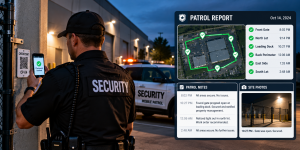
- Annual Transparent Reconciliation: Landlords must provide itemized accounting showing the contracted security rate, patrol GPS sweep logs, and incident reports during annual CAM reconciliations. Full transparency eliminates tenant pushback and demonstrates prudent management.
For strip malls facing inventory leakage across multiple storefronts, review store-level controls in our manual on how to reduce retail shrinkage.
This article is general information, not legal or financial advice. What can be passed through CAM depends on your specific lease terms, so confirm with your property manager or attorney before structuring or billing shared security costs.
Phase 3: Selecting the Right Service Profile for Shared Cost
Pooling funds allows smaller commercial centers to purchase high-impact security services that match their budget profile:
1. Scheduled Mobile Patrol Sweeps
A marked patrol vehicle conducts randomized drive-throughs (3 to 6 sweeps per night). This is the most cost-effective option for strip malls, delivering high-visibility amber-light deterrence across parking bays at a minimal monthly cost per tenant.
2. Dedicated Roving Foot Patrol
A uniformed officer patrols exterior walkways, physically checks locked rear tenant doors, escorts employees to vehicles after dark, and deters loiterers from breezeways during peak afternoon and evening shopping hours.
3. Dedicated Peak-Hours Standing Guard
Stationing a dedicated guard during high-risk evening hours or peak holiday shopping surges provides immediate response to tenant distress calls, prevents parking lot muggings, and deters organized theft rings.
4. Hybrid Model: Cameras + Patrol
Shared CAM funding can finance lot-wide optical cameras paired with contracted mobile patrol response, creating a layered defense that protects property without requiring 24/7 dedicated guard staffing.
To evaluate whether mobile vehicle patrols or foot officers best fit your center’s physical layout, explore our detailed analysis of foot patrol vs mobile vehicle patrol for large commercial lots.
Phase 4: Resolving the “Free-Rider” Problem in Strip Centers
When shopping centers rely on informal merchant associations rather than landlord enforced CAM billing, the free-rider issue quickly emerges: two or three responsible merchants pay for a security patrol, while neighboring tenants enjoy the safer parking lot without contributing a dime.
To overcome this imbalance, successful commercial centers deploy these structural solutions:
1. Tenant-Specific Interior Benefits for Contributors
The contracted security vendor provides differentiated service tiers. While the mobile patrol vehicle visibly circles the entire common parking lot, paying consortium members receive dedicated interior check-ins, closing cash escorts, rear delivery door physical checks, and priority dispatch response. Non-paying tenants do not receive these interior protections.
2. Signage and Window Decal Identification
Participating storefronts display prominent window decals stating: “Protected by On-Site Commercial Security Patrols.” This signals to criminal scouts that the participating stores carry active, professional protection, shifting shoplifting pressure away from contributing businesses.
3. Transitioning to Landlord CAM Integration at Lease Renewal
Informal merchant pools should serve as proof of concept. Once property managers see documented drops in parking lot break-ins and rising tenant satisfaction, the security line item should be formally incorporated into standard CAM lease renewals for all incoming and renewing tenants.
For strip malls experiencing vehicle break-ins along customer aisles, review targeted lot defenses in our guide on how to stop car break-ins in commercial parking lots.
Phase 5: Calculating the ROI of Shared Commercial Security
Investing in shared security produces measurable financial returns that extend far beyond preventing petty theft:
- Lower Property & Casualty Insurance Premiums: Commercial real estate insurers regularly offer risk discounts to properties that maintain documented, contracted security patrol services and GPS-logged inspections.
- Tenant Retention and Faster Lease-Up: Prospective retail tenants actively evaluate night-time safety and parking lot cleanliness. Commercial centers with visible security patrols command higher lease rates and experience lower vacancy turnover.
- Defense Against Texas Premises Liability Lawsuits: In Texas, commercial property owners face serious civil liability if a customer is assaulted in an unpatrolled, poorly lit common area where crime was foreseeable. Maintaining a documented security patrol creates a documented record of reasonable care; review liability standards in our analysis of parking lot crime liability for property owners.
- Mitigating Catalytic Converter & Fleet Theft: Overnight mobile patrol sweeps protect customer vehicles, service vans, and delivery trucks from costly exhaust theft rings; see fleet tactics in our guide on catalytic converter theft prevention in commercial parking facilities.
Partner with God’s Armour Security for Commercial Strip Mall Defense
Structuring an equitable, effective shared security program requires an experienced commercial security provider. God’s Armour Security provides Texas DPS-licensed security officers, marked mobile vehicle patrols, and shared security management for retail strip centers, shopping plazas, and commercial business parks across Greater Houston, Harris County, and statewide Texas.
Our supervisory team collaborates directly with property management firms, commercial landlords, and merchant associations to design custom patrol schedules, GPS-tracked sweep reporting, and transparent billing logs that simplify CAM reconciliation. Explore our dedicated commercial shopping center patrol services in Houston and our broader commercial property security offerings, or discover retail-specific loss prevention options under our retail security services in Houston.
Ready to structure an affordable shared security plan for your shopping center? Request a commercial property security assessment and shared-cost proposal or call our Houston command center directly at (713) 878-9984.
Frequently Asked Questions
Can commercial landlords charge tenants for private security through CAM?
Yes, provided the commercial lease agreement explicitly defines security personnel, mobile vehicle patrols, and exterior lot monitoring as allowable Common Area Maintenance (CAM) operating expenses. The security services must benefit common areas such as parking lots, walkways, and exterior grounds rather than the interior of a single tenant’s unit.
How is a pro-rata shared security cost calculated for a shopping center?
In a pro-rata model, each tenant pays a percentage of the total security invoice based on the square footage of their leased suite divided by the total gross leasable area of the shopping center. For example, a 3,000 sq. ft. tenant in a 30,000 sq. ft. strip center pays 10% of the monthly security cost.
What is the most affordable security option for a small strip mall?
Scheduled mobile vehicle patrol sweeps are generally the most cost-effective option. Rather than paying for a dedicated full-time guard, a marked security patrol vehicle conducts randomized drive-through sweeps, property perimeter checks, and light inspections several times per night, splitting the cost across all tenants for an affordable monthly fee per business.
How do shopping centers prevent non-paying tenants from benefiting from shared security?
When organized through voluntary merchant associations rather than landlord CAM leases, security vendors provide dedicated interior benefits exclusively to paying members. These include closing employee escorts, interior store checks, emergency response priority, and window security decals that non-contributing stores do not receive.
Key Takeaways
- Shared security cost models allow strip malls and shopping centers to deploy professional protection at an affordable per-tenant rate.
- Common allocation models include pro-rata square footage (CAM), equal per-door splits, risk-weighted splits, and voluntary merchant consortiums.
- To pass security expenses through triple-net (NNN) CAM leases, landlords must have clear lease authorization and limit shared security to common areas.
- Marked mobile vehicle patrol sweeps provide the highest return on investment for strip centers by combining visual deterrence with low per-tenant costs.
- Documented security patrols lower insurance premiums, improve tenant retention, and protect commercial property owners from Texas premises liability claims.