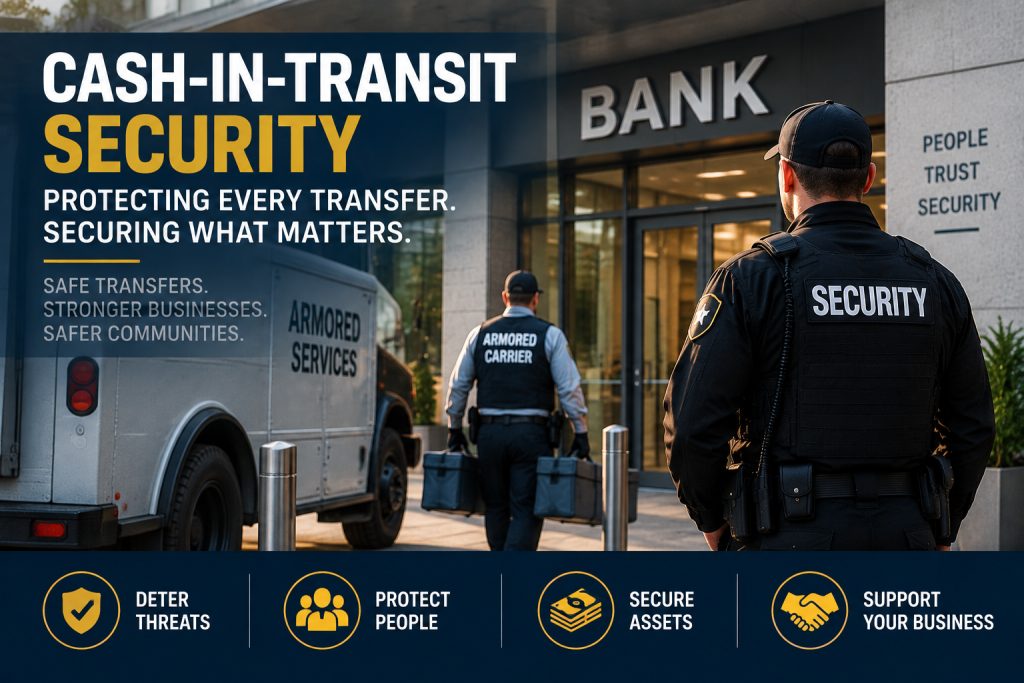
Every business that handles physical currency – bank branches, credit unions, retail chains, cannabis dispensaries, check cashers, and vending operators – eventually faces the same exposure: moving cash from point A to point B. Across Greater Houston and Texas, the most dangerous minutes in that journey are not on the highway inside a hardened truck. They are at the curb, the vestibule, and the back-office door, during the brief handoff when cash changes hands and people are exposed. Strong cash-in-transit security is built around protecting exactly those transfer windows.
This guide explains how professional armed officers secure cash transfers and armored-carrier handoffs, why the transfer point is the highest-risk moment, and what protocols keep staff, couriers, and currency safe. A clarifying note up front: an armored-carrier company operates the trucks and moves the cash between cities; a licensed security guard company provides the armed escort and on-site perimeter protection that hardens the vulnerable handoff. Gods Armour Security operates in that second lane – escort and asset protection – working alongside armored carriers, not replacing them.
Why the Transfer Point Is the Most Dangerous Moment
Armored trucks themselves are extremely hard targets: reinforced steel, ballistic glass, and locked cargo holds. Criminals know this, so they rarely attack the vehicle in motion. Instead, they wait for the transfer – the seconds when a courier, guard, or employee is outside the armor, on foot, carrying a bag between the door and the truck. Industry loss data and news coverage of armored car robbery incidents consistently show that attacks cluster at the curbside handoff and the sidewalk approach, not on the open road.
That single fact reshapes how cash-in-transit security should be designed. The objective is not a faster truck; it is a controlled, monitored, and rehearsed transfer zone where an exposed courier is never alone and never surprised.
| Transfer Phase | Primary Vulnerability | Security Officer Countermeasure |
|---|---|---|
| Vehicle Approach and Staging | Ambush vehicles staged near the entrance; blocked or blind approach lanes. | Officer clears and holds the transfer zone before the carrier arrives; watches for loitering vehicles. |
| Curbside Dismount | Courier is outside the armor, on foot, hands occupied with cash bags. | Armed officer provides overwatch and a physical buffer along the walking path. |
| Interior Handoff and Reconciliation | Tailgating intruders slip in behind the courier; internal diversion. | Officer controls the door, verifies credentials, and prevents unauthorized entry during the count. |
| Departure | Follow-away vehicles tracking the courier or the emptied branch staff. | Officer observes for surveillance, varies patterns, and confirms a clean exit. |
Phase 1: Pre-Transfer Planning and Route Discipline
1. Randomize Timing and Patterns
Predictability is the enemy of cash security. Deposits made at the same minute every day, by the same employee, using the same door, hand criminals a schedule. Transfer windows, pickup times, and even the staff assigned should rotate so no external observer can anticipate the exposure.
2. Establish a Controlled Transfer Zone
Before any handoff, the officer surveys and secures the immediate area: clear sightlines, adequate lighting, no staged vehicles, and an unobstructed path between the vehicle and the door. The same perimeter discipline that governs facility entrances applies here; see our guide on access control best practices for commercial facilities.
3. Coordinate With the Armored Carrier
The escort officer and the armored-carrier crew must operate from a shared plan: who dismounts, who covers, where the vehicle stages, and what the abort signal is. Clear roles prevent the confusion that attackers exploit. This coordination is where a dedicated on-site officer adds value the truck crew alone cannot provide – a fixed set of eyes who knows the site.
Phase 2: Securing the Handoff Window
1. Overwatch, Not Handling
The escort officer’s job is protection and observation, not carrying cash. Keeping the officer’s hands free preserves their ability to respond instantly to a threat.
2. Control the Doorway
During the interior handoff, the officer manages the entry point so no unauthorized person tailgates in behind the courier while attention is on the count.
3. Maintain 360-Degree Awareness
The officer positions to see the approach, the vehicle, and the interior simultaneously, scanning for staged vehicles, loiterers, or a diversion designed to split attention.
4. Rehearsed Emergency Signals
A pre-agreed duress signal and abort protocol let the team stop a transfer instantly if something looks wrong, without shouting or hesitation.
For businesses weighing whether an on-site officer is worth the cost versus cameras alone at the transfer point, our analysis of security guards vs surveillance cameras for commercial facilities lays out the trade-offs; cameras document a robbery, but only a physical officer can deter or interrupt one.
Phase 3: Where Cash-Transfer Escort Fits Your Broader Program
Cash-in-transit protection rarely stands alone. It connects to the rest of a financial institution’s or business’s security posture:
- Bank and credit union deposits: Armed escort of night-drop and end-of-day deposits pairs directly with branch opening and closing security protocols, when staff carry cash and are most exposed.
- Regulatory context: For federally insured institutions, cash-handling procedures live inside the written security program required by the Bank Protection Act for banks and the equivalent framework for credit unions under NCUA Part 748.
- Armed vs unarmed decision: Cash-transit overwatch is one of the clearest cases for an armed officer; see the full reasoning in armed vs unarmed bank security guards.
- High-value asset transport: The same escort discipline protects jewelry, precious metals, and other valuables, which overlaps with close-protection work covered under our executive protection services.
Phase 4: Retail, Dispensary, and Small-Business Cash Runs
Cash-in-transit risk is not limited to banks. High-volume cash businesses face the same exposure, often with fewer safeguards:
1. Retail and Restaurant Deposits
Managers making nightly bank runs are a favorite target because the pattern is easy to observe and the individual is unprotected. An armed escort for the walk to the vehicle and the drive to the night drop eliminates the lone-employee vulnerability.
2. Cannabis and Cash-Intensive Operations
Businesses that operate largely in cash because of banking restrictions accumulate unusually large sums on site, making both storage and transfer high-risk. These operations benefit from scheduled armed escort and secure transfer protocols tailored to their volume.
3. ATM Replenishment Support
Standalone ATM servicing exposes technicians during cash loading. On-site armed presence during replenishment deters the same crews that install skimming hardware; review that adjacent threat in our guide on detecting and preventing ATM skimming devices.
Phase 5: Texas DPS Licensing and Vendor Verification
Armed cash-escort work in Texas is regulated under Chapter 1702 of the Texas Occupations Code. Officers providing armed overwatch must hold a Texas DPS Level III commission, and their employer must maintain an active Class B or Class C license through the Texas DPS Private Security Bureau.
Before contracting escort or asset-protection coverage, confirm those credentials and adequate armed-liability insurance using our structured security vendor evaluation checklist. Using unlicensed personnel to guard cash transfers is both a statutory violation and an insurance-voiding risk. Note as well that the armored-carrier company itself carries separate DOT and transport licensing; the escort officer supplements that coverage rather than replacing it.
Cash-in-Transit Security in Houston
Across Downtown, the Galleria, the Energy Corridor, and retail corridors throughout Harris, Fort Bend, and Montgomery Counties, high-cash businesses move currency every day. Gods Armour Security provides Texas DPS licensed armed officers for deposit escorts, armored-carrier handoff overwatch, and high-value asset transport support, coordinated with your existing carrier and branch procedures. Explore our full bank and cash-handling security services in Houston and broader commercial security services.
For executives or owners personally handling large sums who face targeted threats, review our diagnostic manual on 7 signs you need a personal security detail.
Partner with Gods Armour Security for Cash-Transfer Protection
The strongest armored truck in the world cannot protect the ten seconds a courier spends on the sidewalk. That exposed window is where professional armed escort matters most. Gods Armour Security delivers Texas DPS certified officers, Level III commissioned armed guards, and mobile patrol support to secure cash transfers, deposit runs, and armored-carrier handoffs for financial institutions and cash-intensive businesses across Greater Houston, Harris County, and statewide Texas.
Need to harden your cash-transfer windows or coordinate escort with your armored carrier? Request a cash-in-transit security consultation or contact our Houston command operations desk directly at (713) 878-9984.
Frequently Asked Questions
What is cash-in-transit security?
Cash-in-transit security is the set of protocols and personnel that protect money while it is being moved – especially during the exposed transfer between a building and a vehicle. It includes route and timing discipline, a controlled transfer zone, armed officer overwatch, and rehearsed emergency signals to deter or interrupt a robbery.
Is a security guard company the same as an armored car service?
No. An armored-car (cash-in-transit carrier) company operates hardened trucks and moves cash between locations under DOT and transport licensing. A security guard company provides armed officers who escort staff, secure the handoff window, and protect the site. The two work together: the carrier moves the cash, and the escort officer hardens the vulnerable transfer point.
Why is the cash handoff more dangerous than the drive?
Armored trucks are heavily fortified, so criminals rarely attack them in motion. The risk concentrates at the transfer – the seconds a courier or employee is on foot, outside the armor, carrying cash between the door and the vehicle. Securing that window is the entire point of transfer protocols.
Do retail businesses need cash-transfer escorts?
Any business whose staff make predictable cash runs benefits from escort coverage. Restaurants, retailers, and cash-intensive operations are frequently targeted precisely because a lone manager on a nightly bank run is an easy, observable target. An armed escort removes the lone-employee vulnerability.
Key Takeaways
- The transfer point – not the drive – is the highest-risk moment in cash-in-transit; robberies cluster at the curbside and doorway handoff.
- Effective protection relies on randomized timing, a controlled transfer zone, armed overwatch, doorway control, and rehearsed abort signals.
- A guard company provides escort and perimeter security; it works alongside an armored-carrier company rather than replacing it.
- Cash-transfer escort connects to branch opening and closing procedures, Bank Protection Act and NCUA security programs, and high-value asset protection.
- In Texas, armed cash-escort officers need a Level III commission under Chapter 1702, backed by an active Class B or C contractor license.