Credit unions and commercial banks both hold cash, both serve daily walk-in traffic, and both are bound by federal physical-security obligations. Yet the way each institution is owned, regulated, staffed, and funded produces meaningfully different risk profiles – and those differences should shape how each one deploys security officers. For risk managers, boards, and facility directors across Greater Houston and Texas, understanding where credit union security and commercial bank security diverge is the first step toward a protection program that fits the institution rather than a generic template.
This guide compares the two side by side: regulatory frameworks, ownership and budget realities, cash-exposure patterns, staffing depth, and the guard models that make sense for each. It builds on the federal baseline covered in our Bank Protection Act compliance guide, then explains where credit unions follow a separate regulatory path.
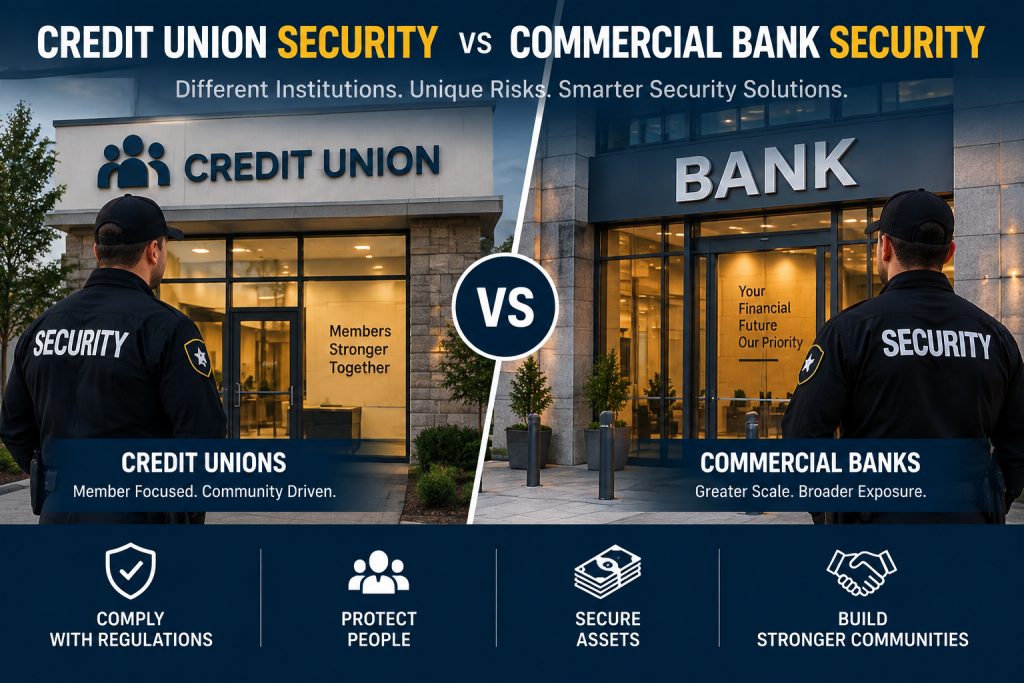
Credit Union vs Commercial Bank Security: Side-by-Side Risk Differences
The core distinctions between financial institution security at a member-owned credit union and a shareholder-owned commercial bank fall across seven risk dimensions:
| Risk Dimension | Commercial Banks | Credit Unions |
|---|---|---|
| Regulatory Framework | Bank Protection Act of 1968, enforced via FDIC (12 CFR 326), OCC (12 CFR 21), and the Federal Reserve (12 CFR 208.61). | NCUA Rules and Regulations Part 748 (and Appendix A guidelines); deposits insured by the NCUSIF, not the FDIC. |
| Ownership and Risk Appetite | Shareholder-owned, for-profit; typically larger dedicated security budgets. | Member-owned, not-for-profit; leaner security budgets, often overseen by volunteer boards. |
| Typical Cash Exposure | Regional cash hubs, corporate treasury deposits, and frequent armored-carrier transfers. | Member-focused branches with lower per-branch cash, but frequently thinner physical-guard coverage. |
| Security Staffing Depth | Dedicated corporate security departments and regional loss-prevention teams. | Often a single designated security officer juggling compliance, IT, and facilities duties. |
| Access Control Nuance | Standard branch and vault access control tied to employees and known clients. | Shared branching and CO-OP networks add the challenge of verifying non-member visitors from other credit unions. |
| Common Threat Profile | Armed robbery, ATM skimming, and opening or closing ambush attempts. | Same threats, occasionally targeted precisely because they are perceived as softer, less-guarded locations. |
| Typical Guard Model | Armed Texas DPS Level III officers at high-cash hubs; cash-transit escorts. | Unarmed Level II, hospitality-forward officers, reassessed upward when cash volume or local crime rises. |
Phase 1: The Regulatory Divide (NCUA Part 748 vs the Bank Protection Act)
The single clearest difference is who writes the rules. Commercial banks answer to the federal banking agencies under the Bank Protection Act, while credit unions answer to the National Credit Union Administration (NCUA).
1. How Commercial Banks Are Governed
Federally insured banks must appoint a security officer and maintain a written security program under the Bank Protection Act of 1968, enforced through FDIC, OCC, and Federal Reserve regulations. The statutory baseline – vaults, alarm systems, lighting, and tamper-resistant locks – is detailed in our Bank Protection Act physical security guide.
2. How Credit Unions Are Governed
Credit unions follow a parallel but separate track. Under NCUA Rules and Regulations Part 748, every federally insured credit union must designate a security officer and develop a written security program appropriate to its size and risk. Appendix A adds guidance on protecting members and staff, deterring robberies, and assisting law enforcement after an incident. The practical obligations closely mirror the bank requirements, but the enforcing agency and examination process differ.
3. Why the Distinction Matters Operationally
Because credit unions are member-owned and not-for-profit, security spending competes directly with member dividends and rates. Boards – frequently composed of volunteers rather than career risk executives – may underinvest in physical guards until an incident forces the issue. A qualified security partner helps a credit union satisfy its Part 748 obligations without overspending, matching officer coverage to genuine branch risk.
Phase 2: Structural Risk Differences That Change the Threat Picture
1. Cash Concentration and Armored Transfers
Large commercial branches often act as regional cash hubs, aggregating merchant deposits and coordinating frequent armored-carrier pickups. Those transfer windows are among the highest-risk moments of the banking day and typically justify armed coverage. Credit union branches usually hold less cash per location, but that lower profile can breed complacency – and thieves know it.
2. The Soft-Target Perception
Precisely because many credit unions run leaner, hospitality-forward lobbies with no visible officer, some criminal crews view them as easier marks than a downtown commercial bank with an armed guard at the door. A modest, visible deterrent often closes this gap without changing the welcoming member experience; weigh the presence trade-offs in our analysis of concierge vs dedicated security guard models.
3. Shared Branching and Member Verification
Credit unions frequently participate in shared branching (CO-OP) networks, where a member of one credit union transacts at another. This convenience introduces an access-control wrinkle commercial banks rarely face: staff must verify individuals who are not their own members. Clear identity-verification protocols – the same discipline covered in our guide on access control best practices for commercial facilities – keep shared branching from becoming a fraud vector.
4. Shared Threats Across Both Models
Regardless of charter, both institutions face the same core physical threats: armed robbery, ATM and card fraud, and ambush attempts during opening and closing. Every branch should harden those windows using the procedures in our manuals on opening and closing security protocols for bank branches and detecting and preventing ATM skimming devices.
Phase 3: Choosing the Right Guard Model for Each Institution
The correct staffing decision follows the risk, not the charter. The comparison below is a starting point, not a substitute for a branch-level risk assessment.
Commercial Bank Regional Hub
High cash volume and frequent armored transfers favor armed Texas DPS Level III officers with cash-transit escort duties and perimeter coverage during opening and closing.
Community Credit Union Branch
Lower cash exposure and a member-first culture often suit unarmed Level II officers focused on visible deterrence, de-escalation, and member hospitality.
Higher-Risk Location (Either Charter)
Elevated ZIP-code crime, prior robbery history, or slow police response can push either a bank or a credit union toward armed coverage regardless of size.
Budget-Constrained Branch
Where a full-time guard is not feasible, marked mobile patrols and monitored cameras provide partial coverage – with the trade-offs detailed below.
For a deeper breakdown of the armed-versus-unarmed decision specific to financial lobbies, read our companion guide on armed vs unarmed bank security guards. To weigh physical officers against electronic monitoring, see security guards vs surveillance cameras for commercial facilities, and for typical Texas rate ranges, review security officer hourly costs in Houston.
Phase 4: Texas DPS Licensing (Identical for Both Institutions)
Whatever the charter, the guards themselves are licensed the same way. Under Chapter 1702 of the Texas Occupations Code, unarmed officers hold a Texas DPS Level II registration and armed officers hold a Level III commission. The guard employer must maintain an active Class B or Class C license from the Texas DPS Private Security Bureau.
Both banks and credit unions should verify these credentials before signing a contract. Use our structured security vendor evaluation checklist to confirm licensing, insurance limits, and supervisory capacity, and remember that hiring unlicensed staff to perform guard duties can void commercial insurance coverage after an incident.
Credit Union and Bank Security in Houston
Greater Houston hosts both large commercial branches in Downtown, the Galleria, and the Energy Corridor, and a dense network of community and member-focused credit unions across Harris, Fort Bend, and Montgomery Counties. A capable Houston security partner can staff an armed officer at a high-cash commercial hub while providing an unarmed, hospitality-forward officer at a neighborhood credit union – all under one supervised, insured agreement. Explore the full scope of our bank and credit union security services in Houston and our broader commercial security services.
For credit union or bank executives facing specific personal threats beyond branch protection, review our diagnostic manual on 7 signs you need a personal security detail.
Partner with Gods Armour Security for Financial Institution Protection
Whether you manage a single community credit union branch or a multi-location commercial bank network, protecting members, staff, and cash requires a partner who tailors coverage to real risk. Gods Armour Security provides Texas DPS certified security officers, Level III commissioned armed guards, and mobile patrol response units built for the compliance standards of Texas financial institutions.
Our leadership works directly with security officers and branch managers across Greater Houston, Harris County, and statewide Texas to assess vulnerabilities, satisfy NCUA Part 748 or Bank Protection Act obligations, and keep member and customer trust intact.
Need a customized evaluation for your credit union or bank branch? Request a financial institution security consultation or contact our Houston command operations desk directly at (713) 878-9984.
Frequently Asked Questions
Are credit unions safer than banks?
For deposit protection they are comparably safe: bank deposits are insured by the FDIC and credit union deposits by the NCUSIF, both up to 250,000 dollars per depositor. For physical security, safety depends less on charter than on the individual branch guard coverage, cash volume, and local crime rate. A well-guarded credit union can be safer than an unguarded bank, and vice versa.
Do credit unions have security guards?
Some do and some do not. NCUA Part 748 requires a written security program but does not mandate an on-site guard at every branch. Larger or higher-risk credit unions commonly staff officers, while smaller community branches may rely on alarms, cameras, and staff training. A branch-level risk assessment determines whether a guard is warranted.
How is credit union security regulated?
Federally insured credit unions are regulated by the National Credit Union Administration under Part 748 of the NCUA Rules and Regulations, which requires a designated security officer and a written security program. This is the credit union parallel to the Bank Protection Act that governs commercial banks.
What is the main security difference between a bank and a credit union?
The biggest practical difference is resources and oversight. Commercial banks typically run dedicated security departments and larger budgets, while credit unions often operate leaner programs under volunteer boards. That gap, not the level of threat, is usually what shapes each institution guard deployment.
Key Takeaways
- Commercial banks are governed by the Bank Protection Act (via FDIC, OCC, and the Federal Reserve), while credit unions follow NCUA Part 748 – parallel obligations under different agencies.
- Credit unions typically run leaner, member-funded security budgets, which can leave branches under-guarded relative to the threat they actually face.
- Shared branching (CO-OP) networks give credit unions a member-verification challenge that commercial banks rarely encounter.
- Guard model should follow branch-level risk – armed Level III at high-cash hubs, unarmed Level II at hospitality-forward community branches, reassessed as crime or cash volume changes.
- In Texas, guards at both banks and credit unions are licensed identically under Chapter 1702; verify Level II or III credentials and an active Class B or C contractor license before contracting.