Federal financial compliance often seems dominated by digital cybersecurity, anti-money laundering frameworks, and data privacy mandates. Yet for community banks, commercial retail branches, credit unions, and savings associations across Greater Houston and Texas, physical bank security remains an enforceable federal obligation with direct regulatory and operational consequences.
Passed to curb rising armed robberies, the Bank Protection Act of 1968 (codified under 12 U.S.C. 1882 and enforced via agency rules such as 12 CFR 208.61, 12 CFR 21, and 12 CFR 326) mandates that federally insured financial institutions adopt minimum physical security procedures. Financial boards of directors and designated bank security officers must implement written protection programs, install mandated security hardware, conduct rigorous employee training, and deliver verified annual effectiveness reports.
Failing an audit by the Federal Deposit Insurance Corporation (FDIC), the Office of the Comptroller of the Currency (OCC), or the Federal Reserve Board can result in administrative enforcement actions, civil money penalties, and expanded civil liability following an armed incident. This operational guide translates statutory legal text into a clear roadmap for bank executives, branch managers, and facility security directors.
Phase 1: Minimum Required Security Devices (The Statutory Hardware Baseline)
Federal regulations stipulate that every banking facility must install, operate, test, and maintain four mandatory physical security mechanisms:
| Statutory Device Requirement | Federal Standard (12 CFR 208.61 / 326.3) | Modern Field Implementation Standard |
|---|---|---|
| Vault or Secure Asset Space | A secure means of protecting cash, negotiable securities, and liquid assets. | UL-listed modular concrete vaults, time-lock mechanisms, cash recycler safes, and dual-custody access panels. |
| Nighttime Vault Lighting | Illumination around the vault during hours of darkness if visible from the building exterior. | High-lumen LED arrays backed by uninterruptible battery backup systems visible from municipal patrol roadways. |
| Tamper-Resistant Perimeter Locks | Tamper-resistant locks on all exterior doors and operable exterior windows. | High-security mortise deadbolts, magnetic shear locks tied to fire systems, and impact-resistant glazing laminate. |
| Duress & Robbery Alarm System | An alarm device for promptly notifying local law enforcement of an attempted robbery or burglary. | Silent hold-up buttons (foot rails, money clips, under-counter bars), dual-path cellular communicators, and vault seismic vibration sensors. |
When selecting professional guard personnel to protect sensitive financial assets, review our comprehensive vetting guide on the security vendor evaluation checklist to audit regulatory compliance, insurance limits, and supervisory capacity.
Phase 2: Administrative Mandates: Written Program and the Bank Security Officer
Hardware represents only half of the regulatory mandate. Federal statutes hold financial institution leadership personally accountable for the administration of physical security:
1. Mandatory Board Designation of a Bank Security Officer
The board of directors of each newly chartered or insured financial institution must formally appoint a dedicated Security Officer within a statutory window (typically within 30 to 180 days of opening). This officer holds executive authority, subject to board approval, to design, enforce, and audit the written physical security program across all retail branch offices and operational cash hubs.
2. The Written Bank Security Program
Institutions cannot operate on ad-hoc or verbal security routines. The bank must maintain a formal, living document detailing operational workflows, including:
- Opening and Closing Procedures: Strict dual-custody opening protocols, exterior perimeter inspections, concealed all-clear signals, and emergency lockout procedures.
- Currency Safekeeping: Teller cash drawer limits, bait money management, scheduled vault drops, and cash-in-transit transfer protocols.
- Suspect Identification Devices: Maintaining high-resolution digital CCTV cameras recording counter interactions, customer queues, ATM surrounds, and vehicle drive-thru lanes.
- Evidence Preservation Procedures: Protocols for isolating crime scenes, preventing employee fingerprint contamination of teller counters, and packaging surveillance footage for immediate handoff to the FBI and local police detectives.
3. Annual Effectiveness Reporting to the Board of Directors
At least once each calendar year, the security officer must present a written evaluation directly to the board of directors. This report details the operational readiness of all branch security hardware, audits robbery alarm test logs, documents criminal attempts or internal larcenies, and provides a forward-looking risk assessment to determine whether additional security personnel or equipment upgrades are warranted.
Phase 3: Discretionary Security Devices: When Are Extra Measures Mandated?
The Bank Protection Act recognizes that a small rural branch does not face the same threat environment as an urban retail location. Under 12 CFR 208.61(c)(2)(v), security officers must evaluate specific local threat factors to decide whether discretionary security devices are legally necessary:
1. Regional Crime Incidence
If local municipal crime analytics reflect high rates of commercial robberies or vehicle smash-and-grabs in the branch ZIP code, static minimum hardware is insufficient. Upgraded deterrence is required.
2. Cash Volume Exposure
Branches handling high-volume commercial cash transactions or processing vault distribution for corporate accounts carry elevated vulnerability profiles demanding ballistic teller glazing and armed guard posts.
3. Law Enforcement Response Time
If the distance to the nearest municipal police station or sheriff dispatch results in estimated emergency response times exceeding 10 to 15 minutes, physical on-site human deterrence becomes an essential risk control.
4. Physical Branch Architecture
Standalone retail pad sites with multiple entry doors and secluded ATM islands require external lighting towers, bollards, and roving perimeter checks; see multi-acre sweep procedures in our guide on overnight property security patrols.
To inspect physical entry point hardening, locking hardware, and access control vestibules across commercial properties, explore our operational manual on the commercial security checklist for facility managers.
Phase 4: The Strategic Role of Texas DPS Licensed Security Guards
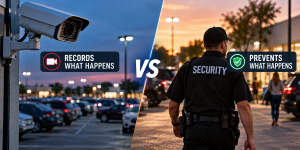
While video surveillance cameras provide post-incident forensic evidence, they cannot physically deter an armed robber or escort an employee to their vehicle after dark:
1. Immediate Robbery Deterrence at the Threshold
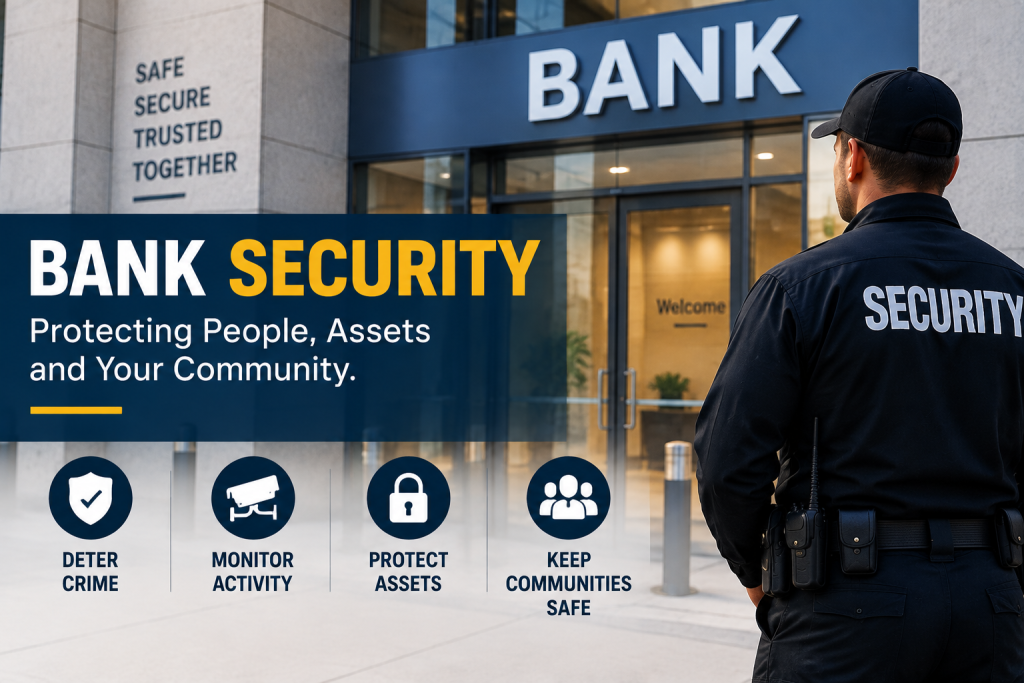
Bank robbery crews actively case branches before selecting a target. The visible presence of a uniformed, professional security officer positioned in the retail lobby or entry vestibule disrupts pre-operational planning, prompting perpetrators to seek softer, unguarded targets. Compare physical guarding against camera systems in our detailed analysis on security guards vs surveillance cameras for commercial sites.
2. Managing Texas DPS Licensing Standards
In Texas, security officers operating in financial environments must be licensed through the Texas Department of Public Safety (DPS) Private Security Bureau. Financial institutions generally utilize Level III Commissioned Armed Security Officers. These officers undergo mandatory firearms proficiency, background investigations, and conflict de-escalation training, backed by appropriate commercial liability insurance coverage.
3. Securing Cash Transfers and ATM Servicing
Armed officers provide visual security during cash replenishment, armored car courier arrivals, and ATM technician servicing. Controlling the perimeter during these high-risk operational windows prevents ambush robberies; review vehicle intake procedures in our manual on access control best practices for secure facilities.
For standard hourly rates and budget parameters for professional armed and unarmed officers in Texas, consult our pricing reference on security officer hourly costs in Houston.
Phase 5: Mandatory Employee Training and Regulatory Audit Preparation
Federal examiners focus heavily on staff preparedness. Even the most sophisticated electronic vaults and silent alarms fail if frontline employees do not know how to respond under duress:
1. Robbery Response and De-Escalation Protocols
Staff must be trained to prioritize human life over institutional assets. Training covers compliance during an armed robbery, smooth surrender of funds including bait money, silent alarm activation only when safe, mental retention of suspect physical traits, and lockdown procedures immediately following suspect departure.
2. Bait Money and GPS Currency Trackers
Frontline tellers must maintain pre-recorded serial-numbered currency packets (bait money) in specific cash drawers. Modern security best practices integrate electronic tracking packs or micro-GPS tracking devices disguised as currency bundles that activate automatically when pulled from the drawer.
3. Avoiding Costly Regulatory Audit Deficiencies
During routine safety and soundness examinations, regulatory auditors scrutinize three primary areas for non-compliance: missing or unrecorded semi-annual alarm testing logs, outdated employee training attendance records, and failure to present an annual security report approved by the board of directors.
For corporate banking executives or wealth managers handling sensitive high-profile transactions who face direct harassment or targeted physical threats, review our diagnostic assessment on 7 signs you need a personal security detail.
Partner with Gods Armour Security for Financial Institution Protection
Safeguarding bank branches, credit unions, corporate financial offices, and vault facilities requires an uncompromising standard of physical defense. Gods Armour Security provides Texas DPS certified security officers, Level III commissioned armed guards, and marked mobile patrol services tailored to the rigorous compliance mandates of financial institutions across Greater Houston, Harris County, and statewide Texas.
Our supervisory leadership collaborates directly with bank security officers and facilities directors to eliminate retail branch vulnerabilities, enforce access control standards, protect cash replenishment operations, and maintain comprehensive audit readiness.
Need to assess your branch physical security posture or schedule professional security guard staffing? Request a financial institution security consultation and compliance audit or contact our Houston command operations desk directly at (713) 878-9984.
Key Takeaways
- The Bank Protection Act of 1968 requires all federally insured depository institutions to designate a qualified security officer and maintain a written security program.
- Federal regulations mandate four physical security baselines: secure vaults, nighttime vault lighting, tamper-resistant locks, and emergency robbery alarms.
- Security officers must present an annual physical security effectiveness report directly to the institution board of directors.
- High local crime rates, extended law enforcement response times, and large cash volumes legally mandate discretionary defenses like armed security guards.
- Deploying Texas DPS Level III commissioned armed officers delivers active robbery deterrence that surveillance cameras and passive alarms cannot provide alone.