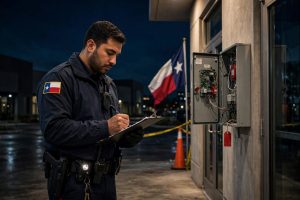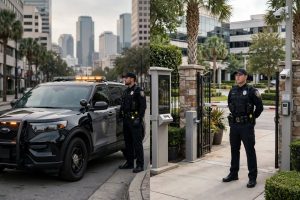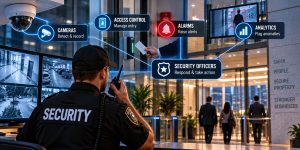
For general contractors, civil engineering firms, and commercial developers across Greater Houston and Texas, budgeting for nighttime jobsite security is a critical risk-management necessity. Leaving high-value machinery, copper spools, and heavy trade tools unattended overnight invites severe financial loss from organized burglary crews. However, project managers balancing tight bid estimates often ask a direct question: how much does construction site security actually cost per night?
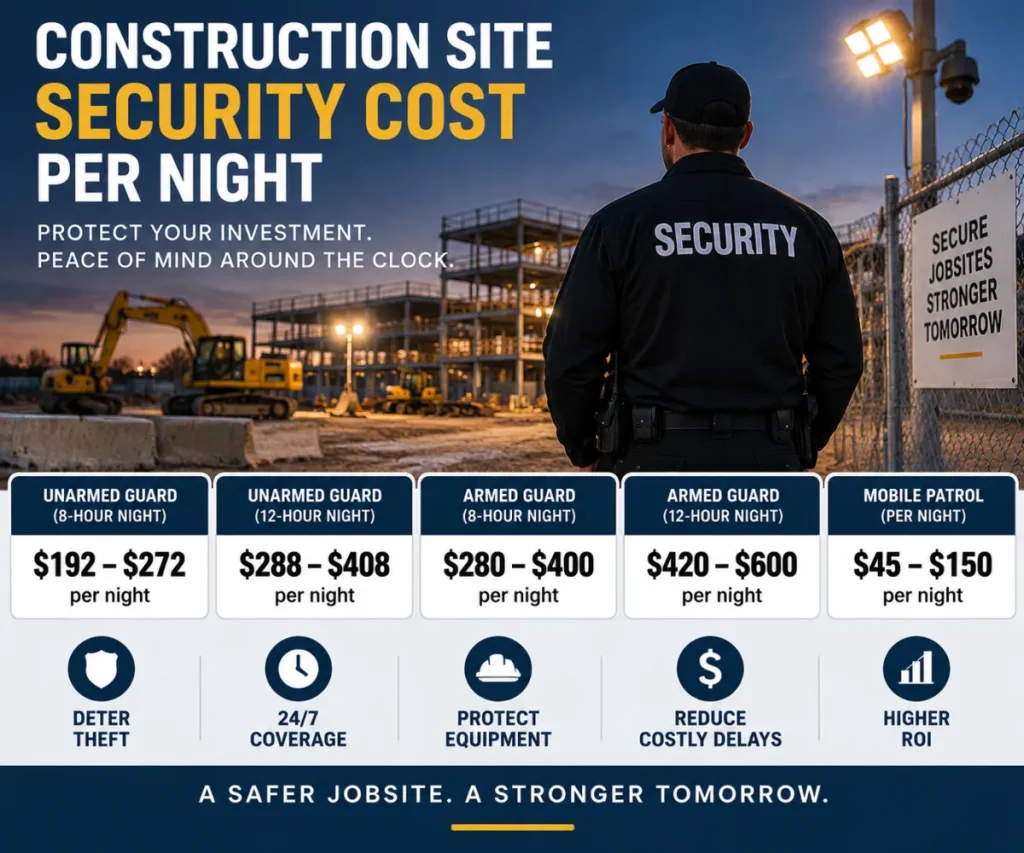
Nighttime construction security costs depend on shift length, officer licensing tiers under the Texas Department of Public Safety (DPS) Private Security Bureau, armed versus unarmed post requirements, and whether the jobsite deploys dedicated on-site personnel or roving mobile patrol sweeps. In Texas, dedicated overnight security guard coverage generally ranges from 190 dollars to 600 dollars per night, while shared mobile vehicle patrol sweeps range from 45 dollars to 150 dollars per night.
This comprehensive pricing guide breaks down nightly shift expenses, hourly rate structures, armed versus unarmed differentials, and contract models to help you forecast security budgets accurately.
Phase 1: Nightly Construction Security Cost Matrix (Texas Benchmarks)
Overnight security deployments operate on standard shift lengths: an 8-hour shift (typically 10:00 PM to 6:00 AM) or a comprehensive 12-hour shift (6:00 PM to 6:00 AM) covering the entire window from trade departure to morning contractor roll call:
| Security Deployment Model | Hourly Bill Rate (Texas) | 8-Hour Night Cost (10 PM – 6 AM) | 12-Hour Night Cost (6 PM – 6 AM) |
|---|---|---|---|
| Dedicated Unarmed Guard (Level II) | 24 to 34 dollars / hr | 192 to 272 dollars / night | 288 to 408 dollars / night |
| Dedicated Armed Officer (Level III Commissioned) | 35 to 50 dollars / hr | 280 to 400 dollars / night | 420 to 600 dollars / night |
| Dedicated Guard + Marked Patrol Vehicle | 32 to 44 dollars / hr | 256 to 352 dollars / night | 384 to 528 dollars / night |
| Marked Mobile Patrol (2 to 4 Sweeps Per Night) | Flat fee per visit | 45 to 110 dollars / night (2 to 3 sweeps) | 75 to 150 dollars / night (3 to 4 sweeps) |
| Weekend Lockout Coverage (Friday PM – Monday AM) | Blended 60-hour rate | 1,450 to 2,400 dollars total per weekend (continuous 60 hours) | |
To compare commercial jobsite rates with general event staffing expenses, review our baseline analysis on event security costs in Houston.
Phase 2: What Drives Nightly Security Costs for Construction Sites?
Nightly security bill rates reflect direct wages, specialized equipment, statutory compliance, and overhead. Five primary variables determine where your jobsite falls on the pricing scale:
1. Armed (Level III) vs Unarmed (Level II) Licensing
Under Texas law, security officers must be licensed through the Texas DPS Private Security Bureau. Unarmed Level II guards provide physical deterrence, inspect fence lines, and check storage locks. However, jobsites containing high-value copper wiring or remote staging yards often require Texas DPS Level III Commissioned Armed Security Officers. Armed officers undergo firearms marksmanship qualification and tactical training, and companies carry elevated firearms liability insurance riders, adding 8 to 16 dollars per hour to baseline rates.
2. Property Footprint and Vehicle Deployment
For a single commercial building or compact urban infill site, a guard conducting foot patrols is standard. For sprawling horizontal developments, master-planned subdivisions, or highway infrastructure spanning dozens of acres, guards require a dedicated marked patrol vehicle equipped with amber strobe bars, search spotlights, and GPS tracking. Vehicle amortizations, commercial auto insurance, and fuel add 5 to 10 dollars per hour to nightly billing.
3. High-Risk Neighborhoods and Asset Exposure
Jobsites situated in high-crime zones or areas experiencing targeted equipment thefts demand higher wage incentives to prevent guard turnover and absenteeism. Sites actively storing high-theft machinery like skid steers or mini excavators face higher risk profiles; evaluate equipment exposure metrics in our report on construction equipment theft statistics and prevention.
4. Shift Structure: 8-Hour vs 12-Hour Deployments
While an 8-hour shift covers midnight hours (10:00 PM to 6:00 AM), it leaves a vulnerable 4-hour gap between 6:00 PM and 10:00 PM when trades depart. Many burglary rings strike at dusk when sites are empty. Contracting a full 12-hour shift (6:00 PM to 6:00 AM) secures the property seamlessly from sunset to sunrise.
Phase 3: The True Cost of NOT Hiring Night Security
While paying 250 to 450 dollars per night represents a tangible budget allocation, comparing it against the financial consequences of an unmonitored burglary reveals why overnight security is an investment rather than an expense:
Copper Wire Feeder Theft
Typical Incident Loss: 15,000 to 50,000 dollars.
Thieves rip pulled wire from switchgear boxes, destroying conduit and finished drywall. Rework delays project completion by 2 to 4 weeks; explore preventative staging tactics in our guide on how to stop copper wire and tool theft on active job sites.
Commercial Power Tool Raids
Typical Incident Loss: 5,000 to 25,000 dollars.
Thieves defeat gang box padlocks using angle grinders. Missing specialty tools halt subcontractor framing and electrical crews the following morning, resulting in thousands of dollars in idle labor.
Project Liquidated Damages
Typical Contract Penalty: 1,000 to 5,000 dollars / day.
Major commercial contracts enforce strict completion deadlines. A single overnight theft that sets back critical inspections can trigger massive contractual late penalties.
To examine how physical guarding expenses compare directly against mobile solar camera trailer leases, review our detailed analysis on security guards vs surveillance cameras for job sites.
Phase 4: Cost-Saving Strategies for Jobsite Night Security
General contractors can optimize overnight security expenditures without compromising physical defense by applying four proven operational strategies:
1. Phase-Based Security Deployment
Do not contract full-time overnight guards during early civil grading or dirt-work stages when material loss exposure is minimal. Scale security guard deployment to match project phases:
- Grading & Foundation: Deploy shared mobile patrol sweeps (45 to 75 dollars / night).
- Rough Framing & Electrical Pulls: Deploy dedicated 12-hour overnight security guards (288 to 450 dollars / night) to protect exposed copper wire, HVAC condensers, and tool containers.
- Interior Finishes & Commissioning: Maintain gate access control officers to screen subcontractor trades and prevent tool shrinkage.
2. The Hybrid Security Model (Mobile Patrol + Cameras)
If budget caps prevent deploying a dedicated guard every night, deploy a solar mobile surveillance trailer combined with dedicated mobile patrol sweeps. The camera provides continuous perimeter recording, while marked patrol vehicles conduct 3 to 5 randomized sweeps per night to inspect storage gates and verify padlocks; explore multi-acre sweep procedures in our manual on overnight security patrols for properties.
3. Enforce Strict Contractor Gate Controls
Thieves frequently pose as early-morning delivery crews to remove materials unchallenged. Directing all after-hours traffic through a single access gate staffed by security prevents unauthorized flatbed haulers from entering staging yards; review gatehouse protocols in our guide on access control best practices for gated communities.
Phase 5: Contract Clauses and Red Flags in Security Bids
When reviewing security guard vendor bids for your construction site, ensure the proposal contains these protections:
1. Transparent Billing: Overtime and Holiday Rates
Examine contract terms regarding holiday coverage (Thanksgiving, Christmas, New Year). Reputable security companies bill holidays at 1.5 times standard hourly rates. Ensure the contract explicitly defines billable hours with no hidden administrative equipment surcharges.
2. Mandatory GPS Guard Tour Verification
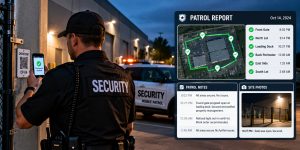
Never accept verbal assurances that a guard remained awake and patrolled your site. The contract must mandate an electronic Guard Tour Verification System (GPS geofencing and RFID/NFC checkpoint scans). Guards must scan checkpoints positioned at tool containers, switchgear rooms, and remote fence gates, delivering a digital patrol audit every morning. Review vendor vetting criteria in our security vendor checklist for boards and contractors.
3. Beware of Unrealistically Low Hourly Rates
If a vendor quotes 18 to 20 dollars per hour for dedicated overnight guards, proceed with extreme caution. After factoring in statutory payroll taxes, workers compensation, and Texas DPS compliance overhead, an 18-dollar bill rate means the guard is being paid minimum wage. This inevitably results in chronic no-shows, guards sleeping in personal vehicles, and high employee turnover.
For executive developers and stakeholders facing contentious labor disputes or personal safety threats on site, examine our guide on 7 signs you need a personal security detail.
Partner with Gods Armour Security for Jobsite Protection
Safeguarding active construction developments requires a dependable, professional security partner that delivers real accountability. Gods Armour Security provides Texas DPS certified security officers, armed personnel, marked mobile patrol fleets, and GPS-verified guard tour auditing across Greater Houston, Harris County, and statewide Texas.
Our supervisory leadership collaborates directly with general contractors, developers, and site superintendents to eliminate after-hours trespassing, secure material compounds, enforce vehicle gate access, and protect your project timeline from costly theft disruptions.
Need an exact nightly security quote for your upcoming project? Request a free jobsite security consultation and cost estimate or contact our Houston dispatch operations desk directly at (713) 878-9984.
Key Takeaways
- Dedicated overnight construction security in Texas costs between 192 and 272 dollars per 8-hour shift for unarmed guards, and 280 to 400 dollars per night for armed officers.
- Comprehensive 12-hour overnight coverage (6:00 PM to 6:00 AM) ranges from 288 to 600 dollars per night depending on licensing and patrol vehicle requirements.
- Shared marked mobile patrol sweeps offer an economical alternative for early-phase projects, ranging from 45 to 150 dollars per night.
- A single overnight copper wire or tool burglary routinely causes 15,000 to 50,000 dollars in direct losses and project delays, far exceeding the cost of security.
- Ensure your provider supplies GPS-verified guard tour logs and operates under an active Texas DPS Private Security Bureau license.