For job seekers exploring careers in private security and commercial property managers budgeting for physical guard services, compensation is a central consideration. In Greater Houston, the nation’s fourth-largest metropolitan economy, the private security job market is large, active, and varied. From access-control desks in Downtown office towers and Energy Corridor campuses to 24/7 truck gates along the Houston Ship Channel and chemical terminals in Baytown, pay rates reflect diverse responsibilities, risks, and qualifications.
A common mistake is assuming there is a single universal security guard salary. In Texas, compensation varies significantly based on an officer’s state licensing tier (Level II Unarmed, Level III Armed, or Level IV Personal Protection Officer), specialized site hazard certifications, shift timing, and tactical experience. Understanding current Houston market rates gives job seekers clear earning expectations and helps facility executives understand what quality guard coverage actually costs.
This operational guide breaks down current security guard salary benchmarks across the Greater Houston area, analyzing hourly pay scales by license level, industry sector, overtime dynamics, and the operational spread between officer pay rates and commercial contractor bill rates.
The figures below are general market estimates for the Houston area to help you gauge pay, not a guaranteed wage or an offer. Actual pay varies by employer, role, site, shift, and experience, and market rates change over time.
Phase 1: Houston Market Wage Overview by Licensing Level
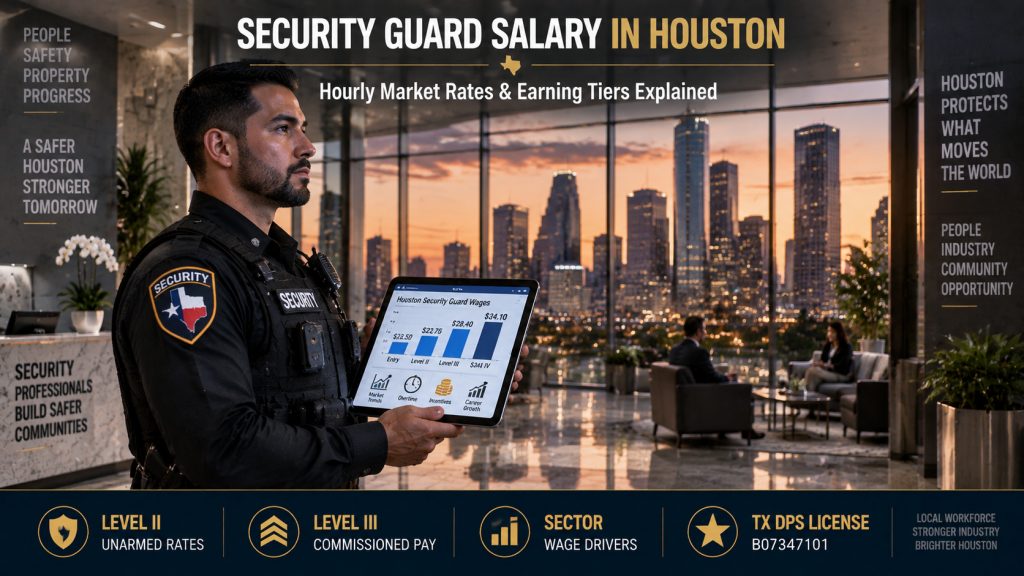
The primary driver of security compensation in Texas is the state licensing level authorized by the Texas Department of Public Safety (DPS) Private Security Bureau. Higher licensing tiers require more classroom training, firearms qualifications, and legal accountability, which translates directly to higher base pay:
| Licensing Tier | Houston Hourly Rate (Typical) | Estimated Annual Gross (Full-Time) | Core Assignment Scope |
|---|---|---|---|
| Level II (Unarmed) | $14.00 – $17.50 / hr | $29,120 – $36,400 | Corporate lobbies, retail centers, gatehouses, light warehouse access control. |
| Level III (Commissioned Armed) | $18.00 – $25.00 / hr | $37,440 – $52,000 | Mobile patrol vehicles, refineries, high-threat retail, banks, critical logistics yards. |
| Level IV (PPO / Executive Protection) | $30.00 – $55.00+ / hr | $62,400 – $114,400+ | Executive close protection, dignitary escort, secure transport, threat management. |
| Field Supervisor / Account Manager | $22.00 – $30.00 / hr | $45,760 – $62,400 | Post inspections, scheduling, training oversight, client incident escalation. |
To review the exact state requirements, classroom hours, and testing required to earn each credential, consult our detailed walkthrough on how to get a Texas security guard license: Level 2, 3, and 4 explained.
Phase 2: Industry-Specific Pay Rates Across Houston Sectors
Geography and industry sector play an influential role in wage rates across Harris County, Fort Bend County, and Brazoria County. A post requiring industrial safety credentials commands a noticeable premium over a quiet, climate-controlled commercial desk:
1. Petrochemical and Energy Infrastructure ($19 – $26 / hr)
Refineries, chemical processing complexes, and tank farms along the Houston Ship Channel, Pasadena, and Baytown pay near the top of the commercial security scale. Officers at these posts must hold Transportation Worker Identification Credentials (TWIC), complete Basic Plus safety training, wear flame-resistant clothing (FRC), and operate personal H2S gas monitors. The physical hazards and regulatory compliance standards warrant higher hourly wages.
2. Corporate High-Rises & The Energy Corridor ($16 – $20 / hr)
Class A commercial properties in Downtown Houston, the Galleria, and the Energy Corridor place a heavy premium on customer service, professional verbal de-escalation, and technical familiarity with modern access control systems. These roles require polished presentation, clean communication, and detailed digital report writing.
3. Freight Logistics Yards & Intermodal Depots ($16 – $21 / hr)
Cross-dock terminals, container yards, and intermodal freight facilities along I-10 and Beltway 8 demand rigorous gate verification procedures. Officers managing Commercial Driver’s License (CDL) screenings, bill of lading reconciliation, and ISO bolt seal integrity audits earn higher wages due to the active pace and inventory loss prevention stakes; explore standard operating procedures in our guide on industrial truck gate and loading dock check-in procedures.
4. Healthcare & Hospital Facilities ($17 – $23 / hr)
Healthcare security officers in the Texas Medical Center manage dynamic environments involving patient restraint, emergency department de-escalation, and visitor screening. These posts often require specialized non-violent crisis intervention certifications.
Phase 3: Key Factors That Increase a Security Officer’s Earning Power
Security is not an industry where everyone stays at entry-level wages. Officers who systematically develop specialized capabilities quickly progress into higher-paying operational tiers:
1. Upgrading to Commissioned (Armed)
Moving from Level II unarmed to Level III commissioned armed immediately raises baseline earnings by $3.00 to $7.00 per hour across Greater Houston.
2. Clean Driving Record & Patrol Duty
A valid Texas driver’s license with zero major infractions allows officers to operate marked patrol vehicles, qualifying for dynamic mobile route assignments and higher hourly shift rates.
3. Industrial Safety Certifications
Holding an active federal TWIC card, OSHA 10/30 certification, or Houston Area Safety Council (HASC) credentials opens immediate placement into high-paying petrochemical facilities.
4. Shift Differentials & Overtime
Third-shift overnight coverage (graveyard shifts) and weekend rotations often include hourly shift differentials ($0.50 to $2.00/hr) plus ample overtime opportunities at 1.5x base pay.
To examine the long-term career progression and earnings ceiling between armed and unarmed paths, read our detailed analysis on the armed vs unarmed security career path in Texas.
Phase 4: Understanding Pay Rate vs Commercial Bill Rate
For facility directors, property managers, and procurement officers reviewing commercial security proposals, understanding the distinction between an officer’s wage and a guard company’s contract bill rate is critical:
- Officer Pay Rate: The direct hourly wage paid to the individual security officer working the post (e.g., $18.00 / hr).
- Contractor Bill Rate: The comprehensive hourly rate billed to the commercial client by the licensed security guard company (e.g., $26.00 to $32.00 / hr).
The difference between the pay rate and the bill rate is not pure profit. Under Texas and federal law, a legitimate licensed contractor must cover essential payroll and operational overhead from this margin:
- Mandatory Payroll Taxes: Employer FICA, Medicare, Federal Unemployment (FUTA), and Texas Workforce Commission state unemployment insurance (SUTA).
- Workers’ Compensation Insurance: High-coverage workers’ comp policies specific to physical security officers and armed personnel.
- Commercial General Liability: Comprehensive liability coverage required by Texas DPS and commercial property lease standards.
- Uniforms and Duty Equipment: Ballistic gear, duty belts, body-worn cameras, digital reporting tablets, and marked patrol vehicle fuel and maintenance.
- 24/7 Field Supervision & Dispatch: Dedicated mobile field supervisors and dispatch operations ensuring officers arrive on time and relieve posts smoothly.
When security companies quote artificially low bill rates (e.g., $18/hr total bill rate), they can only pay officers minimum wage or cut corners on insurance. Low-paying guard companies suffer chronic turnover, absenteeism, and unmotivated guards. For a full cost comparison across mobile and stationary deployment models, review our guide on how much mobile security patrol costs in Houston.
Phase 5: Preparing for Higher-Paying Security Roles
Securing top-tier compensation in the Houston market requires preparation before you walk into an interview. Professional security contractors evaluate reliability, presentation, and communication skills just as rigorously as licensing credentials:
- Keep State Records Current: Ensure your Texas DPS TOPS profile is active, course completion certificates are downloaded, and your physical pocket card is in hand.
- Prepare for Background Audits: Top-tier security companies run detailed background screenings and 10-panel drug tests; learn what state investigators review in our guide on physical and background check requirements for Texas security officers.
- Demonstrate Situational Awareness: Interviewers prioritize candidates who understand professional report writing, conflict de-escalation, and boundary enforcement over candidates who simply want to sit in a booth.
For commercial property owners deciding whether to hire internal guards directly or partner with an established security company, examine the complete balance sheet in in-house vs contract security: cost, liability, and management.
Advance Your Security Career with God’s Armour Security
At God’s Armour Security, we believe providing exceptional security protection starts with paying competitive wages, treating officers with professional respect, and offering real paths for career advancement. We are licensed by the Texas Department of Public Safety as a security contractor and guard company (license no. B07347101). We deploy professional Level II, Level III, and Level IV security personnel across Houston high-rises, industrial complexes, energy terminals, and logistics hubs.
We provide stable schedules, responsive supervisory support, modern digital reporting tools, and structured training programs to help motivated officers advance from unarmed positions into high-paying armed mobile patrol and supervisory careers. Discover employment opportunities on our security officer careers in Houston page.
Ready to join an elite security team in Houston? Apply online today or call our Houston headquarters directly at (713) 878-9984.
Frequently Asked Questions
What is the average security guard salary in Houston, TX?
The average base pay for a security guard in Houston typically ranges between $15.00 and $18.50 per hour for general roles. However, pay varies significantly by credential: entry-level Level II unarmed guards typically earn $14.00 to $17.50 per hour, while Level III commissioned armed officers average $18.00 to $25.00 per hour.
How much do armed security guards make in Houston?
Commissioned armed security officers (Level III) in Houston generally earn between $18.00 and $25.00 per hour, depending on the assignment risk, shift schedule, and required certifications. High-hazard posts at chemical plants, ports, and critical infrastructure can pay $22.00 to $28.00 per hour.
Do night shift security guards get paid more in Texas?
Yes, many professional security companies offer shift differentials for overnight (graveyard) shifts and weekend assignments, typically adding $0.50 to $2.00 per hour above the standard day rate. Overtime opportunities also allow officers to earn 1.5 times their base hourly rate.
Why is there a big difference between guard pay and company bill rates?
The contractor bill rate covers much more than guard wages: it includes employer payroll taxes (FICA, FUTA, SUTA), mandatory workers’ compensation insurance, general liability policies, uniforms, duty gear, marked patrol vehicles, fuel, digital reporting software, and 24/7 field supervisory oversight.
Key Takeaways
- Security guard compensation in Houston is primarily determined by state licensing levels: Level II ($14–$17.50/hr), Level III ($18–$25/hr), and Level IV ($30–$55+/hr).
- Petrochemical terminals along the Houston Ship Channel and Energy Corridor corporate high-rises represent the region’s highest-paying commercial sectors.
- Earning power increases rapidly with an active Level III armed commission, a clean driving record for mobile patrol duty, and industrial credentials like TWIC cards.
- Commercial bill rates reflect mandatory employer overhead: payroll taxes, workers’ comp, liability insurance, duty uniforms, and 24/7 field management.
- God’s Armour Security operates under Texas DPS license B07347101, delivering competitive compensation, professional respect, and clear career paths for Houston security officers.