A security career in Texas is not a single job; it is a ladder. Where you start, unarmed or armed, and how far you climb, from an entry post to executive protection, shapes your pay, your assignments, and your day-to-day work. For anyone in the Houston area weighing this field, one of the first real decisions is the armed versus unarmed question, and understanding how the two paths connect makes the whole career easier to plan.
The short version is that they are not separate careers so much as stages of one. Nearly everyone starts unarmed, and moving to armed work is the most common step up. This guide lays out what each path involves, the trade-offs between them, and how the progression works from the entry level all the way to the top of the field.
Phase 1: Unarmed vs Armed at a Glance
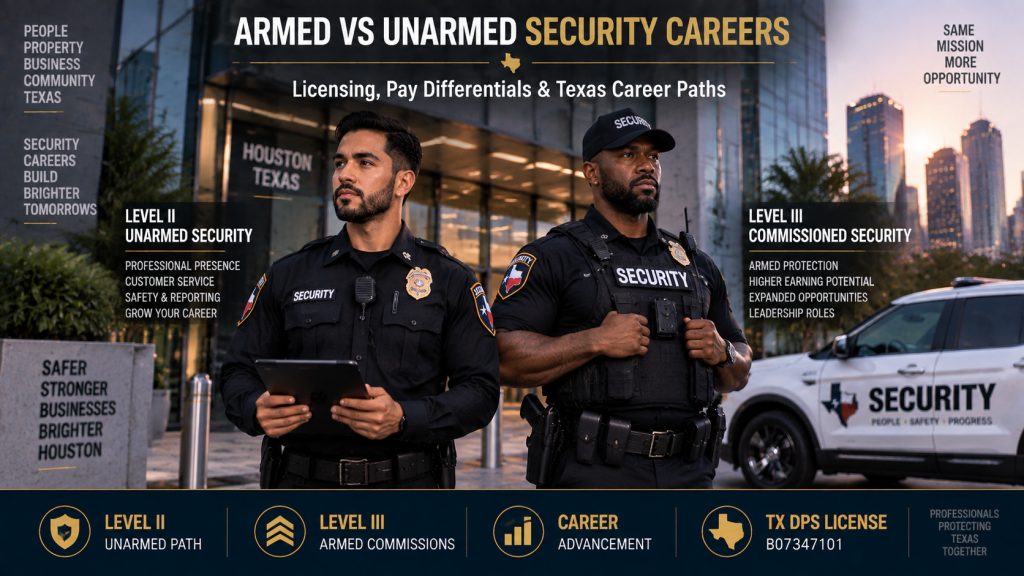
The two paths differ in more than just whether you carry a firearm. Here is how they compare across the things that matter to a career.
| Factor | Unarmed (Level II) | Armed (Level III) |
|---|---|---|
| Entry barrier | Lower: shorter training, faster to start. | Higher: more training, firearms qualification, added screening. |
| Pay | Entry-level range. | Higher hourly pay for the added responsibility. |
| Responsibility and risk | Observe, deter, report; lower personal and legal risk. | Carrying a firearm raises both responsibility and legal exposure. |
| Typical posts | Lobbies, retail, offices, general access control. | Banks, industrial and energy sites, high-value or higher-risk posts. |
| Advancement | The foundation everyone builds on. | Opens the door to specialized and personal protection work. |
Neither path is “better” in the abstract. Unarmed work is the faster, lower-risk way in; armed work pays more and opens more doors but asks more of you. The right first step depends on where you are starting and how fast you want to move.
Phase 2: The Unarmed Path (Level II)
Almost every security career in Texas starts here, as a non-commissioned, unarmed officer. It is the fastest route into the field and the foundation the rest of the career is built on.
Unarmed officers work the posts most people picture when they think of security: lobbies and front desks, retail centers, office buildings, gatehouses, and general access control. The job is about presence, observation, reporting, and de-escalation, deterring problems and calling for help rather than physically forcing outcomes. The training is shorter and the barrier to entry is lower, so you can be working relatively quickly. For many officers this is not just a starting point but a stable, long-term role, and it is also where you prove the reliability that earns better assignments and opens the path upward. The steps to get this license are covered in our guide on how to get a Texas security guard license.
Phase 3: The Armed Path (Level III)
Moving to armed work is the most common and most significant step up in a security career. A commissioned (Level III) officer is licensed to carry a firearm on duty, which changes both the work and the pay.
Getting there means more than another course. On top of the unarmed foundation, an armed officer completes the Level III commissioned training with a firearms qualification, and a psychological evaluation, reflecting the higher responsibility of carrying a weapon. In return, armed officers earn more per hour and qualify for posts that unarmed officers cannot take: banks, industrial and energy facilities, and other higher-risk or high-value sites. The trade-off is real, more training, more cost to get there, and more legal responsibility on duty, but for officers who want to advance, it is the clearest single move toward higher pay and more opportunity. How that pay difference plays out in the Houston market is covered in our guide on the average security guard salary in Houston.
Phase 4: Beyond the Line: Specialized and Supervisory Roles
The career does not stop at armed work. Once an officer has a commission and experience, several higher tiers open up.
1. Personal Protection Officer (Level IV)
Executive protection and bodyguard work, the most specialized path, built on top of Levels II and III. It is the top of the individual licensing ladder.
2. Specialized Posts
Industrial, energy, and high-risk assignments that require added credentials and pay above standard guard work for the skill they demand.
3. Field Supervisor and Site Lead
Overseeing other officers, inspecting posts, and managing schedules, a step from doing the work to leading it.
4. Account Manager and Operations
Managing client accounts and coordinating coverage, the move into the management side of the business.
The path from an entry-level unarmed post to a specialized or leadership role is a real one, and each rung pays more than the last. Level IV, the personal protection officer credential, is the peak of the individual licensing ladder, and the full requirements are covered in our guide on the Texas security guard license levels.
Phase 5: Which Path Should You Start On?
The right starting point depends on your goals, your timeline, and your circumstances. A few questions help decide.
- Do you want to start working quickly? The unarmed path has a lower barrier and a shorter runway, so you can be on a post sooner.
- Is higher pay the priority? Armed work pays more, but it requires the extra training, qualification, and screening first, so it takes longer and costs more to reach.
- Are you comfortable carrying a firearm and the responsibility that comes with it? Armed work is not just a pay bump; it is a real increase in legal and personal responsibility.
- What is your long-term goal? If you are aiming for executive protection or specialized high-risk work, you will need to move up the levels regardless, so starting with that path in mind helps.
For most people, the practical answer is to start unarmed, get on the job, build a reliable record, and then move up to armed and specialized work as their goals and circumstances allow. There is no penalty for starting at the bottom rung; it is how nearly everyone in the field began.
Phase 6: Pay, Promotions and Supervisor Roles
Each step up the ladder raises your pay and the responsibility you carry. Here is how the pay steps and the leadership roles stack up.
Unarmed Level II officers earn entry-level rates. A Level III commission brings a higher hourly rate for the added responsibility. Level IV personal protection work and specialized industrial and energy posts pay above standard armed rates.
Above armed work sit the leadership roles. Field supervisors and site leads oversee other officers, inspect posts, and manage schedules. Account managers and operations staff coordinate client coverage. These jobs go to officers with a clean track record, proven reliability, and experience across different post types.
For the licensing steps behind each move up, see our guide on how to get a security license in Texas.
Build Your Career With God’s Armour Security
A security job is a starting point; a security career takes an employer that helps you climb. God’s Armour Security is a Texas DPS-licensed security contractor and guard company (license no. B07347101) hiring unarmed, armed, and specialized officers across Greater Houston, Harris County, and statewide Texas, with real assignments at every level and a path to move up.
We hire officers at the unarmed level and support those who want to earn a commission, take specialized posts, and grow into personal protection and supervisory roles. Whether you are just starting or ready to advance, we would like to talk. Explore our security patrol services and learn more on our security professionals page.
Ready to build a security career in Houston? Apply with God’s Armour Security or call our Houston operations desk directly at (713) 878-9984.
Frequently Asked Questions
Is it better to start as an armed or unarmed security officer in Texas?
For most people, starting unarmed (Level II) makes sense: the training is shorter, the barrier is lower, and you can begin working sooner. Armed (Level III) work pays more and opens more posts, but it requires additional training, a firearms qualification, and screening. Nearly everyone starts unarmed and moves up to armed as a deliberate next step.
How do you go from unarmed to armed security in Texas?
You build on the unarmed Level II foundation by completing the Level III commissioned training, which includes a firearms qualification and a psychological evaluation. Once licensed as a commissioned officer, you can carry a firearm on duty and take higher-paying armed posts. It is the most common and most significant step up in the field.
What is the highest level in a Texas security career?
On the individual licensing ladder, Level IV, the Personal Protection Officer (executive protection) credential, is the top, built on top of Levels II and III. Beyond individual licensing, officers can also advance into field supervisor, site lead, account manager, and operations roles on the management side.
Does armed security pay more than unarmed in Texas?
Yes. Armed (Level III) officers generally earn more per hour than unarmed (Level II) officers because carrying a firearm requires more training and screening and carries more responsibility. Moving from unarmed to armed is usually the single largest pay increase available in the field.
Key Takeaways
- Armed and unarmed security are not separate careers but stages of one; nearly everyone starts unarmed and moves up.
- The unarmed Level II path has a lower barrier and faster entry; the armed Level III path pays more but requires more training, a firearms qualification, and screening.
- Above armed work sit specialized posts, the Level IV personal protection credential, and supervisory and management roles, each paying more than the last.
- For most people the smart route is to start unarmed, build a reliable record, and move up as goals and circumstances allow.
- Advancement comes from earning the next license, building a clean track record, adding credentials, and working for an employer that promotes from within.