Greater Houston is one of the busiest freight hubs in the country. Between the Houston Ship Channel, the intermodal yards, and the warehouse corridors along I-10 and Beltway 8, an enormous volume of cargo sits staged in yards and distribution centers every day, and that concentration of high-value freight makes the region a magnet for cargo theft. For logistics operators, warehouse managers, and distribution center directors, a loaded trailer left in an unsecured yard overnight is one of the most exposed assets a business owns.
Cargo theft is not one crime; it is several, from a crew hooking up a trailer and driving it off the lot to a fraudster posing as a legitimate carrier to pick up a load that is handed over willingly. Stopping it takes a plan that addresses each of those methods, not just a fence and a camera. This guide breaks down how theft happens at a logistics yard and the layered defenses that shut it down.
Phase 1: How Theft Happens at a Logistics Yard
You cannot defend against a threat you do not understand. Theft at a distribution yard comes in distinct forms, and each one calls for a different countermeasure.
| Theft Type | How It Works | Primary Countermeasure |
|---|---|---|
| Straight cargo theft | A crew enters the yard and physically hooks up and drives off a loaded trailer, often overnight. | Secured perimeter, trailer locks, lighting, and patrols that cover the whole yard. |
| Fictitious or fraudulent pickup | A thief poses as a legitimate carrier and is handed a load at the gate, with no force involved. | Strict driver and carrier verification against the appointment and paperwork at the gate. |
| Pilferage | Part of a load is taken from a trailer or the dock rather than the whole shipment. | Trailer seals, dock supervision, and load verification at check-in and check-out. |
| Internal theft | Employees or drivers with legitimate access divert product or manipulate records. | Dual verification, documented processes, and supervision at receiving and shipping. |
The mistake operators make is defending against only the first type, the crew that breaks in, while leaving the gate open to a fraudster who simply asks for the load. A real plan closes both the fence line and the paperwork.
Phase 2: Securing the Yard and the Trailers
The yard is where loaded and empty trailers sit exposed, often for hours or overnight. Hardening it removes the easy opportunity for straight cargo theft.
1. Perimeter and Lighting
A maintained perimeter fence with controlled gates keeps a getaway tractor from simply driving in and out, and even, maintained lighting across the yard removes the darkness a crew relies on to work a trailer unseen. Dark back rows of a large yard are where trailers go missing.
2. Trailer Security Devices
Loaded trailers left in the yard should be physically secured. Kingpin locks, landing gear locks, and glad-hand locks make it far harder and slower to hook up and tow a trailer, which is often enough to send a crew looking for an easier target.
3. Smart Staging
Where loaded trailers are parked matters. Staging high-value loads in well-lit, central, camera-covered areas, and nose-to-nose or against a wall so they cannot be hooked easily, adds friction. Empty trailers can screen the loaded ones from the fence line.
Phase 3: Gate Control and Pickup Verification
The most damaging cargo theft often involves no break-in at all. In a fictitious pickup, a thief presents as a legitimate carrier, arrives at the gate, and is handed a loaded trailer because the paperwork looked right and no one verified it closely. The load leaves willingly, and the theft is not discovered until the real carrier shows up.
Stopping this happens at the gate. Every pickup should be verified against a scheduled appointment, the driver’s identity and carrier credentials checked, and the load released only when everything matches. A trained officer at the gate is the control point that catches the driver whose paperwork does not line up, the carrier that was never booked, and the pickup that does not match the appointment. The full procedures for managing truck and driver flow are covered in our guide on industrial truck gate and loading dock check-in procedures.
Phase 4: Patrol Coverage of the Yard
A distribution yard is too large for a single fixed post to watch. Rows of trailers, a long perimeter, and dark corners all need coverage that moves, which is why mobile patrols are central to yard security.
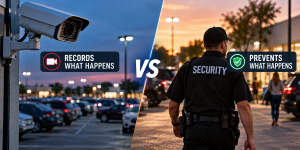
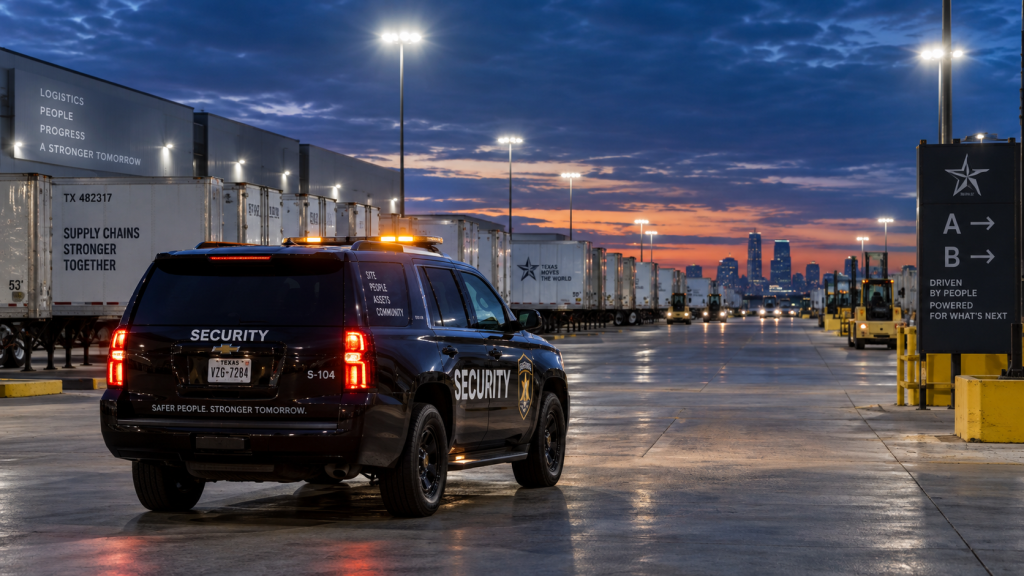
A marked patrol vehicle runs the perimeter, moves through the trailer rows, and checks the staging and dock areas on each round, and its visible presence deters a crew scouting the yard. Randomized timing is what makes it work: if the patrol comes through on a predictable schedule, a crew simply waits for the gap, so the rounds have to be unpredictable, as we explain in our guide on randomized vs scheduled patrol rounds. The overnight hours, when the yard is quiet and staged full of loads, are the highest-risk window, covered in our guide on commercial property security after-hours. Employee and visitor vehicles in the lot are their own exposure, addressed in our guide on stopping car break-ins in commercial parking lots.
Phase 5: Internal Theft and Process Controls
Not every loss comes from outside the fence. People with legitimate access, employees and regular drivers, can divert product or manipulate records, and this loss is harder to see because it hides inside normal operations.
1. Trailer Seals
Numbered seals on loaded trailers, recorded at loading and checked at the gate, make it obvious if a trailer was opened between the dock and departure.
2. Dual Verification
Requiring two people to confirm counts on high-value inbound and outbound loads makes it far harder for one person to cover up a diversion.
3. Documented Check-In and Check-Out
Logging every trailer, driver, and load in and out creates a record that surfaces discrepancies and deters manipulation.
4. Supervision at the Dock
A visible presence at receiving and shipping discourages the quiet diversion of product that thrives when no one is watching the dock.
Phase 6: Building the Layered Plan
No single measure secures a logistics yard, because no single method is how it gets hit. The plan has to cover every layer at once:
- Harden the yard. Fencing, lighting, controlled gates, and trailer locks stop the crew that would break in and tow a load.
- Verify at the gate. Strict pickup and driver verification stops the fraudster who would be handed a load without force.
- Patrol the footprint. Randomized mobile patrols cover the rows, perimeter, and dark corners no fixed post can watch.
- Control the process. Seals, dual verification, and documentation close the internal and pilferage gaps inside normal operations.
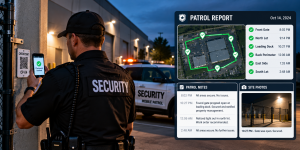
- Document everything. Time-stamped patrol logs and gate records deter theft, support recovery and insurance, and show reasonable care.
Protect Your Yard with God’s Armour Security
A loaded yard is a target the moment it is left unwatched. God’s Armour Security, licensed by the Texas DPS as a security contractor and guard company (license no. B07347101), provides gate officers, marked mobile yard patrols, and documented coverage for distribution centers, warehouse yards, intermodal facilities, and logistics operations across the Houston Ship Channel, the I-10 corridor, and statewide Texas.
Our supervisory team assesses your yard, gates, and staging areas, then builds a coverage plan, gate verification, patrols, or both, matched to the size and risk of your operation. Explore our security patrol services in Houston and our broader commercial security services.
Ready to secure your logistics yard? Request a yard security consultation and site assessment or call our Houston operations desk directly at (713) 878-9984.
Frequently Asked Questions
What are the main types of theft at a logistics yard?
Four main types: straight cargo theft, where a crew physically hooks up and drives off a trailer; fictitious or fraudulent pickup, where a thief poses as a legitimate carrier and is handed a load; pilferage, where part of a load is taken; and internal theft, where people with legitimate access divert product. Each requires a different countermeasure.
What is a fictitious pickup, and how do you prevent it?
A fictitious pickup is a fraud where a thief presents as a booked carrier and is handed a loaded trailer without any break-in. It is prevented at the gate by verifying every pickup against a scheduled appointment, checking the driver’s identity and carrier credentials, and releasing the load only when everything matches.
How do you secure trailers left in a yard overnight?
Combine a hardened yard with trailer security devices. A controlled perimeter and even lighting remove the easy opportunity, while kingpin locks, landing gear locks, and glad-hand locks make a trailer far harder to hook and tow. Staging high-value loads in well-lit, camera-covered central areas adds further friction.
Why are mobile patrols important for distribution centers?
A distribution yard is too large for one fixed post to watch, with long perimeters, rows of trailers, and dark corners. Mobile patrols cover the whole footprint on rounds, and randomized timing prevents a crew from waiting out a predictable gap. Overnight, when the yard is quiet and staged full, is the highest-risk window.
Key Takeaways
- Logistics yards face four distinct theft types: straight cargo theft, fictitious pickups, pilferage, and internal theft, and each needs its own countermeasure.
- Harden the yard with a controlled perimeter, lighting, smart staging, and trailer locks to stop crews that would tow a load.
- Strict gate verification of every pickup, driver, and carrier is what stops fraudulent pickups handed over without force.
- Randomized mobile patrols are essential to cover a large yard’s perimeter, trailer rows, and dark corners overnight.
- Seals, dual verification, and documentation close the internal and pilferage gaps that hide inside normal operations.