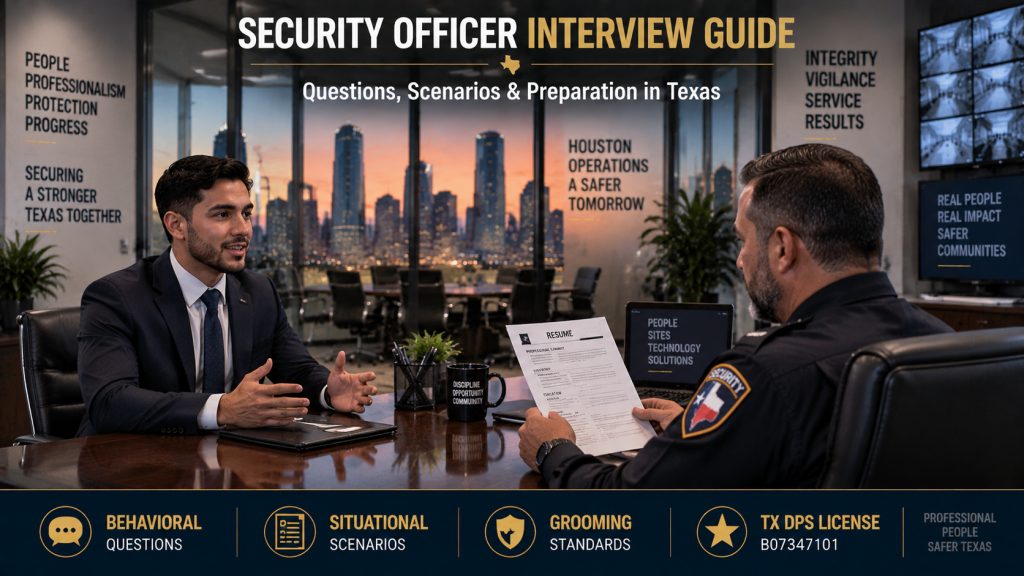
You have the license, or you are working toward it, and now there is an interview between you and the job. For a security officer role, that interview is not a formality. A professional security company is deciding whether to trust you with its clients’ property, its reputation, and situations where your judgment matters. Knowing what they are looking for, and preparing for it, is what turns a nervous conversation into a confident one.
The good news is that security interviews are fairly predictable. Employers ask about the same core things, look for the same qualities, and are put off by the same red flags. This guide walks through what to expect, the questions you will likely face and how to answer them, and how to present yourself so you stand out for the right reasons.
Phase 1: What the Interviewer Is Really Looking For
Before the questions, understand the goal. A security employer is not just checking that you can stand at a post. They are assessing a specific set of qualities, and every question maps back to one of them.
| Quality | Why It Matters | How They Test For It |
|---|---|---|
| Reliability | A post that goes unmanned is a failure; showing up matters most. | Questions about attendance, transportation, and shift flexibility. |
| Judgment | Officers face situations where the right call is not written down. | Scenario questions: “What would you do if…”. |
| Composure | Staying calm under pressure prevents incidents from escalating. | Questions about conflict, angry people, and emergencies. |
| Professionalism | Officers represent the client’s brand and the security company. | Your presentation, communication, and how you carry yourself. |
| Integrity | Officers are trusted around valuables, access, and sensitive areas. | Honesty questions and the background check behind them. |
If you keep these five qualities in mind, most interview questions become easy to read. The interviewer is always asking, in some form, “Can I count on this person to show up, stay calm, use good judgment, represent us well, and be trusted?”
Phase 2: Common Questions and How to Answer Them
Security interviews lean heavily on a handful of question types. Here are the ones you are most likely to hear and what a strong answer looks like.
1. “Why do you want to work in security?”
They want to know you are serious about the work, not just filling time. A strong answer connects to the real job: you take responsibility seriously, you are observant and level-headed, and you want a role where reliability matters. Avoid answers that are only about the paycheck or that make it sound like a fallback.
2. “What would you do if…” (scenario questions)
These are the heart of a security interview. Expect scenarios like an unauthorized person trying to enter, an alarm going off, a medical emergency, or an aggressive visitor. The framework that works: observe and assess, follow post orders and procedure, communicate and call for help when needed, and stay within your authority. Show that you would document the incident and escalate rather than overreach.
3. “How do you handle an angry or aggressive person?”
Employers are listening for de-escalation, not confrontation. A strong answer emphasizes staying calm, listening, keeping a safe distance, and using clear communication to defuse the situation, and knowing when to call for backup or police rather than forcing a physical outcome. These are the same skills covered in our guide on de-escalation techniques for security officers.
4. “Tell me about a time you had to be reliable or handle responsibility.”
This is a behavioral question, and the best answers are specific. Use a real example, briefly describe the situation, what you did, and the result. Even from a non-security job, a story about perfect attendance, handling cash, or staying calm in a tense moment shows the qualities they want.
5. “Are you comfortable with the shift, the post, and the requirements?”
Be honest about your availability, transportation, and willingness to work nights or weekends. Security runs around the clock, and a candidate who is upfront and flexible about coverage is far more attractive than one who is vague.
Phase 3: What to Bring and How to Prepare
Preparation shows before you say a word. Walk in ready with the right documents and the right knowledge.
1. Your Documents
Bring your license or pocket card (or proof you are in training), a government photo ID, and any relevant certifications. Have them organized and ready.
2. Know the Company
Look up what the company does and the kinds of sites it protects. Being able to speak to that shows you are serious and did your homework.
3. Prepare Your Scenarios
Think through how you would handle common situations in advance, so a scenario question does not catch you flat. Have one or two real examples ready.
4. Have Questions Ready
Ask about the post, the schedule, supervision, and advancement. Thoughtful questions signal genuine interest and professionalism.
Phase 4: How to Present Yourself
In security, presentation is part of the job, and the interview is where the employer sees it first. How you show up is itself an answer to whether you can represent them at a post.
Arrive early, dressed neatly and conservatively, groomed, and ready. Make eye contact, offer a firm handshake, and speak clearly and calmly. Sit and stand with good posture, and stay composed even if a question surprises you, because composure is exactly the trait the job requires. Officers represent the client’s property and the security company to everyone who walks in, so an interviewer is reading whether you would look the part and stay professional on duty. You do not need to be formal to the point of stiffness, but you do need to look like someone who can be trusted at a front desk or a gate.
Phase 5: Red Flags to Avoid
Just as employers look for good signs, certain things end an interview quickly. Steer clear of these:
- Downplaying reliability. Being vague about attendance, transportation, or availability tells an employer you might leave a post uncovered.
- Sounding eager to use force. A candidate who talks about wanting confrontation, or “handling” people physically, worries employers. The job is prevention and de-escalation, not fighting.
- Being dishonest about your record. A background check is coming, so hiding something is worse than addressing it. Honesty about your history builds trust; a surprise later ends it.
- Poor presentation. Showing up late, unkempt, or on your phone signals how you would show up to a post.
- No knowledge or questions. Knowing nothing about the company and asking nothing suggests you are not genuinely interested.
Being honest about your background matters because the employer will verify it, which is exactly what our guide on the physical and background check requirements for Texas security officers covers. And understanding what a professional company itself looks for in its people, and its vendors, is laid out in our guide on the questions to ask before hiring a commercial security guard company.
Phase 6: After the Interview
The interview is not the last step, and how you handle what follows still counts.
Expect a background check and, at many companies, a drug screening as conditions of the offer, so be ready to complete those promptly. If you are hired, you will need to be affiliated with the company through the state system before you can work, and you may go through site-specific orientation or post-order training before your first shift. A brief, polite thank-you or follow-up after the interview leaves a good final impression. From there, reliability on the job is what turns a first post into a career, and what earns the better assignments and higher pay covered in our guide on the average security guard salary in Houston.
Interview With God’s Armour Security
If you are preparing for a security interview in Houston, we would like it to be with us. God’s Armour Security is a Texas DPS-licensed security contractor and guard company (license no. B07347101) hiring reliable, professional officers across Greater Houston, Harris County, and statewide Texas, for unarmed, armed, and specialized roles.
We look for exactly the qualities above, reliability, judgment, composure, professionalism, and integrity, and we support the officers who show them with real assignments and room to grow. If you are licensed, in training, or just starting out, we want to hear from you. Learn more on our security professionals page.
Ready to interview for a security role in Houston? Apply with God’s Armour Security or call our Houston operations desk directly at (713) 878-9984.
Frequently Asked Questions
What questions are asked in a security officer interview?
Expect a mix of motivation questions (why security?), scenario questions (“what would you do if…”), conflict and de-escalation questions, behavioral questions about reliability and responsibility, and practical questions about your availability, shift flexibility, and transportation. Every question maps back to reliability, judgment, composure, professionalism, or integrity.
How should I answer a “what would you do if” scenario in a security interview?
Use a simple framework: observe and assess the situation, follow post orders and procedure, communicate and call for help when needed, and stay within your authority. Show that you would document and escalate rather than overreach or force a physical outcome. Interviewers want sound judgment and de-escalation, not aggression.
What should I bring to a security guard interview?
Bring your security license or pocket card (or proof you are in training), a government photo ID, and any relevant certifications, organized and ready. It also helps to know the company and the kinds of sites it protects, and to have a couple of thoughtful questions prepared.
What are the biggest mistakes in a security interview?
The most common are being vague about reliability and availability, sounding eager to use force rather than de-escalate, being dishonest about your background (which a check will surface), poor presentation, and showing no knowledge of the company or interest in the role.
Key Takeaways
- Security interviews assess five core qualities: reliability, judgment, composure, professionalism, and integrity, and every question maps to one of them.
- Expect motivation, scenario, conflict, behavioral, and availability questions; answer scenarios by observing, following procedure, communicating, and staying within your authority.
- Come prepared with your documents, knowledge of the company, rehearsed scenarios, and thoughtful questions of your own.
- Presentation is part of the job; arrive early, neat, calm, and professional, because the interviewer is picturing you at a post.
- Avoid the red flags, unreliability, eagerness to use force, dishonesty, poor presentation, and expect a background check and drug screening after a successful interview.
Before the interview, it also helps to know the difference between security officers and security guards in Houston, since employers may use the titles in specific ways.