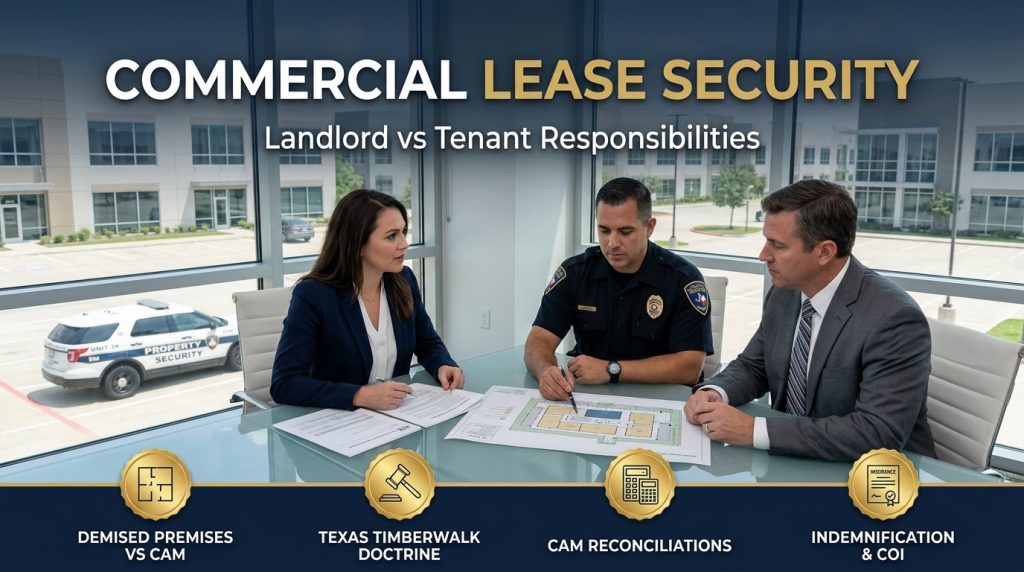
When something goes wrong at a leased commercial property, a break-in at a unit, an assault in the shared parking lot, a vandalized entrance, one question comes up fast: whose responsibility was the security? For business owners, property managers, and landlords across Greater Houston, the honest answer is that it depends, and where it lands is decided by two things: what the lease says, and who actually controlled the area where it happened.
Security is one of the most common gray areas in commercial leasing, and it stays gray until an incident forces the issue. The time to sort it out is before signing, not in a dispute afterward. This guide breaks down how security duties usually split between landlord and tenant, why the lease is the first answer, and how premises liability sets a floor that no contract fully erases.
Phase 1: Who Is Usually Responsible for What
There is no fixed rule that assigns security to one party, but commercial leases tend to follow a common pattern based on who controls each area. Use this as a starting point, not a substitute for reading your actual lease.
| Area | Typically Responsible | What It Usually Covers |
|---|---|---|
| Parking lots and exterior grounds | Landlord | Lot lighting, patrols, and common-area coverage, often funded through CAM charges. |
| Shared entrances and common areas | Landlord | Lobby access control, shared corridors, and building-wide systems. |
| Interior of the leased premises | Tenant | The tenant’s own locks, alarms, cameras, and internal access within their unit. |
| The tenant’s own operations | Tenant | Cash handling, employee safety, and any guard the tenant hires for their business. |
This split holds only where the lease is silent or general. A specific lease clause can move any of these duties either way, which is exactly why the document itself is the real answer.
Phase 2: The Lease Is the First Answer
Commercial leasing is governed by contract. Unlike residential tenancies, which carry certain built-in statutory protections, commercial security duties are largely whatever the two parties negotiate and write down. That freedom cuts both ways: if the lease is clear, it controls; if it is vague, disputes follow.
When reviewing or drafting a lease, these are the clauses that decide security responsibility:
- Common area maintenance (CAM). Whether security is a reimbursable CAM expense, and how it is allocated among tenants, usually sits here. Our guide on shared security cost models for strip malls and shopping centers covers how that works.
- Security or services provisions. Some leases spell out what the landlord will and will not provide, sometimes with an explicit statement that the landlord is not obligated to provide security at all.
- Maintenance and repair. Responsibility for lighting, locks, gates, and fencing often lives in the maintenance clause rather than a security clause.
- Insurance and indemnification. These clauses decide who carries coverage and who holds whom harmless when an incident leads to a claim.
The practical takeaway for both sides: do not assume. A tenant who expects the landlord to patrol the lot, or a landlord who assumes tenants secure their own entrances, can each be wrong depending on the wording.
Phase 3: Premises Liability Sets the Floor
A lease can allocate who pays for and provides security, but it cannot fully erase the duty owed to the people who come onto the property. That duty comes from Texas premises liability law, and it applies to whoever controls the area where an incident happens.
Under the standard set in Timberwalk Apartments v. Cain, a party who controls a premises owes invitees a duty of ordinary care to protect them from third-party crime when that crime is both unreasonable and foreseeable. Courts judge foreseeability by the proximity, recency, frequency, and similarity of prior crimes, and how publicly known they were. In a leased setting, that duty tends to follow control: a landlord who controls the parking lot generally carries the duty there, while a tenant who controls their own unit carries it inside. A lease can shift cost and indemnity between the parties, but an injured customer or employee can still sue whoever was in control, so neither side can simply contract the risk away. Our guide on parking lot crime liability for property owners covers this framework in detail.
This article is general information, not legal advice. Lease terms and liability turn on the specific facts and documents, so have a licensed Texas attorney review your lease and your obligations.
Phase 4: The Common Gray Areas
Most landlord-tenant security disputes cluster around the same few points. Spot these early and address them in writing.
1. The Parking Lot
The most disputed area. It is shared, it is where much crime happens, and tenants and landlords often each assume the other covers it. Name the responsible party and the coverage in the lease.
2. After-Hours Coverage
When the building is closed, who is responsible for the empty property? See our guide on after-hours commercial property security for what that coverage looks like.
3. Shared Entrances and Access
Lobby access control and shared doors sit between the parties. Our guide on office building access control covers how these are managed.
4. Upgrades After an Incident
After a break-in or assault, who pays to add lighting, cameras, or patrols? A lease that is silent here turns a needed fix into a fight.
Phase 5: Getting Security Right in the Lease
Whether you are the landlord or the tenant, a few steps keep security from becoming a dispute later:
- Define the scope. State plainly which areas each party is responsible for securing, rather than leaving it to a general clause.
- Address common areas directly. Name who provides parking, lighting, and common-area security, and how the cost is allocated through CAM.
- Set insurance and indemnity clearly. Require appropriate coverage on both sides, and use additional insured and indemnification language so a claim lands where the parties intend.
- Plan for changes. Include how security upgrades are decided and funded if the risk level rises, so a post-incident improvement is not an argument.
- Have counsel review it. Security and liability clauses interact with each other, so a Texas attorney should check that they line up.
When either party needs to actually provide coverage, the questions in our guide on hiring a commercial security guard company help you choose a provider that meets the lease’s requirements.
Clarify Your Property’s Security with God’s Armour Security
Whether you are a landlord covering common areas or a tenant securing your own operation, the coverage has to match what the lease requires. God’s Armour Security provides Texas-licensed officers, marked mobile patrols, and documented coverage for office buildings, retail centers, industrial parks, and multi-tenant properties across Greater Houston, Harris County, and statewide Texas.
Our supervisory team assesses the property, clarifies which areas need coverage, and builds a documented plan that fits a landlord’s common-area obligations or a tenant’s own scope. Explore our commercial security services in Houston and our commercial security patrol services.
Need coverage that matches your lease obligations? Request a commercial security consultation and property assessment or call our Houston operations desk directly at (713) 878-9984.
Frequently Asked Questions
Who is responsible for security in a commercial lease, the landlord or the tenant?
It depends on the lease and on who controls the area. Landlords typically handle common areas such as parking lots, shared entrances, and building systems, while tenants handle the interior of their own leased space and their own operations. A specific lease clause can shift any of these, so the lease itself is the deciding document.
Are commercial landlords legally required to provide security in Texas?
There is no general statute forcing a commercial landlord to provide security guards. However, under Texas premises liability law, whoever controls an area owes invitees a duty of ordinary care to protect them from foreseeable third-party crime. A lease can allocate cost and responsibility, but it does not erase that underlying duty to people on the property.
Can a commercial lease shift all security liability to the tenant?
A lease can shift cost, provide indemnification, and require insurance between the parties, but an injured third party can still sue whoever actually controlled the area where the harm occurred. That is why both sides should carry coverage and why the allocation should be reviewed by an attorney rather than assumed.
What security clauses should a commercial lease include?
At a minimum, define which party secures which areas, address common-area security and how it is funded through CAM, set insurance and indemnification terms, and include how security upgrades are decided and paid for if risk increases. Clear wording here prevents most landlord-tenant security disputes.
Key Takeaways
- Commercial lease security responsibility follows control: landlords typically cover common areas and parking, tenants cover their own leased space and operations.
- The lease is the first answer, because commercial security duties are largely contract-driven and not fixed by statute.
- Premises liability sets a floor: whoever controls an area owes invitees reasonable care against foreseeable crime, and a lease cannot fully contract that away.
- The parking lot, after-hours coverage, shared entrances, and post-incident upgrades are the most common dispute points, so address them in writing.
- Define scope, common-area coverage, insurance, indemnity, and upgrade funding in the lease, and have a Texas attorney review it.