In popular media and entertainment culture, the terms bodyguard and executive protection agent are frequently used interchangeably. Film depictions typically present both roles as imposing, muscular figures wearing sunglasses, physically pushing through paparazzi crowds, and reacting with physical force during unexpected ambushes. In the modern private security industry, however, these two professions represent vastly different operational methodologies, licensing standards, and strategic mindsets.
While a traditional bodyguard provides physical presence to deter confrontation, an executive protection specialist functions as a strategic risk mitigation manager. Executive protection relies on extensive advance planning, continuous intelligence gathering, route reconnaissance, and discrete tactical navigation to guarantee that a threat never materializes in the first place.
For corporate executives, high-net-worth families, public figures, and legal counsels operating in Texas, understanding the operational distinction between a bodyguard and an executive protection agent is vital to choosing the appropriate security asset.
Phase 1: Defining the Core Operational Mindset
The foundational divergence between bodyguards and executive protection agents lies in their approach to personal safety: physical reaction versus proactive prevention.
1. The Bodyguard Paradigm: Reactive Physical Defense
Traditional bodyguarding is fundamentally reactive. The officer accompanies the principal into public environments, serving as a visible physical barrier between the client and surrounding crowds. The primary value of a conventional bodyguard relies on visible intimidation to discourage hostile approaches.
When an incident occurs, a bodyguard reacts to the immediate physical threat. However, relying purely on reactive tactics means that the security detail has already surrendered the element of time and positional advantage to the adversary.
2. The Executive Protection Paradigm: Proactive Risk Mitigation
Executive protection, often referred to as close protection, operates on avoidance rather than confrontation. An executive protection specialist measures success by what does not happen. The primary operational objective is to design travel itineraries, secure venue perimeters, and identify evacuation routes so thoroughly that the principal never encounters an imminent hazard.
If an executive protection agent must draw a weapon or engage in hand-to-hand combat, it indicates that advance reconnaissance, perimeter screening, or operational planning experienced a critical breakdown. Executive protection focuses on intelligence, discretion, seamless logistics, and total operational invisibility.
Phase 2: Comprehensive Comparison: Bodyguard vs Executive Protection
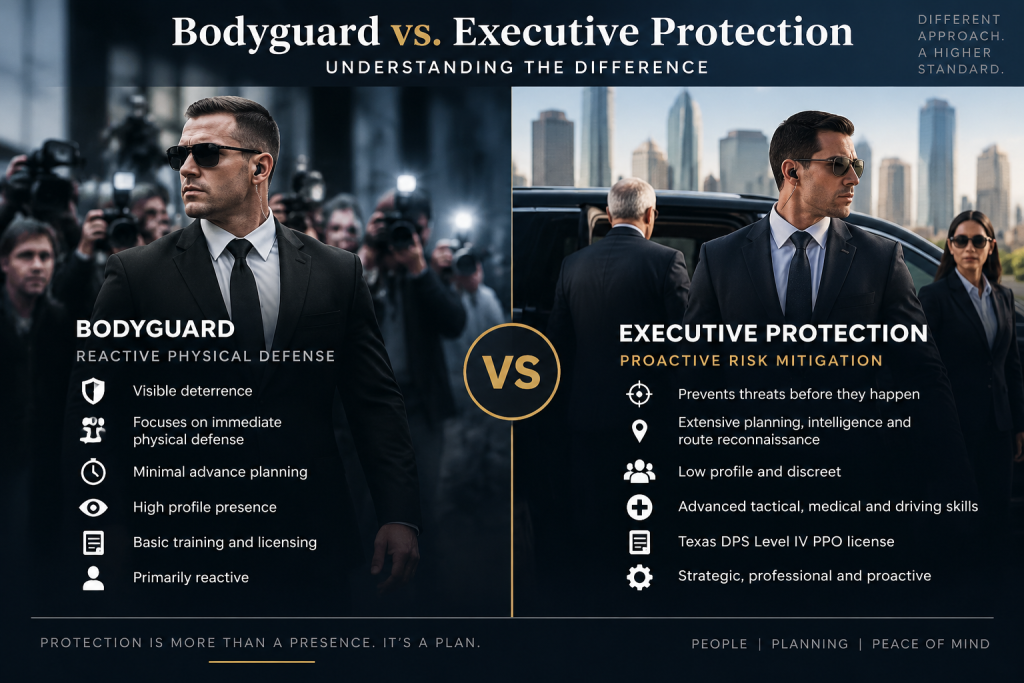
To clarify how these protective roles function in real-world scenarios, examine their operational differences across six critical dimensions:
| Operational Dimension | Traditional Bodyguard | Executive Protection Specialist |
|---|---|---|
| Primary Operational Objective | Visible deterrence and immediate physical defense during confrontation. | Pre-incident avoidance, route reconnaissance, threat intelligence, and safe extraction. |
| Advance Planning & Logistics | Minimal; typically arrives with the principal and assesses hazards on the spot. | Comprehensive; conducts advance site surveys, verifies trauma centers, maps secondary egress routes. |
| Public Profile & Discretion | High profile; prominent muscular physique intended to stand out and intimidate. | Low profile; blends seamlessly into corporate boardrooms, five-star galas, and private flights. |
| Medical & Tactical Capabilities | Basic CPR, physical restraint, and standard firearm qualification. | Trauma medicine (TCCC), tactical motorcade driving, surveillance detection, counter-ambush driving. |
| Corporate & Social Etiquette | Limited; focus remains strictly on physical presence and crowd shielding. | Polished; fluent in executive protocols, international diplomatic decorum, and confidentiality. |
| Licensing Standards (Texas DPS) | Commonly Level II (Unarmed) or Level III (Commissioned Armed Security). | Texas DPS Level IV Personal Protection Officer (PPO) license with advanced credentials. |
When budgeting for executive-level security assets, review our transparent market analysis on event security costs in Houston, which details the billable hourly rates for Level IV specialists compared to standard guarding tiers.
Phase 3: The Four Pillars of Professional Executive Protection
A full executive protection program integrates multi-layered protective intelligence to guarantee seamless movement throughout the principal daily schedule.
1. Advance Reconnaissance Work
The hallmark of executive protection is the advance survey. Hours or days before the principal travels, an advance agent physically inspects every destination:
- Walking secondary corridors, freight elevators, and private kitchen exits at hotels and convention halls.
- Locating the nearest Level 1 trauma hospital and driving the emergency medical transit route to clock travel times during peak traffic hours.
- Liaising with local municipal law enforcement, venue directors, and building engineers to ensure secure parking access.
- Auditing venue perimeter doors using an established event security checklist for venue managers.
2. Protective Intelligence and Threat Analysis
Executive protection teams monitor online threats, corporate activist communications, local civil unrest patterns, and direct communications sent to the principal company. Knowing whether an activist group plans to disrupt an annual shareholder summit allows the team to adjust arrival times and access gates before the vehicle motorcade departs.
3. Evasive and Defensive Motorcade Driving
Statistical security data confirms that over eighty percent of violent attacks, kidnappings, and physical ambushes targeting high-profile individuals occur while entering, exiting, or riding inside a motor vehicle. Executive protection specialists undergo rigorous driver training, mastering tactical vehicle positioning, counter-surveillance detection, skid recovery, and rapid ambush escape maneuvers.
4. Emergency Trauma Medical Response
The most probable life safety emergency facing a corporate executive is not a ballistic assault; it is a medical crisis, such as cardiac arrest, heatstroke, or accidental physical trauma. Executive protection agents maintain certifications in Tactical Combat Casualty Care, carrying tourniquets, hemostatic gauze, and automated external defibrillators directly within their transport vehicles.
Phase 4: Texas Licensing Regulations: Understanding the PPO Requirement
Texas maintains strict statutory oversight regarding who can legally provide close personal protection. Hiring unqualified personnel creates severe criminal liability and commercial insurance voids.
1. Texas DPS Level IV Personal Protection Officer Certification
Under Chapter 1702 of the Texas Occupations Code, operating as a close protection agent in plainclothes requires a valid Level IV Personal Protection Officer license issued by the Texas Department of Public Safety Private Security Bureau.
To qualify as a Level IV officer in Texas, a candidate must:
- Hold an active Texas DPS Level III Commissioned Armed Security license in good standing.
- Complete intensive state-mandated training in defensive tactics, non-lethal weapon deployment, weapon retention, and civil liability statutes.
- Pass a comprehensive psychological examination administered by a state-licensed psychologist (Minnesota Multiphasic Personality Inventory).
- Work directly under a licensed security company rather than acting as an independent, uninsured contractor.
2. Plainclothes Concealment Authority
Standard Level II and Level III security officers in Texas are legally required to wear conspicuous uniforms displaying company badges. Only a certified Texas DPS Level IV PPO holds the legal authority to provide armed personal protection while wearing business suits or discrete casual clothing, allowing them to blend into luxury corporate meetings and private family functions.
Phase 5: When Should You Choose Executive Protection Over a Bodyguard?
While some nightclub appearances, celebrity fan greetings, or public rallies benefit from the visible deterrence of a traditional bodyguard, most corporate and high-net-worth scenarios require executive protection:
1. Corporate Conferences, Shareholder Summits, and Galas
High-level business symposiums demand specialists who understand boardroom decorum and corporate protocol. When attending conventions, deploying personnel trained in corporate event and conference security in Houston ensures that intellectual property and executive safety are preserved without intimidating foreign business partners.
2. Private Family Weddings and Estate Gatherings
Milestone family events require extreme discretion. An executive protection specialist secures the bridal party, coordinates private transit, and prevents gatecrashers while wearing formal black-tie attire that complements the celebration. Explore our operational guide on when to hire wedding security guards in Texas to see how close protection pairs with event staff.
3. High-Turnout Festivals and Concert Stages
Public entertainment spaces require close coordination between stage barrier teams and personal VIP escorts. Headliner artists benefit from close protection agents who coordinate backstage lockouts and stage-pit extractions. Review the operational dynamics in our concert and festival crowd control management plan.
Partner with Gods Armour Security for Discrete Executive Protection
Your safety, personal privacy, and professional reputation require security management that anticipates threats rather than merely reacting to them. Gods Armour Security provides elite, Texas DPS licensed executive protection specialists and close protection details across Houston, Harris County, and the broader Texas corridor.
Our team consists of seasoned security professionals with extensive backgrounds in corporate protection, tactical driving, and trauma medicine. We operate with absolute discretion, ensuring that your business and personal travel proceed safely and without interruption.
Need discrete executive protection for an executive, family, or upcoming corporate itinerary? Request a confidential executive protection consultation or contact our Houston command center directly at (713) 878-9984.
Key Takeaways
- Traditional bodyguards focus on reactive physical defense and visible deterrence, while executive protection specialists emphasize proactive planning, threat intelligence, and avoidance.
- Over eighty percent of targeted attacks occur around motor vehicles, making advance reconnaissance and evasive driver training crucial components of executive protection.
- Under Texas law, providing armed personal protection in plainclothes legally requires an active Texas DPS Level IV Personal Protection Officer license.
- Executive protection specialists carry advanced medical credentials, including Tactical Combat Casualty Care, to manage physical and medical crises immediately.
- Always partner with a licensed security agency that maintains comprehensive commercial liability insurance and state-certified protective assets.