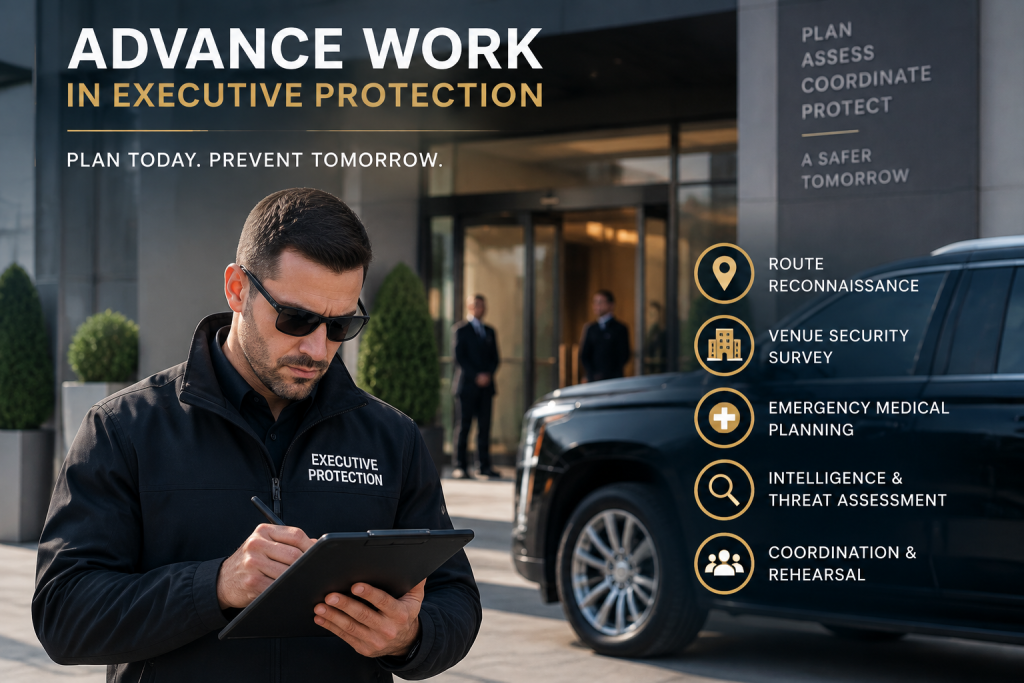
In high-level executive protection, the most critical protective operations occur long before the principal arrives at a destination. While movies depict bodyguards reacting dramatically to sudden gunfire or ambush scenarios, professional security specialists measure success by the complete absence of surprises. The operational discipline responsible for this invisible security net is known as advance work.
Advance work is the systematic process of surveying, assessing, coordinating, and hardening every environment, transit corridor, venue, and emergency medical facility along a client itinerary before their arrival. Without thorough advance operations, a security detail is simply guessing, moving blindly through uncontrolled public spaces, and exposing the principal to avoidable ambushes, physical confrontations, or medical delays.
Whether preparing for a Fortune 500 board summit in downtown Houston, a high-stakes court appearance, or private estate transit across Greater Houston, understanding how advance agents operate reveals why advance reconnaissance forms the backbone of close personal protection.
Phase 1: Defining the Role and Philosophy of the Advance Agent
In a structured executive protection detail, protective personnel are split into two complementary functions: the Close Protection Team (the agents walking directly alongside the principal) and the Advance Security Team.
1. The Proactive Shield vs The Reactive Escort
The advance agent functions as a scout and logistics planner. While the close protection detail focuses entirely on immediate 360-degree situational awareness around the client, the advance agent travels hours, days, or weeks ahead to eliminate physical vulnerabilities. For an operational comparison of tactical roles, review our breakdown on bodyguard vs executive protection differences.
2. The Golden Rule of Advance Operations
The governing doctrine of protective advance work is simple: control the environment before the client enters it. An advance agent ensures that doors are unlocked, elevators are held on designated floors, private staging suites are sterile, and emergency departure vehicles are running before the principal ever sets foot on the property.
Phase 2: The Core Components of Executive Advance Operations
A comprehensive advance security survey covers five mandatory operational stages:
| Advance Stage | Primary Action Checkpoint | Key Deliverable & Protocol |
|---|---|---|
| 1. Route Reconnaissance | Primary, secondary, and tertiary driving corridors | Identify construction chokepoints, bridge crossings, traffic gridlock patterns, and ambush kill zones. |
| 2. Physical Venue Survey | Arrival bays, loading docks, private elevators, safe rooms | Audit physical ingress using an established event security checklist for venue managers; secure service keycards. |
| 3. Trauma Medical Survey | Nearest Level 1 trauma hospital, emergency bay entrance | Physically drive the hospital route, verify ambulance entrance access, record direct emergency room numbers. |
| 4. Local Liaison & Intelligence | Local police precinct, private venue security directors | Coordinate radio frequencies, verify credentialing lists, and monitor activist protest indicators. |
| 5. Safe Haven Identification | Hardened interior spaces at every destination stop | Designate lockable interior rooms with secondary egress, communication access, and medical trauma supplies. |
When planning security budgets, review our transparent breakdown on how much a personal bodyguard costs per day, which details how advance hours and travel per diem are structured into daily service rates.
Phase 3: Step-by-Step Advance Reconnaissance Workflow
To understand the operational complexity of advance work, follow an advance agent through an executive assignment:
1. Step 1: Route Mapping and Chokepoint Identification
Over eighty percent of violent confrontations and vehicular ambushes occur while the principal is in transit. The advance agent physically drives the intended route between the airport, hotel, and meeting venue during the exact expected time of travel.
The agent maps alternative detour corridors around traffic bottlenecks, notes one-way streets, identifies underpasses susceptible to flooding during heavy Houston storms, and establishes safe rally points (such as police stations or firehouses) where the convoy can seek shelter during an emergency.
2. Step 2: Hotel and Executive Suite Hardening
Hotels present significant security challenges due to transient crowds. Advance agents arrive before check-in to:
- Secure rooms positioned between the second and sixth floors (above street vehicle intrusion, yet within reach of city fire department ladder trucks).
- Ensure the principal room is not adjacent to public elevators, vending machines, or exterior fire stair doors.
- Check adjoining rooms to confirm who holds adjacent reservations and inspect balconies for line-of-sight exposure.
- Coordinate with hotel engineering to override master elevator controls, allowing direct, non-stop transit to the executive floor.
3. Step 3: Venue Access Control and Kitchen Corridors
When an executive attends a symposium or gala, walking through main lobby turnstiles creates crowd friction. For corporate itineraries, explore our protocols on corporate event and conference security in Houston.
The advance agent identifies discrete service loading docks, walks private freight elevators, and coordinates with back-of-house culinary staff to route the principal directly through private kitchen corridors into reserved green rooms, bypassing public areas entirely.
4. Step 4: Medical Facility Pre-Clearance
Medical emergencies represent the single most common life-safety threat facing corporate executives. The advance agent identifies the nearest Level 1 trauma center (such as Memorial Hermann in the Texas Medical Center for Houston operations). The agent confirms the exact emergency intake bay, identifies any construction detours, and records direct trauma desk phone contacts.
Phase 4: Texas DPS Licensing and Legal Standards for Advance Agents
Conducting protective advance operations in Texas requires strict statutory compliance:
1. Texas DPS Level IV Personal Protection Officer Mandate
Under Chapter 1702 of the Texas Occupations Code, conducting close personal protection reconnaissance while armed and in plainclothes requires a valid Level IV Personal Protection Officer credential issued by the Texas Department of Public Safety. An advance agent must be licensed through an authorized Texas security company, carry valid proof of licensing, and maintain clear authority to coordinate with local law enforcement.
2. Commercial Liability and Vendor Contracts
If an unlicensed contractor conducts advance work and causes property damage or an unauthorized facility breach, standard commercial insurance policies are voided. Always partner with a licensed security agency maintaining at least 1,000,000 dollars in commercial general liability insurance.
Phase 5: Critical Pitfalls of Skipping Advance Work
Failing to allocate resources for advance security operations is one of the most hazardous mistakes an event planner or executive assistant can make:
1. Trapped in Transit Bottlenecks
Without route reconnaissance, a motorcade can be trapped in unexpected road closures, accident gridlocks, or planned public protests, turning an executive vehicle into a stationary, vulnerable target.
2. Locked Secondary Egress Doors
Arriving at a venue during an emergency only to find that rear fire exits are chained, locked from the outside, or blocked by banquet tables creates fatal delay. Advance surveys verify that every primary and secondary escape route functions freely.
3. Unexpected Credential Denials
Arriving at private corporate buildings or high-security convention halls without pre-coordinated clearance results in embarrassing delays, public exposure at security turnstiles, and disrupted schedules.
If you observe signs that your personal or corporate risk profile is escalating, review our guide on 7 signs you need a personal security detail to evaluate your immediate protective requirements.
Partner with Gods Armour Security for Elite Executive Protection
True personal security relies on rigorous preparation, disciplined intelligence, and silent execution. Gods Armour Security delivers state-certified, Texas DPS licensed executive protection specialists who master every phase of advance security operations across Houston, Harris County, and statewide Texas.
Our protective details conduct exhaustive route reconnaissance, manage discreet facility access, verify medical trauma readiness, and coordinate with local authorities to ensure that your professional travel proceeds without disruption.
Planning an upcoming executive itinerary, corporate summit, or high-profile appearance? Request a confidential executive protection consultation or call our Houston command center directly at (713) 878-9984.
Key Takeaways
- Advance work is the systematic process of surveying routes, venues, hospitals, and safe havens before a principal arrives.
- Over eighty percent of targeted violent attacks happen around motor vehicles, making route reconnaissance and chokepoint mapping essential.
- Advance agents audit physical facilities, secure private elevator controls, and walk service pathways to ensure discrete entry.
- In Texas, operating as an armed plainclothes protection specialist requires an active Texas DPS Level IV Personal Protection Officer license.
- Skipping advance reconnaissance leaves protective details blind, converting proactive protection into high-risk reactive defense.