Hiring security guards for private events at a residence is a different exercise from hiring them for a hotel ballroom. People tend to assume it is the simpler version, since the guest count is smaller and everyone theoretically knows each other. In practice a house is harder to cover than a venue, because a venue was built to control who comes in and a house was built for the opposite reason.
Here is what actually changes, and what a host should settle before the first guest arrives.
There Is No Venue Staff to Share the Work
At a hotel or event space, a lot of security work happens without anyone thinking about it. There is a front desk. There are cameras. There is a manager who can make a decision about a guest. Doors lock on a schedule and someone owns the keys. Staff know the building and notice when a person is somewhere they should not be.
None of that exists at a house. Whatever officers do not cover is not covered by anyone. That changes the sizing of a detail, because posts that would be shared at a venue all fall to the security team at a residence.
It also changes the host’s role. At a venue, the host can hand a problem to the venue manager. At home, the host is the venue manager, which is not a role anyone wants while hosting their own party.
The Perimeter Was Not Built for This
A ballroom has walls and a set number of doors. A house has a front door, a back door, a side gate, a garage, sliding doors onto a patio, and windows onto a yard that may or may not be fenced.
For most of the year, none of that matters. During an event with fifty people moving through, it matters a great deal. Guests prop the back door open because they are carrying food. The side gate gets unlatched by the caterer and stays that way. The garage is open because that is where the drinks are.
Officers working a residence spend a good share of their time on access points that a homeowner has never thought of as access points. Walking the property beforehand and deciding which ones stay closed, which ones stay staffed, and which ones stay open is the first practical step.
Parking Is Usually the Weakest Part
At a venue, parking is a lot or a garage, and it is usually lit and often watched. At a house, parking is the street.
Guest vehicles sit along a residential road for several hours, often with items visible inside, in a neighborhood where a row of unfamiliar cars is itself an announcement that something is happening. Break-ins at private events almost always happen on the street rather than inside the house.
Street parking also creates the arrival and departure problem. Guests walk to their cars in the dark, sometimes a block or more away, sometimes after several drinks. An officer covering the street during arrival and departure windows solves more than an officer standing in the living room.
There is a neighbor dimension as well. Blocked driveways and cars parked across mailboxes generate complaints that can end an event early. An officer directing parking prevents most of it.
The Guest List Works Differently
At a ticketed event, entry is binary. Either the name is on the list or it is not.
Private home events are not like that. Guests bring people. A cousin arrives with someone nobody has met. A friend brings a partner who was assumed to be included. Someone shows up who was invited by a family member and not by the host. Turning any of these people away is a social decision, not a security one, and an officer should never be the one making it.
The way to handle this is to name one person, not the host, who can be reached at the door and can say yes or no in a few seconds. It might be a sibling, a close friend, or a planner. Officers check with that person and act on the answer. The host stays out of it and stays at their own party.
If there is someone specific who should not be admitted, officers need to know that in advance, along with a description and a plan for what happens if that person arrives. This comes up more often than hosts expect, particularly at events tied to a divorce, a family dispute, or a business matter.
Alcohol at a Private Residence
At a licensed venue, a bartender is trained to cut people off and the venue carries the liability for serving. At a house, the host is often serving, and the picture is less defined.
The practical concern is the same as anywhere, which is a guest who is impaired and intends to drive. The difference is that at a house there is no venue policy to point to and no manager to be the one saying no. Officers can take that role if the host asks them to, and it is worth asking them to. A guest is far more likely to hand over keys to an officer than to a friend they were arguing with ten minutes earlier.
Deciding this in advance matters. Officers need to know if they are authorized to stop someone from driving, who to call for a ride, and who on the host side gets told.
Where Officers Stand
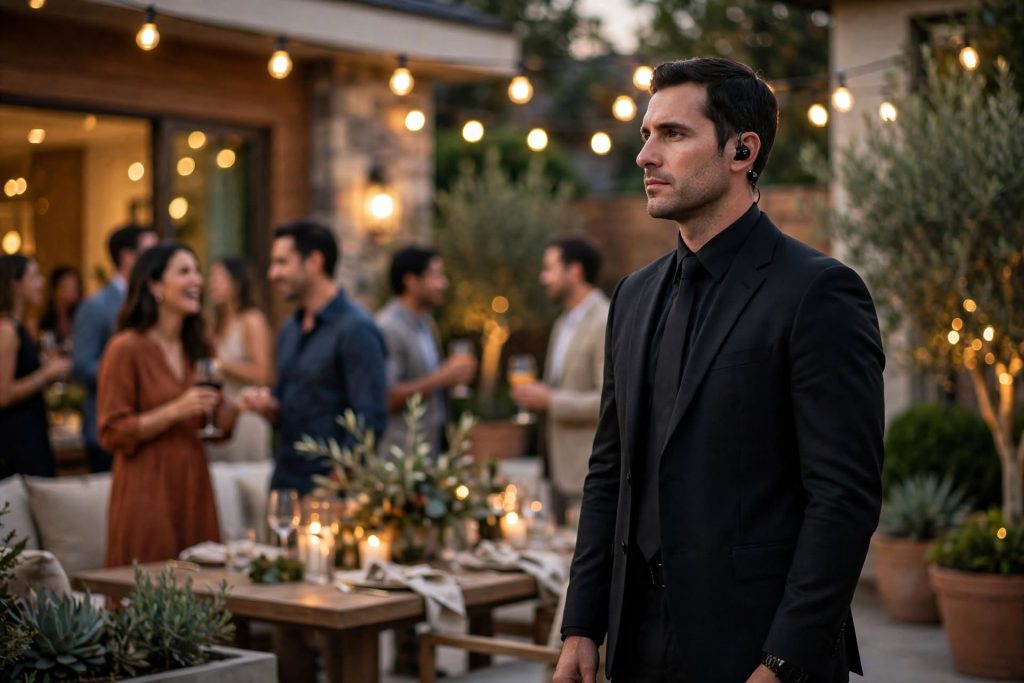
At a home event, positioning is a balance between coverage and atmosphere. Most hosts do not want a uniformed officer standing in the middle of their living room, and that is reasonable.
Coverage usually works best with someone at the entry point, someone on the street handling parking and arrivals, and someone moving between the exterior access points and any area holding gifts, catering equipment, or personal property. Interior presence can stay light at most residential events.
Dress can be adjusted as well. Uniformed officers act as a visible deterrent, which is useful on the street and at the door. Some hosts prefer a lower-profile dress inside. Both are workable, and it is a conversation worth having when booking rather than on the day.
What the Host Should Decide Beforehand
Most problems at residential events trace back to a decision that was never made. Settle these in advance and the night runs itself.
- Who at the door has authority over the guest list, and how officers reach that person
- Which entrances stay staffed, which stay locked, and who holds keys
- If officers are authorized to stop an impaired guest from driving
- Where guest parking goes and which driveways stay clear
- What happens to gifts, cash, or valuables during and after the event
- Which rooms are off limits, and how officers know which is which
- Who officers contact when something needs a decision
- When coverage starts and ends, including setup and cleanup
That list takes twenty minutes to work through and removes nearly everything that would otherwise land on the host mid-event.
The Difference It Makes
The measure of a well-covered home event is that the host spent the evening as a guest at their own party. No one came to them about a car blocking a driveway. Nobody asked what to do about the person at the door. They were not the one taking keys away from someone at midnight.
That outcome comes from planning rather than headcount. A residence needs fewer officers than a venue of the same guest count in most cases, but it needs more decisions made in advance, and those decisions have to come from the host.
A home event still needs the same preparation a venue event gets. See what special event security does before the doors open, and what happens when something goes wrong at your event.