Training gets you ready for the job; the background check decides whether you can hold it. Before anyone works as a security officer in Texas, the Department of Public Safety (DPS) Private Security Bureau runs a criminal history check, and the state has clear rules about what disqualifies an applicant. On top of that, employers add their own screening, most commonly a drug test and a check that you can physically perform the post’s duties.
For anyone in the Houston area planning a security career, knowing these requirements in advance saves time, money, and disappointment. This guide breaks down exactly what the state background check involves, what can disqualify you and for how long, the eligibility rules beyond criminal history, and the physical side employers expect, so there are no surprises when you apply.
Phase 1: Two Kinds of Screening
Getting cleared to work as a security officer means passing two separate checks: the state’s licensing screening and the employer’s own hiring screening. They cover different things.
| Screening | Who Runs It | What It Covers |
|---|---|---|
| State licensing background check | Texas DPS Private Security Bureau. | Fingerprint-based criminal history against state disqualifier rules. |
| Employer hiring screening | The security company hiring you. | Drug test, employment history, references, and fitness for the post. |
| Added checks for armed officers | DPS, via the Level III process. | Psychological evaluation and firearms qualification on top of the above. |
You have to clear both to work. The state check decides whether you can be licensed at all; the employer check decides whether that company will hire and place you.
Phase 2: The State Fingerprint Background Check
The core of the state’s screening is a fingerprint-based criminal history check. Every applicant goes through it as part of getting licensed, and it is run through the state’s system, not by the employer.
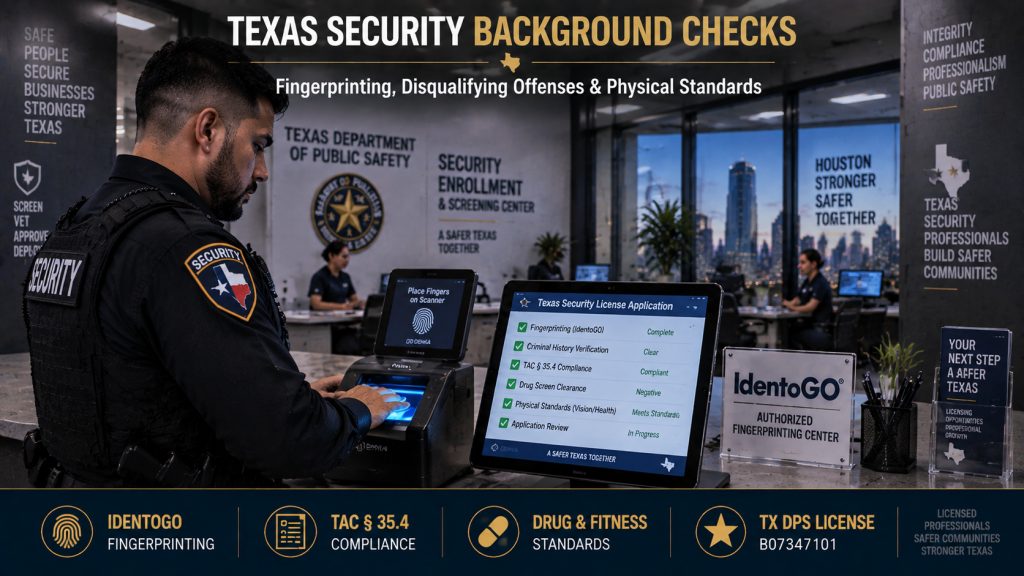
You complete electronic fingerprinting through the DPS-approved vendor (IdentoGO), which submits your prints for a state and federal (FBI) criminal history check. The results are tied to your application in the Texas Online Private Security (TOPS) portal, where DPS reviews your record against its disqualification rules. This is why you cannot simply take a course and start working: the background check is the gate, and it happens through the state before a pocket-card license is issued. The full licensing sequence, including where this step fits, is covered in our guide on how to get a Texas security guard license.
Phase 3: What Can Disqualify You
Not every mark on a record is disqualifying, but some are, and the timeframe depends on the offense. DPS sets out the specific list in its rules (37 TAC §35.4). The general framework looks like this.
1. Serious and Violent Offenses
The most serious crimes, such as homicide, kidnapping, sexual offenses, and certain others, are permanently disqualifying.
2. Felonies and Class A Misdemeanors
These are disqualifying for a set period of years from the date of conviction, as defined in the DPS rules for each offense.
3. Class B Misdemeanors
These typically disqualify for a shorter set period. Class C misdemeanors are generally not disqualifying.
4. Pending Charges
If you have unresolved criminal charges, you generally cannot be licensed until the case is resolved.
Because the exact offenses and timeframes are specific and can change, the definitive source is the DPS disqualification rule, and the timeframes vary by offense class. Anyone unsure about their own record should check it against those rules before investing in training, which Phase 6 explains how to do.
Phase 4: Eligibility Beyond Criminal History
Criminal history is the biggest factor, but it is not the only eligibility requirement. A few others apply to every applicant.
- Age. You must be at least 18 to be licensed as a security officer. Some armed and personal protection roles require you to be 21, in line with the requirements for carrying a firearm.
- Work authorization and eligibility documentation. Applicants must be authorized to work and provide the eligibility documentation DPS requires. Texas has updated these documentation rules recently, so confirm the current requirement when you apply.
- Military discharge. A dishonorable or other-than-honorable discharge may affect eligibility.
- Psychological evaluation for armed officers. Commissioned (Level III) applicants complete a psychological evaluation on a DPS-prescribed form, signed by a licensed psychologist or psychiatrist, reflecting the added responsibility of carrying a firearm.
This article is general information, not legal or licensing advice. Eligibility rules, disqualifying offenses, timeframes, and documentation requirements are set by Texas DPS and can change. Confirm the current requirements for your situation with the Texas DPS Private Security Bureau or a licensed training school before applying.
Phase 5: The Physical and Fitness-for-Duty Side
People often ask about a “physical” for security work. Texas does not impose a formal state fitness test for a basic security license, but there is a real physical dimension to the job, and it comes mostly from the employer and the role.
Most security companies require a drug screening as a condition of hire, and many re-test under their own policies. Beyond that, an officer needs to be able to perform the post’s duties, which can mean standing or walking for long shifts, patrolling a large site, climbing stairs, and responding if something happens. Armed roles add a physical requirement of their own: qualifying on the range to the state’s firearms proficiency standard as part of the Level III process. So while there is no state-mandated fitness exam, being fit for the specific duties, and passing an employer’s drug test, is a genuine part of getting and keeping the job.
Phase 6: Check Your Eligibility Before You Invest
If you have anything on your record that you are unsure about, the smart move is to find out where you stand before you spend time and money on training. Texas gives you a way to do exactly that.
Under Texas law, you can request a criminal history evaluation letter from the department to determine whether your record would disqualify you, before you apply or enroll. This is worth doing if you have any doubt, because it answers the eligibility question up front rather than after you have paid for a course. Two other principles matter: be honest, because the fingerprint check will surface your history and a disclosed issue is always better than a discovered one, and resolve anything pending, since open charges block licensing until they are closed. Being upfront about your background is also exactly what employers expect in the hiring process, as covered in our guide on what to expect during a security officer interview.
Start Your Security Career With God’s Armour Security
Clearing the requirements is the first step; the next is joining a company that will put you to work. God’s Armour Security is a Texas DPS-licensed security contractor and guard company (license no. B07347101) hiring reliable officers across Greater Houston, Harris County, and statewide Texas, for unarmed, armed, and specialized roles.
We help qualified candidates through the affiliation process, place them on real assignments, and support advancement for those who want to move from unarmed into armed and specialized work. If you meet the requirements, or want help understanding them, we would like to hear from you. Learn more on our security professionals page.
Ready to start your security career in Houston? Apply with God’s Armour Security or call our Houston operations desk directly at (713) 878-9984.
Frequently Asked Questions
What background check is required to be a security officer in Texas?
Every applicant must complete a fingerprint-based criminal history check. You get fingerprinted through the DPS-approved vendor (IdentoGO), which submits your prints for a state and FBI check, and the results are reviewed by the DPS Private Security Bureau through the TOPS portal against its disqualification rules before a license is issued.
What disqualifies you from being a security guard in Texas?
The most serious violent and sexual offenses are permanently disqualifying. Felonies and Class A misdemeanors disqualify for a set period of years, and Class B misdemeanors typically for a shorter period, as defined in the DPS rules (37 TAC §35.4). Class C misdemeanors are generally not disqualifying, and pending charges usually block licensing until they are resolved. Confirm your specific situation against the DPS list.
Is there a physical fitness test to become a security guard in Texas?
There is no formal state fitness test for a basic security license. However, employers commonly require a drug screening, and you need to be able to perform the post’s physical duties. Armed officers must also qualify on the range to the state’s firearms proficiency standard as part of the Level III process.
How can I find out if my record disqualifies me before applying?
You can request a criminal history evaluation letter from the department to determine whether your record would disqualify you, before you enroll in training or apply. This lets you resolve the eligibility question up front rather than after paying for a course.
Key Takeaways
- Becoming a Texas security officer requires clearing two screenings: the state’s fingerprint background check and the employer’s hiring screening.
- The state check is fingerprint-based through IdentoGO, covering state and FBI criminal history, reviewed by DPS through the TOPS portal.
- The most serious offenses are permanently disqualifying; felonies and Class A misdemeanors disqualify for a period of years, Class B for a shorter period, and Class C generally not, per DPS rule 37 TAC §35.4.
- Beyond criminal history, applicants must meet age (18, or 21 for some armed roles), work-authorization, and, for armed officers, psychological evaluation requirements.
- There is no state fitness test, but employers require drug screening and fitness for the post; if unsure about your record, request a criminal history evaluation letter before you invest.