Who this is for: applicants pursuing a Texas security officer license. If you are comparing vendor quotes instead, read what the levels mean for buyers.
Starting a security career in Texas begins with one thing: the right state license. Every person who works as a security officer for hire in Texas has to hold a license from the Texas Department of Public Safety (DPS) Private Security Bureau before they can be assigned to a post. But there is not just one license, there are levels, and which one you need depends on whether you want to work unarmed, carry a firearm, or provide personal protection.
For anyone in the Houston area looking to get started or move up, this guide explains what Level II, Level III, and Level IV mean, the training and background steps each one requires, and how the whole process works through the state’s online system. If you are ready to build a career in security, this is the roadmap.
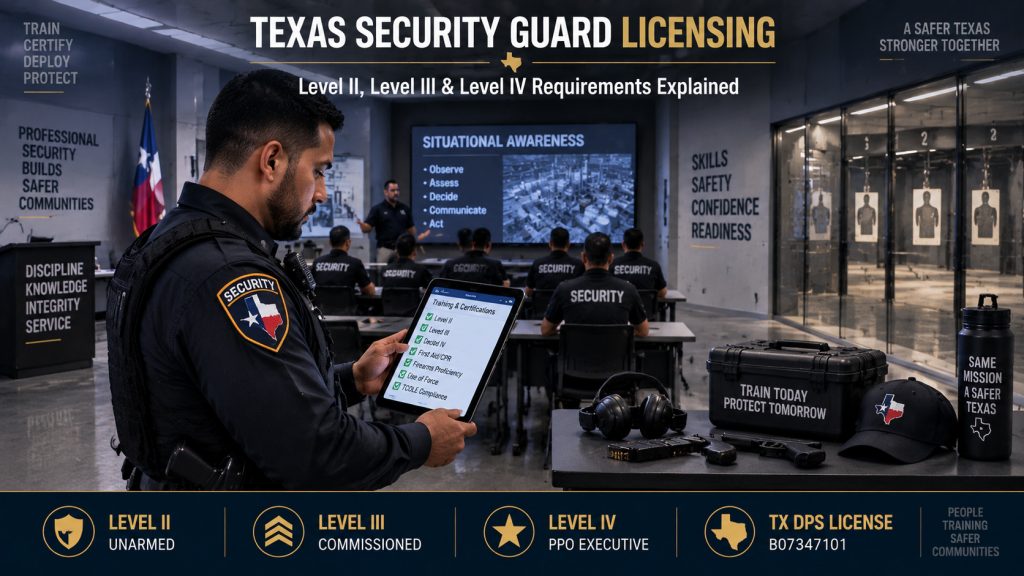
Phase 1: The Three License Levels at a Glance
Texas structures individual security officer licensing into levels, and each one builds on the one before it. Here is how they compare.
| Level | What It Is | Training Required | Who It Is For |
|---|---|---|---|
| Level II | Non-commissioned (unarmed) security officer. | Level II training course and test; the baseline for every officer. | Anyone starting an unarmed security career. |
| Level III | Commissioned (armed) security officer. | Level II plus the Level III course (minimum 45 hours) with a firearms course of fire. | Officers who will carry a firearm on duty. |
| Level IV | Personal Protection Officer (PPO), executive protection. | Level II and III plus the Level IV course (minimum 15 hours). | Officers moving into bodyguard and close-protection work. |
The key point is that the levels stack. Level II is the foundation everyone needs, Level III adds armed authority on top of it, and Level IV adds personal protection on top of Level III.
Phase 2: Level II, the Non-Commissioned Foundation
Level II is where nearly every security career in Texas starts. It is the training required for a non-commissioned, unarmed security officer, and it is also a prerequisite for the higher levels, so even officers heading toward armed work complete it first.
The Level II course covers the basics of the job: the officer’s role and legal limits, observation and reporting, public interaction, and how to handle common situations professionally. It is delivered by a licensed training school or, in many cases, by a licensed guard company for its own hires. Once you pass the Level II course and its test, complete the background and application steps below, and are affiliated with a licensed employer, you can work as an unarmed officer. For most people, this is the fastest route into the field and the platform everything else is built on.
Phase 3: Level III, Becoming a Commissioned Armed Officer
Level III is the step up to carrying a firearm on duty. A commissioned security officer has completed Level II plus the Level III commissioned course, which DPS sets at a minimum of 45 hours and which includes a firearms course of fire.
The Level III training goes well beyond the unarmed basics. It covers firearms handling and safety, use-of-force law, and defensive tactics, and it requires demonstrating firearm proficiency by qualifying on the range to the state’s standard. Commissioned applicants also complete a psychological evaluation on a DPS-prescribed form signed by a licensed psychologist or psychiatrist, an added step that reflects the higher responsibility of carrying a weapon. The course must be taught by a licensed Level III school and instructor. Armed work pays more and opens more assignments, but it carries more legal responsibility, which is why the training and screening are heavier.
Phase 4: Level IV, the Personal Protection Officer
Level IV is the personal protection officer (PPO) credential, the license for executive protection and bodyguard work. It sits at the top of the individual licensing ladder and requires completing Level II and Level III first, then the Level IV course, which DPS sets at a minimum of 15 hours.
The Level IV course focuses on personal protection skills: threat assessment, protective tactics, situational awareness, and close-protection work, rather than firearms, since the armed qualification is handled at Level III. Because a PPO must stack all three levels, the total training adds up to well over sixty hours before the license is issued. This is the path for officers who want to move from guarding property to protecting people, and it is the most specialized route in the field. The broader progression from unarmed work up to this level is covered in our guide on the armed vs unarmed security career path in Texas.
Phase 5: The Steps to Get Licensed
Whatever level you are aiming for, the path to an actual pocket-card license follows the same core steps through the state’s system. Here is the process.
1. Complete the Right Training
Take the DPS-approved course for your level: Level II for everyone, plus Level III for armed, plus Level IV for PPO, from a licensed school or employer.
2. Get Fingerprinted
Complete an electronic fingerprint background check through the DPS-approved vendor (IdentoGO) so the state can run your criminal history.
3. Apply Through TOPS
Submit your application and fee through the Texas Online Private Security (TOPS) portal, the state’s system for all individual security licensing.
4. Affiliate With an Employer
An individual license is not enough on its own; you must be affiliated through TOPS with a licensed guard company before you can work.
The background check is central to the whole process, and it is worth understanding what it screens for before you apply. We cover that in detail in our guide on the physical and background check requirements for Texas security officers. Once licensed, the credential renews every couple of years, and armed officers have continuing education and firearms requalification to keep current.
This article is general information, not legal or licensing advice. Texas licensing rules, training hours, and fees are set by DPS and can change. Confirm the current requirements and steps for your situation with the Texas DPS Private Security Bureau or a licensed training school before applying.
Phase 6: Choosing Your Path
Which level you pursue comes down to the kind of work you want and how far you plan to take it.
- Start with Level II if you want to enter the field quickly as an unarmed officer. It is the fastest, lowest-cost route, and it is required no matter where you go next.
- Add Level III if you want to work armed, earn more, and open up higher-responsibility assignments. Expect more training, a range qualification, and the psychological evaluation.
- Pursue Level IV if your goal is executive protection or bodyguard work, the most specialized path, built on top of Levels II and III.
A practical route for many officers is to start at Level II, gain experience on the job, and then move up to Level III and beyond as their career develops. There is no requirement to jump straight to the top; each level is a stable place to work while you decide your next step.
Build Your Security Career With God’s Armour Security
Getting licensed is the first step; the next is working for a company that invests in its officers. God’s Armour Security is a Texas DPS-licensed security contractor and guard company (license no. B07347101) hiring licensed and licensable officers across Greater Houston, Harris County, and statewide Texas, for unarmed, armed, and specialized roles.
We help the right candidates get affiliated, put them on real assignments, and support the path from Level II into armed and specialized work for those who want to grow. If you are licensed, in training, or just starting to look into the field, we would like to hear from you. Learn more about careers on our security professionals page.
Ready to start or advance your security career in Houston? Apply with God’s Armour Security or call our Houston operations desk directly at (713) 878-9984.
Frequently Asked Questions
What are the security guard license levels in Texas?
Texas uses three individual training levels: Level II is the non-commissioned, unarmed officer credential and the baseline for everyone; Level III is the commissioned, armed officer credential, requiring a minimum 45-hour course with a firearms qualification on top of Level II; and Level IV is the Personal Protection Officer (PPO) credential for executive protection, requiring a minimum 15-hour course on top of Levels II and III.
How do I get a security guard license in Texas?
Complete the DPS-approved training for your level, get an electronic fingerprint background check through the state’s approved vendor, submit your application and fee through the TOPS (Texas Online Private Security) portal, and affiliate with a licensed guard company. An individual license alone does not authorize work; you must be affiliated with a licensed employer.
Do I need Level III to carry a firearm as a security officer in Texas?
Yes. Carrying a firearm on duty requires a Level III commissioned security officer license, which includes Level II plus the Level III course (a minimum of 45 hours), a firearms course of fire, and a psychological evaluation. An unarmed Level II officer may not carry a firearm on duty.
How long does the training take for each level?
Level II is a shorter baseline course. Level III adds a minimum of 45 hours including firearms training, and Level IV adds a minimum of 15 hours of personal protection training. Because the levels stack, a PPO completes all three, totaling well over sixty hours of training before the license is issued.
Key Takeaways
- Every security officer for hire in Texas must hold a DPS Private Security Bureau license before working, and the levels stack on one another.
- Level II is the non-commissioned, unarmed baseline that every officer needs and that higher levels build on.
- Level III is the commissioned, armed credential, adding a minimum 45-hour course, a firearms qualification, and a psychological evaluation.
- Level IV is the Personal Protection Officer credential for executive protection, adding a minimum 15-hour course on top of Levels II and III.
- The path to any level runs through DPS-approved training, a fingerprint background check, a TOPS application, and affiliation with a licensed employer.
The license is the same credential regardless of the job title, but employers use the titles differently. See why the distinction between security officers and security guards matters in Houston before you start applying.