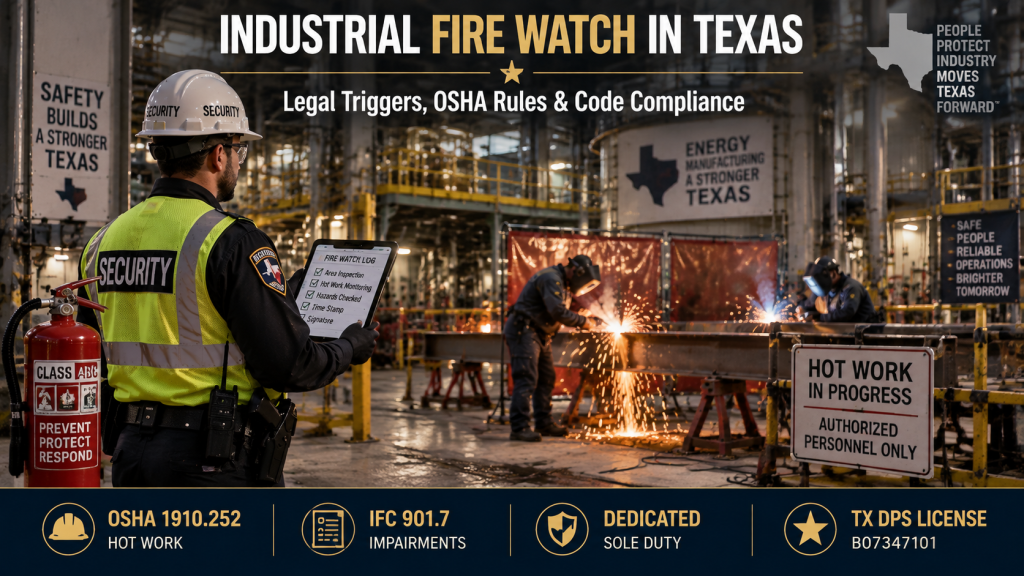
For industrial plant managers, refinery operations directors, general contractors, and commercial warehouse supervisors across Greater Houston, few operational surprises disrupt productivity like a compromised life-safety system or an unscheduled hot work requirement. When an automatic fire sprinkler system suffers a pressure drop, a fire alarm control panel malfunctions, or contractors fire up cutting torches near combustible inventory, facility leaders face an immediate legal and operational mandate: deploying a qualified fire watch.
Failing to establish an active fire watch when mandated carries severe consequences in Texas. Beyond the immediate risk of catastrophic industrial fire, non-compliance invites stop-work orders from municipal fire marshals, immediate OSHA citations, voided commercial property insurance policies, and massive civil liability under Texas tort law if a blaze occurs. Yet, many facility operators remain unclear on the exact legal triggers that separate voluntary safety monitoring from legally required fire watch services.
This industrial compliance guide outlines the legal and operational thresholds governing fire watch requirements in Texas, detailing OSHA hot work mandates, International Fire Code (IFC) life-safety system impairment rules, NFPA monitoring standards, logging obligations, and dedicated personnel qualifications.
Disclaimer: This guide provides operational information on fire codes and safety regulations in Texas and does not constitute formal legal advice. Fire codes are adopted and amended at the municipal and county levels by local Authorities Having Jurisdiction (AHJs). Always consult your local fire marshal, insurer, or safety compliance counsel regarding site-specific mandates.
Phase 1: The Core Legal Framework: Who Regulates Fire Watch in Texas?
Unlike states with a single, uniform fire administration code, Texas operates under a decentralized regulatory framework. Industrial sites, energy terminals, and commercial properties must comply with three distinct layers of legal authority:
1. Occupational Safety and Health Administration (OSHA)
At the federal level, OSHA enforces fire watch mandates under 29 CFR 1910.252 (General Industry – Welding, Cutting, and Brazing) and 29 CFR 1926.352 (Construction Industry). These federal standards mandate a dedicated fire watch whenever hot work operations take place within defined proximity to combustible materials, wall openings, or flammable atmospheres.
2. The Authority Having Jurisdiction (Local Fire Marshals & IFC)
In Texas, local municipalities and counties adopt model codes published by the International Code Council (ICC) and the National Fire Protection Association (NFPA). Most Texas industrial jurisdictions—including the City of Houston, Harris County, Pasadena, Baytown, and Texas City enforce amended versions of the International Fire Code (IFC Section 901.7) and NFPA 1 (Fire Code). These codes dictate when an impairment to water supplies, fire alarms, or suppression systems requires continuous human fire monitoring.
3. Commercial Property Insurance Underwriters
Beyond municipal law, industrial property and casualty insurance policies routinely include strict protective safeguard endorsements. Under Texas Insurance Code frameworks, if an industrial facility suffers a fire loss while its suppression system was shut down without an active, logged fire watch, insurers routinely deny coverage on grounds of breach of warranty.
To evaluate how fire watch duties integrate into broader physical defense strategies across sprawling energy terminals, review our operational guide on physical security protocols for oil and gas facilities in Greater Houston.
Phase 2: Complete Decision Matrix: When Is Fire Watch Required?
To determine whether your commercial or industrial property legally requires a dedicated fire watch, review the mandatory triggers outlined below:
| Operational Trigger | Governing Regulatory Code | Mandatory Fire Watch Condition |
|---|---|---|
| Hot Work Operations (Welding/Cutting) | OSHA 29 CFR 1910.252 / NFPA 51B | Combustibles within 35 feet, wall/floor openings within 35 feet, or work on metal partitions near combustibles. |
| Sprinkler System Impairment | IFC Section 901.7 / NFPA 25 | Water supply shut off, frozen pipes, riser repair, or pump failure exceeding local AHJ impairment windows. |
| Fire Alarm / Monitoring Outage | IFC Section 901.7 / NFPA 72 | Central station communication failure, panel ground fault, or unmonitored building zones during occupancy. |
| Active Construction / Demolition | NFPA 241 / Local Municipal Codes | Major structural alterations before standpipes or temporary alarms are fully commissioned. |
| Direct Fire Marshal Order | Local Municipal Fire Code | Discretionary order issued by AHJ due to temporary hazard, overcrowding, or hazardous storage. |
For after-hours commercial facilities evaluating physical security presence alongside environmental hazards, review night protocols in our guide on commercial property security after-hours: preventing vandalism and trespassing.
Phase 3: Deep Dive into the Two Most Common Legal Triggers
In Texas industrial operations, the vast majority of mandatory fire watches fall into two distinct regulatory categories:
1. Life-Safety System Impairment (IFC Section 901.7)
Under International Fire Code Section 901.7, building owners are legally obligated to notify the fire department immediately whenever an automatic sprinkler system, fire pump, or fire alarm system is out of service. If the system is impaired, the building must either be evacuated or an approved continuous fire watch must be maintained until the system is restored to full service.
- Impaired Sprinkler Fire Watch Texas: An outage affecting an automatic sprinkler system, standpipe riser, or industrial fire pump lasting more than 10 hours within a 24-hour period, or a shorter window where your local fire code amendment sets one.
- Fire Alarm System Impairment: Total communication loss between the on-site FACP and the central monitoring station, requiring physical human patrols across every unmonitored floor or production area.
- Notification Mandate: The local fire marshal (AHJ) must receive formal notification of both the initial impairment and the implementation of the certified fire watch.
2. OSHA Hot Work Mandates (29 CFR 1910.252 & NFPA 51B)
Hot work—defined as welding, torch cutting, brazing, grinding, or thermal spraying generates sparks, slag, and intense heat capable of smoldering inside walls or beneath machinery for hours before bursting into flames. OSHA mandates a dedicated fire watch whenever:
- Appreciable combustible materials (such as wood pallets, chemical containers, cardboard, or dust) are within 35 feet of the point of operation.
- Combustibles are more than 35 feet away but easily ignitable by flying sparks.
- Wall or floor openings (pipe sleeves, gratings, open doorways) within a 35-foot radius expose combustibles in adjacent rooms or lower decks.
- Combustible materials are adjacent to the opposite side of metal partitions, walls, ceilings, or roofs being welded or heated.
OSHA requires the fire watch to remain for at least 30 minutes after the work ends. Under NFPA 51B, which many jurisdictions and insurers adopt, the fire watch must be maintained for a minimum of 60 minutes after the completion of the hot work, followed by an additional monitoring period (up to 3 hours) in high-hazard industrial settings.
Phase 4: Mandatory Duties and Operational Standards of a Fire Watch
Deploying a compliant fire watch requires understanding that fire watch personnel cannot simply be regular employees multitasking other jobs. Texas fire marshals and OSHA guidelines strictly define the duties of a fire watch:
1. Sole Dedicated Duty
Fire watch officers are prohibited from performing other operational duties. They cannot check truck manifests, operate equipment, or perform maintenance. Their single, uninterrupted responsibility is life safety and fire monitoring.
2. Physical Continuous Rounds
Officers must conduct continuous foot rounds through all affected facility areas. Typical municipal codes mandate patrol intervals of no less than once every 15 to 30 minutes, actively checking for smoke, unusual heat, sparks, or chemical odors.
3. Emergency Communication & Authority
Fire watch guards must carry a reliable method of emergency communication (two-way radio or cell phone) to sound building alarms and contact 911 immediately. During hot work, the guard has stop-work authority if conditions become hazardous.
4. Verified Fire Extinguisher Training
Officers must be positioned with appropriate portable fire extinguishers (e.g., Class ABC or Class D) and trained in their practical deployment to suppress incipient-stage fires before they spread.
When selecting professional guard companies to supply trained, licensed fire watch personnel, review critical vetting criteria in our checklist on 10 questions to ask before hiring a commercial security guard company.
Phase 5: The Texas Fire Watch Log: Evidentiary Compliance
In the eyes of OSHA inspectors, municipal fire marshals, and insurance adjusters, if a patrol was not documented, it did not happen. Maintaining a legally defensible Texas Fire Watch Log is mandatory throughout the entire duration of the watch:
Required Elements in a Compliant Fire Watch Log
- Facility Details: Physical address, building name, specific zones/floors affected, and nature of the impairment (e.g., “Sprinkler Riser 3 shut down for valve replacement”).
- Officer Identification: Full legal name of the fire watch officer, employee ID, and security company registration details under Texas DPS Private Security Bureau regulations.
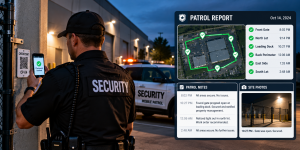
- Time-Stamped Patrol Entries: Exact arrival and departure times for each completed sweep of the designated area (recorded every 15 to 30 minutes).
- Hazard & Operational Notes: Detailed remarks noting hot work start/stop times, condition of fire exits, clear access to fire hydrants, and status of emergency lighting.
- AHJ & Management Sign-Off: Daily supervisor signatures and copies maintained on site for immediate inspection by the local fire marshal.
Professional Fire Watch Services from God’s Armour Security
When a fire alarm drops, a sprinkler system fails, or industrial hot work threatens critical infrastructure, your business cannot afford downtime, fines, or catastrophic fire damage. God’s Armour Security provides rapid-deployment, professional fire watch services across Greater Houston, Harris County, and statewide Texas.
We are licensed by the Texas Department of Public Safety as a security contractor and guard company (license no. B07347101). Our dedicated fire watch personnel are trained in OSHA hot work standards, IFC life-safety regulations, fire extinguisher operation, and NFPA logging procedures. We furnish time-stamped digital patrol logs, maintain continuous physical rounds, and liaison seamlessly with local fire marshals to keep your facility fully compliant and open for business. Explore our specialized commercial security services in Houston and our broader commercial security patrol services.
Need immediate, certified fire watch coverage for your industrial property or construction site? Request an urgent fire watch quote and deployment plan or call our Houston emergency dispatch center directly at (713) 878-9984.
Frequently Asked Questions
When is a fire watch legally required in Texas?
A fire watch is legally required in Texas during two primary operational conditions: when a required fire protection system (sprinklers, water supply, or fire alarms) is impaired or out of service, or during hot work operations (welding, cutting, brazing) within 35 feet of combustible materials under OSHA 29 CFR 1910.252 and NFPA 51B.
Can regular company employees perform fire watch duties?
Yes, provided they are dedicated solely to fire watch duties, have no other operational responsibilities, are trained in fire hazard detection and portable fire extinguisher use, and maintain an active, time-stamped fire watch log. However, most facilities contract licensed third-party security officers to avoid pulling valuable production labor away from core tasks and to ensure independent compliance documentation.
How long must a fire watch stay after hot work is completed?
OSHA sets a minimum of 30 minutes of monitoring after hot work ends. Many jurisdictions and insurers follow NFPA 51B, which requires at least 60 minutes, with up to three additional hours in high-hazard environments. Where NFPA 51B applies, the 60-minute standard governs, so confirm which applies to your site.
What happens if an industrial facility fails to provide a required fire watch?
Failure to provide a legally required fire watch can result in immediate stop-work orders or red-tag building evacuations by the local fire marshal, severe OSHA civil citations, and cancellation or denial of property insurance claims in the event of fire-related losses.
Key Takeaways
- Fire watch in Texas is regulated by federal OSHA rules, local municipal fire marshals (AHJs) adopting the IFC, and insurance underwriters.
- Mandatory triggers include hot work near combustibles (OSHA 1910.252) and fire protection system impairments (IFC 901.7).
- Fire watch personnel must have sole dedicated responsibility—no multitasking with maintenance, production, or general access control.
- Maintain rigorous time-stamped patrol logs (every 15 to 30 minutes) to satisfy municipal fire marshal audits and insurance compliance.
- God’s Armour Security operates under Texas DPS license B07347101, providing certified, immediate-response industrial fire watch personnel across Greater Houston.