Navigating major commercial aviation hubs presents distinct physical security exposures for corporate leaders, foreign delegations, high-net-worth families, and public figures. Houston serves as an international commercial powerhouse and energy capital, funneling tens of millions of passengers annually through George Bush Intercontinental Airport (IAH) and William P. Hobby Airport (HOU). Unmonitored arrivals, congested baggage claims, and public curb transit expose principals to stalking, corporate espionage, aggressive demonstrators, and opportunistic theft.
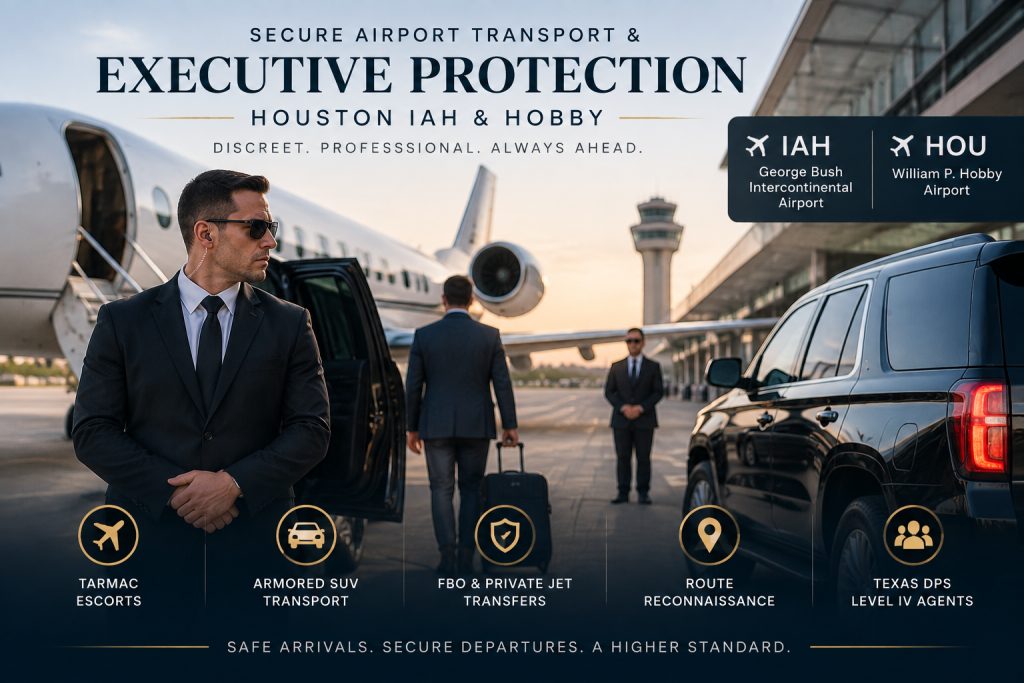
Relying on generic rideshares or unvetted livery services leaves executive safety to chance. Professional airport protection demands an integrated security solution: combining secure tarmac transit, discrete Fixed Base Operator (FBO) arrivals, advanced route reconnaissance, armored transport vehicles, and state-certified protective agents.
Whether arriving via private chartered jet or commercial first class, this operational manual covers the essential security architecture for secure airport transport and executive protection across Houston’s primary aviation corridors.
Phase 1: Transit Bottlenecks and Aviation Security Risks in Houston
Aviation hubs are engineered for mass passenger flow, not high-threat personal isolation. Security planning identifies four critical vulnerability zones during airport arrivals and departures:
1. Public Curbside Arrival and Terminal Congestion
Terminal pick-up lanes at IAH (Terminals A through E) and Hobby Airport experience constant congestion, aggressive vehicular maneuvering, and unpredictable delays. Waiting curbside exposes a principal to stationary ambush risks, unauthorized video recording, and physical approach by hostile individuals.
2. Baggage Claim and Main Hall Ingress Chokepoints
Commercial arrivals require navigating crowded terminal concourses, public escalators, and baggage claim carousels. These high-density choke points make physical shielding difficult. Executive details secure dedicated baggage retrieval protocols, allowing the client to move directly from arrival gates to awaiting secure vehicles without public delay.
3. High-Friction Freeway Transit Corridors
Transit corridors between Houston airports and major commercial districts (such as the Galleria, Downtown, Energy Corridor, and Texas Medical Center) feature elevated traffic risks. Interstate 45 from Hobby and Interstate 69 / North Freeway from IAH present severe bottleneck hazards, construction zones, and flash-flood susceptibility during severe Gulf Coast storms. A complete operational footprint requires thorough transit planning; explore our standard framework for advance work in executive protection operations.
4. Executive Privacy and Asset Protection
Corporate executives routinely travel with unreleased financial records, proprietary technical data, and high-value physical assets. Security drivers and close protection officers ensure sensitive luggage and digital assets remain under continuous chain-of-custody from aircraft stairs to hotel vaults.
Phase 2: Commercial Airport vs Private FBO Transfer Operations
Operational execution differs substantially between commercial airline arrivals and private Fixed Base Operator (FBO) tarmac handling:
| Operational Phase | Commercial Flights (IAH & Hobby Terminals) | Private Aviation / FBO (Signature, Atlantic, Jet Aviation) |
|---|---|---|
| Primary Meet Point | Sterile jet-bridge door or secure VIP lounge interior | Direct aircraft tarmac stairs (ramp-side vehicle positioning) |
| Credential Clearance | TSA pre-coordination, airline VIP terminal escorts | FBO tail-number manifests, pre-screened tarmac gate access |
| Luggage Retrieval | Secondary advance agent handles carousels; principal departs | Ground crew transfers bags directly from cargo bay into escort SUV |
| Vehicular Egress | Staged subterranean executive loading lane or private garage bay | Private security convoy departs directly through secure airfield gates |
When organizing travel budgets for executive transfers, examine our pricing guide on how much a personal bodyguard costs per day to calculate daily vehicle allowances, driver fees, and agent shift minimums.
Phase 3: Tactical Motorcade Dynamics and Executive Vehicles
Secure airport ground transportation involves rigorous motorcade logistics rather than simple passenger driving:
1. Up-Armored and Premium Executive Vehicles
Executive transport utilizes luxury, high-clearance sport utility vehicles, including armored Cadillac Escalades, Chevrolet Suburbans, and Lincoln Navigators. For elevated threat profiles, vehicles equipped with B6 ballistic glass, run-flat tires, and reinforced suspension protect occupants against direct kinetic attacks and road debris.
2. The Lead Vehicle and Chase Vehicle Structure
For high-threat principals, foreign delegations, or sensitive corporate summits, details operate a two-vehicle protective motorcade:
- The Principal Transport Vehicle: Carries the client, the personal protection officer, and a tactical security driver focused exclusively on smooth navigation and vehicle defense.
- The Tactical Follow (Chase) Vehicle: Positioned directly behind the principal vehicle. Manned by armed protection specialists, this vehicle acts as a physical buffer against aggressive tailgaters, intercepts suspicious trailing cars, and provides immediate counter-assault cover during an incident.
3. Evasive Driver Training and Route Reconnaissance
Security drivers undergo tactical driver training, mastering skid control, high-speed reversing, counter-surveillance detection, and precision evasion. Primary, secondary, and tertiary routes from IAH and Hobby Airport are mapped in advance, avoiding freeway construction pinch points and known flood-prone underpasses.
Phase 4: Coordinated Ingress for Corporate Events and Family Details
Secure airport arrivals connect directly into the client’s broader operational schedule:
1. Corporate Conferences, Summits, and Galas
Executives arriving for energy conventions or global symposiums move directly from airport tarmac lanes into secured hotel facilities. Review our dedicated procedures for corporate event and conference security in Houston to understand credentialing, VIP room sweeps, and private stage ingress.
2. High-Net-Worth Family Travel and Estate Transitions
Traveling with family members requires balancing robust security with domestic ease and comfort. Protection agents manage child safety, secure luggage transfers, and coordinate private villa or estate arrivals. Read our operational guide on close protection and security details for families to understand travel protocols for spouses and children.
3. Transitioning Between Bodyguards and Close Protection Specialists
Understanding who handles your airport transport is vital. Traditional livery drivers or standard guards lack counter-surveillance capabilities, while executive protection specialists manage tactical logistics and trauma response. Review our detailed comparison on bodyguard vs executive protection differences to align personnel with your risk profile.
Phase 5: Texas DPS Licensing and Airport Compliance Regulations
Operating personal protection details within municipal airport grounds requires strict compliance with federal and state regulations:
1. Texas DPS Level IV Personal Protection Officer Licensing
Under Chapter 1702 of the Texas Occupations Code, providing armed personal protection while wearing discrete civilian attire legally requires an active Level IV Personal Protection Officer license issued by the Texas Department of Public Safety Private Security Bureau. Unlicensed contractors cannot legally provide close protective transport.
2. Federal Aviation and Port Authority Badging
Conducting tarmac meets at general aviation facilities (such as Wilson Air Center, Signature Flight Support, or Atlantic Aviation) requires proper coordination with airport management, airport operations area badging, and compliance with TSA airfield safety protocols.
3. Pre-Surveying Trauma Medical Facilities
During airport transit, medical crises require rapid diversion. Operating details map direct routes to regional trauma centers: Houston Methodist and Memorial Hermann in the Texas Medical Center for Hobby transit, and Memorial Hermann Northeast or HCA Houston Northwest for IAH corridors.
If you observe signs that your personal, legal, or corporate exposure is escalating prior to travel, review our manual on 7 signs you need a personal security detail to select the correct protection tier.
Partner with God’s Armour Security for Airport Protection
Your arrival in Houston demands seamless transit, uncompromising confidentiality, and state-certified protective assets. Gods Armour Security delivers elite airport transportation and executive protection services at George Bush Intercontinental Airport (IAH), William P. Hobby Airport (HOU), and private regional airfields across Greater Houston.
Our protective details feature Texas DPS licensed Level IV protection specialists, trained tactical drivers, luxury armored transport, and dedicated advance agents. We guarantee punctual tarmac pickups, discrete motorcade transfers, and comprehensive physical security from arrival to final departure.
Scheduling executive airport transport or VIP motorcade logistics in Houston? Request a secure airport transport consultation or contact our Houston command operations desk directly at (713) 878-9984.
Key Takeaways
- Airports present significant security vulnerabilities at public curbs, crowded baggage claim areas, and congested highway transit corridors.
- Private aviation transfers at FBOs permit direct tarmac boarding and ramp-side vehicle departures, eliminating public terminal exposure.
- Tactical motorcades utilize luxury SUVs, security drivers, and chase vehicles to prevent hostile ambushes and surveillance tailing.
- In Texas, plainclothes armed protection legally mandates an active Texas DPS Level IV Personal Protection Officer license.
- Advance agents scout transit routes, map hospital trauma bays, and coordinate with airport operations before client touchdown.