Personal security details are no longer reserved solely for heads of state, foreign diplomats, or A-list Hollywood celebrities. In an increasingly polarized social climate marked by corporate hostility, intrusive digital surveillance, and targeted violent crime, private security details have become an indispensable risk management solution for business executives, high-net-worth families, legal counsels, and public-facing professionals across Texas.
Most individuals wait until a direct confrontation, violent assault, or home invasion occurs before seeking protective services. In the security industry, however, reactive measures always operate at a severe disadvantage. Recognizing early risk indicators allows you to deploy trained, state-certified protection specialists before an escalating threat turns catastrophic.
Whether navigating contentious civil litigation, managing public corporate restructuring, or traveling through high-risk environments, these seven critical signs indicate it is time to retain a professional personal security detail.
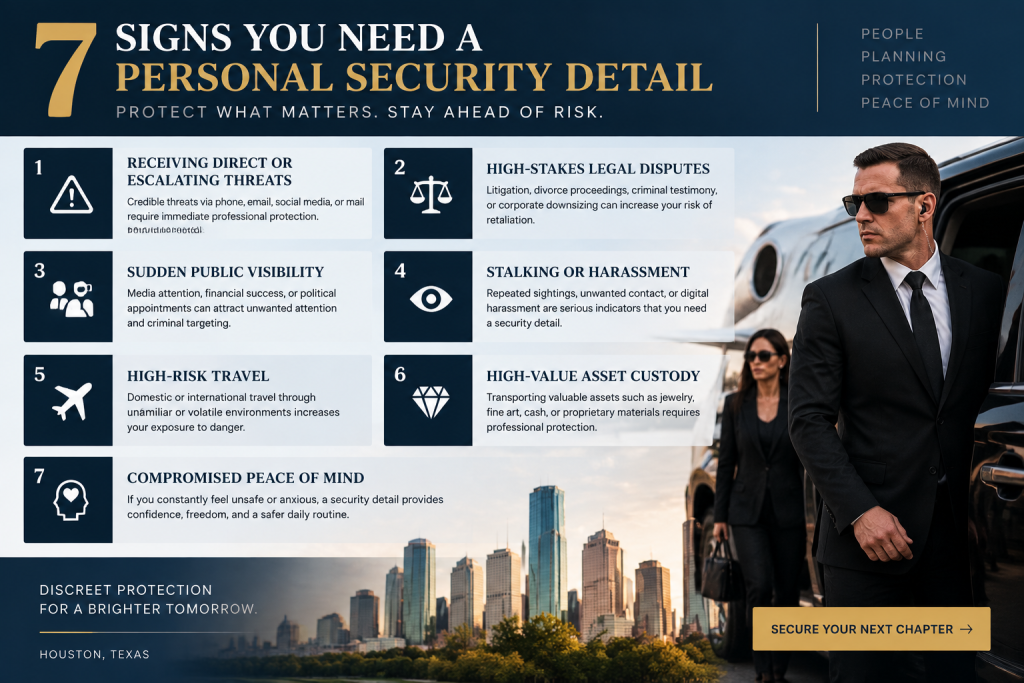
Phase 1: 7 Critical Signs You Need a Personal Security Detail
Evaluate your current daily routine, professional visibility, and personal exposures against these seven definitive threat indicators:
1. Receiving Direct, Credible, or Escalating Threats
Any direct threat delivered via phone, email, social media, or postal delivery must be treated as actionable. Threats that transition from vague grievances to specific details, such as referencing your residence, family members, daily commute corridors, or personal vehicle license plates, indicate active hostile surveillance. A personal protection team immediately establishes physical perimeter buffers, intercepts unauthorized approaches, and coordinates threat profiles with local law enforcement agencies.
2. Active Participation in High-Stakes Legal Disputes or Corporate Downsizing
Civil litigation involving massive financial settlements, high-conflict divorce proceedings, child custody battles, or criminal testimony generates intense emotional volatility. Similarly, corporate executives overseeing mass corporate terminations, controversial labor negotiations, or hostile mergers frequently face retaliatory workplace violence. Dedicated close protection personnel manage secure transit to and from court hearings and corporate boardrooms, insulating principals from aggressive adversaries.
3. Sudden Public Visibility, Wealth Exposure, or Media Attention
Rapid financial success, viral media coverage, high-profile real estate acquisitions, or political appointments immediately elevate your profile to criminal opportunists. Public wealth markers attract extortion attempts, home burglary rings, and kidnapping plots. Deploying a discreet security detail safeguards your privacy and deters opportunistic targeting without disrupting your public schedule.
4. Stalking, Unwanted Patterned Contact, and Harassment
Stalking behavior rarely de-escalates on its own. If you notice repeated sightings of unfamiliar vehicles near your residence, encounter obsessive individuals at public business functions, or experience continuous digital harassment, your physical safety is compromised. Close protection specialists conduct counter-surveillance sweeps to detect and document tracking behavior, preventing physical ambushes before they materialize.
5. Domestic and International Travel Through Volatile Environments
Business travel frequently forces executives into unfamiliar geographic regions, crowded transit hubs, or territories with elevated kidnapping and violent crime statistics. An executive security team provides secure transportation logistics, advance route reconnaissance, and discrete personal shielding from the moment you land at the airport until your return departure.
6. High-Value Asset Custody and Physical Wealth Transport
Individuals who routinely transport high-value tangible assets, such as luxury jewelry collections, fine art, proprietary technical prototypes, or substantial cash reserves, face constant robbery risks. Stationary and mobile security officers maintain physical custody over transport corridors and protect access points during private showings and corporate symposiums.
7. Lingering Anxiety and Compromised Peace of Mind
Personal safety concerns should never dictate how you conduct business, interact with clients, or live your personal life. When persistent safety concerns force you to cancel meetings, avoid public events, or alter family routines out of fear, professional intervention is required. A tailored security detail restores autonomy, allowing you to focus on your professional objectives with total confidence.
Phase 2: Risk Assessment and Threat Evaluation Matrix
Use the following evaluation matrix to assess the required tier of personal protection based on your immediate exposure level:
| Threat Environment | Observed Risk Factors | Recommended Protection Tier | Primary Protective Mission |
|---|---|---|---|
| Moderate Exposure | Public charity banquets, business conventions, executive speaking | Single Plainclothes Officer (Texas DPS Level IV PPO) | Discreet credential screening, crowd buffer, secure departure escort. |
| High Friction Legal Dispute | Aggressive civil depositions, volatile divorces, business buyouts | Two-Agent Armed Detail (Level III / IV) | Courthouse arrival protection, vehicular de-escalation, physical buffer. |
| Imminent Direct Threat / Stalking | Documented death threats, vehicle tracking, persistent perimeter breaches | 24/7 Multi-Agent Close Protection Detail | Residential perimeter sweeps, counter-surveillance, secure motorcade transit. |
To analyze the financial investment required across each operational tier, review our comprehensive pricing guide on how much a personal bodyguard costs per day.
Phase 3: Bodyguards vs Personal Security Details: What Is the Difference?
Many individuals mistakenly assume that hiring a personal security detail is identical to hiring a conventional bodyguard. In practice, their operational scopes differ substantially:
1. Reactive Physical Guarding vs Strategic Security Management
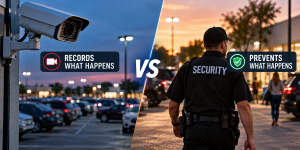
A conventional bodyguard provides physical presence to deter confrontational individuals through intimidation. While useful for red-carpet appearances or nightclub appearances, conventional guarding remains fundamentally reactive. For a complete tactical breakdown, explore our analysis of bodyguard vs executive protection differences.
2. The Multi-Layered Security Detail Framework
A professional personal security detail functions as a proactive risk mitigation unit. Rather than waiting for an ambush to take place, the detail executes structured security protocols:
- Advance Site Reconnaissance: Inspecting meeting venues, private dining rooms, and staging areas hours before client arrival.
- Facility Egress Auditing: Reviewing building exits, loading docks, and emergency pathways using an event security checklist for venue managers.
- Protective Intelligence: Continually monitoring digital feeds, protest movements, and corporate backlash indicators to reroute travel plans before friction occurs.
- Emergency Medical Preparation: Providing certified Tactical Combat Casualty Care, carrying trauma kits, and establishing dedicated transit corridors to regional trauma centers.
Phase 4: Common Misconceptions About Hiring Personal Security
1. Myth: Personal Security Must Be Conspicuous and Intimidating
Professional executive protection specialists operate with extreme discretion. In corporate environments, officers wear tailored business suits, carry low-profile communication earpieces, and blend seamlessly with executive colleagues. In family or casual settings, agents dress in standard casual attire, providing vigilant protection without attracting public curiosity.
2. Myth: Security Is Only Necessary During Working Hours
Statistical threat data confirms that hostile confrontations, stalking encounters, and home burglaries occur disproportionately during evening hours, weekend travel, and residential transitions. A comprehensive protection strategy accounts for residential perimeter safety alongside daily office routines.
3. Myth: Law Enforcement Alone Provides Adequate Protection
Municipal police departments perform vital public safety duties, but their operational role is reactive. Police officers respond after a 911 call is placed. A dedicated personal security detail provides continuous physical presence, immediate intervention, and tailored route management that public law enforcement cannot provide to private citizens.
Phase 5: Selecting a Licensed Security Provider in Texas
Before retaining protective services, verify that your prospective provider meets all state statutory mandates:
1. Texas DPS Level IV Personal Protection Officer Licensing
Under Chapter 1702 of the Texas Occupations Code, providing armed personal protection in plainclothes requires a valid Level IV Personal Protection Officer credential issued by the Texas Department of Public Safety Private Security Bureau. Level IV certification demands rigorous background checks, advanced defensive training, and comprehensive psychological clearance.
2. Comprehensive Commercial Insurance Verification
Never hire independent, uncredentialed bouncers or uninsured contractors. Verify that the private security agency holds an active security company license and maintains at least 1,000,000 dollars in commercial general liability insurance along with full workers compensation coverage.
Partner with Gods Armour Security for Dedicated Close Protection
Your safety, personal freedom, and family well-being require proactive protection managed by seasoned professionals. Gods Armour Security delivers elite, Texas DPS licensed personal security details and executive protection assets throughout Houston, Harris County, and statewide Texas.
Our protective specialists combine tactical backgrounds with impeccable corporate decorum. Whether you need short-term protection during a high-stakes legal matter or comprehensive round-the-clock family security, our command leadership builds a tailored protective footprint that guarantees safety and peace of mind.
Recognizing the warning signs in your personal or professional life? Request a confidential personal security consultation or contact our Houston command operations desk directly at (713) 878-9984.
Key Takeaways
- Escalating threats, stalking, high-conflict litigation, and sudden public visibility are primary indicators that personal security is necessary.
- Personal security details emphasize proactive avoidance, advance route surveys, and protective intelligence rather than reactive physical confrontation.
- Operating as an armed plainclothes protection specialist in Texas legally requires an active Texas DPS Level IV Personal Protection Officer license.
- Executive protection specialists blend seamlessly into corporate, formal, and family environments without drawing unwanted public attention.
- Always verify company licensing and demand proof of commercial general liability insurance before executing a protective service agreement.