A high rise concentrates a lot of people into a small footprint and gives them one way in. That sounds like an advantage, and in some ways it is, since a single controlled lobby is easier to watch than a campus with six entrances. The difficulty is that everything depends on that one point working correctly, every hour, with no exceptions. High rise security services are built around holding that lobby and the three functions that run through it.
Downtown Houston and the Galleria area present slightly different versions of the same job, and the differences are worth knowing before you set coverage.
What Makes a Tower Different
A high rise has vertical separation. The lobby is the only place where everyone passes through the same space, and above it the property splits into floors that cannot see each other. An officer on the ground floor has no view of what is happening on twenty.
Towers also run on a mix of populations. Office buildings have tenants, employees, visitors, vendors, cleaners, and building staff moving through on different schedules. Residential towers add residents, guests, deliveries, and contractors working in units. Mixed use buildings have all of it at once, often with retail on the lower floors keeping its own hours.
Parking usually sits below grade or in an attached structure, which adds levels with restricted sight lines and a second entry path into the building that bypasses the lobby entirely.
Access Control at the Lobby
The lobby post is the center of the operation, and it does more than watch a door.
Officers verify who is entering. In office towers that usually means tenant badges and a visitor process. In residential towers it means recognizing residents and confirming guests before they go up. Either way, the officer is the layer between the street and the floors above.
Floor by floor access is a control point that gets underused. Buildings that restrict which floors a card can reach limit where a visitor travels, and officers are the ones who authorize the exception when someone needs the twelfth floor. That only works if the procedure is written down and applied the same way each shift.
The parking connection is where most towers have a gap. A garage route that reaches residential or office floors without passing the lobby skips every control you have. Somebody needs to be responsible for it, through patrol coverage of the garage levels or through access control on that bank.
After hours is the other half of the job. Once tenants leave and the building settles, the officer is often the only person in the lobby, and the job shifts from managing traffic to controlling a much smaller number of entries carefully.
The Concierge Desk
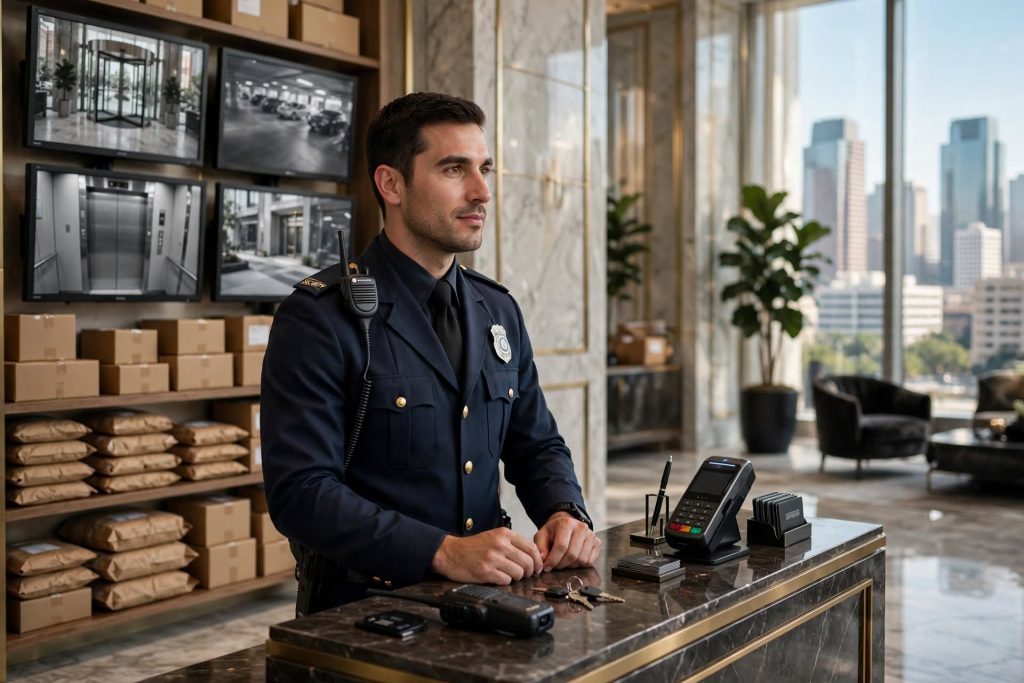
Many towers combine security and concierge functions at a single desk, which works when the balance is set deliberately and creates problems when it is not.
The concierge side is genuine service. Directions, tenant questions, vendor coordination, cab and ride requests, and being the person who knows how the building works. In Galleria area properties and in residential downtown towers, that service level is part of what tenants are paying for, and an officer who handles it poorly reflects on the building.
The security side does not pause while that happens. An officer taking a phone call and signing for a delivery is not watching the door, and anyone who has watched a lobby for an hour knows that people time their entry to exactly those moments.
The answer is usually staffing rather than instruction. A desk that carries real concierge volume needs either a second position during peak hours or a clear written rule about what the officer stops doing when someone unfamiliar walks in. Deciding that in advance is what keeps the two functions from working against each other.
Package & Delivery Handling
Package volume has grown into one of the larger daily workloads in residential towers, and it generates more tenant complaints than nearly anything else.
The operational questions are straightforward once someone asks them. Where do packages go when they arrive? Who signs for them? How do residents find out something is waiting? How long does the building hold an item before it becomes a problem? Who is allowed to collect a package on someone else’s behalf, and how is that verified?
Where this goes wrong is theft, and most package theft in towers is not a stranger off the street. It is packages left unattended in a lobby corner, collected by someone who lives in the building or arrived with a resident. A log with signatures on collection ends most of it, because it turns an anonymous act into a recorded one.
Courier access is worth settling as well. Buildings that let drivers reach individual floors trade tenant convenience for an unescorted person in residential corridors. Buildings that stop deliveries at the desk take on storage and notification work instead. Either approach works. Letting it vary by shift is the version that causes trouble.
Downtown & the Galleria
The two areas shift the emphasis in different directions.
Downtown towers skew toward office use, with heavy weekday traffic and quiet nights and weekends. The busy window is the morning and evening rush, and the exposed one is overnight when the building is nearly empty. Tunnel and skywalk connections add access points that run on their own schedules.
Galleria properties carry more mixed use, more residential density, and more retail nearby, which means higher package volume, more guest traffic on evenings and weekends, and parking structures that fill with people who have no connection to the building.
What to Settle Before Coverage Starts
A tower runs well when the written procedures cover the ordinary decisions. Who may go up and how that gets verified. What happens at the concierge desk when security attention is needed. How packages are received, logged, notified, and released. Who is responsible for the garage levels and the routes that reach them. What the officer does after hours that differs from the day.
Those are building decisions rather than security decisions, and a provider should be asking about them before quoting hours.
Managing a tower in Downtown or the Galleria? See our residential and high-rise security services.